
I was today days old when I learned Anthropic didn't just sign a $13.7 billion, six-year deal to buy AI compute from Rumble Inc. — it also got warrants to buy up to 50.8 million shares of Rumble's own stock, at a penny each, as part of the same deal. The buyer getting cheap equity upside in its own vendor. Rumble's side of the contract is worth roughly $2.28 billion a year, more than triple what Rumble itself was worth on the stock market at the time, and Rumble disclosed in an SEC filing that it doesn't currently have the financing to build the data centers the deal requires. The day it was announced, Rumble's stock jumped about 10% — while competing “neocloud” providers CoreWeave and Nebius both dropped about 9%. Money moved on an announcement, not a delivered result.
That's one deal. Anthropic alone has reportedly struck more than $517 billion in compute deals over the past year. And the structure of the Rumble deal — a customer getting equity in its own vendor, a vendor admitting it can't yet afford to deliver — is exactly the shape of thing that caused real companies real legal trouble the last time an industry got this excited about a technology. Here's what a circular deal actually is, how it played out for real companies in 1999-2000, and where today's version is — and isn't — the same thing.
What a Circular Deal Actually Is
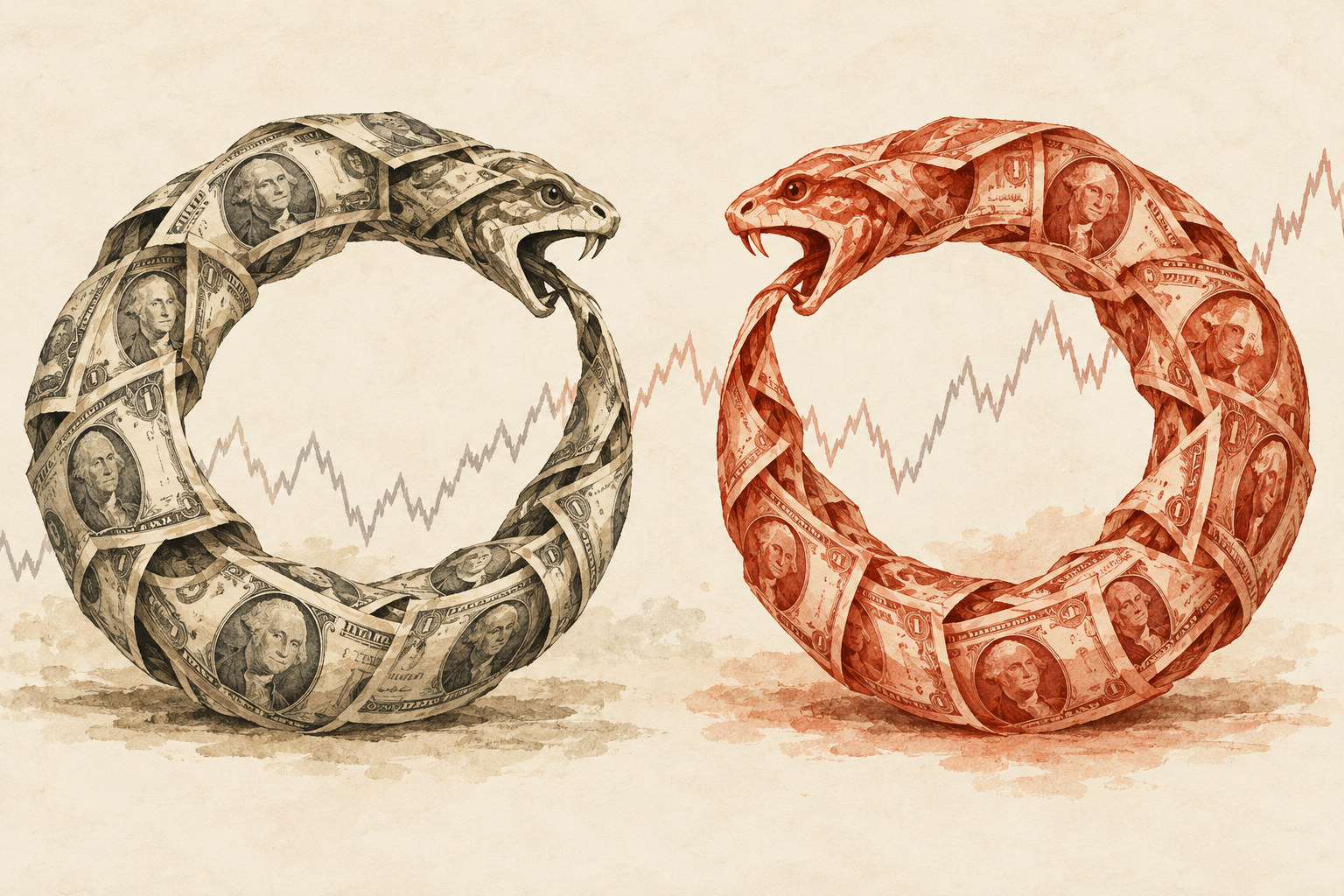
Strip away the jargon and a circular (or “round-trip”) deal is simple: Company A pays Company B for something, and some or all of that money finds its way back to Company A, often through a separate contract, investment, or side deal. Both companies can then report the first transaction as real revenue, even though, netted out, little or no new cash actually came in from outside the loop. It doesn't require anything to be built, delivered, or used — the appearance of a growing business is the point.
The Dot-Com Precedent: AOL, PurchasePro, and the $70 Million That Went Nowhere
This isn't a new theory — it's documented history with real fines and real prison sentences. AOL ran a multi-year scheme, exposed around 2002, in which it paid vendors inflated prices in exchange for those same vendors buying AOL advertising back — inflating the ad revenue that helped justify its $184 billion merger with Time Warner. Time Warner eventually paid a $300 million fine over it in 2005.
The cleanest example is AOL and PurchasePro. PurchasePro paid AOL $70 million for a partnership that produced essentially nothing. Rather than let that money sit as a loss, AOL quietly fed revenue back to PurchasePro through secret side deals and backdated contracts, just to help both companies hit their numbers. The fallout: $210 million in fines, PurchasePro went bankrupt in 2002, and executives on both sides went to prison. Source: Securities and Exchange Commission enforcement history, as compiled at sec.gov.
Telecom ran its own version at the same time. Global Crossing and Qwest simultaneously bought and sold each other nearly identical network capacity — some of it not even built yet — and each booked the cash coming in as revenue, even though real net cash flow between them was close to zero. By 2001, roughly 20% of Global Crossing's revenue was these capacity swaps. Qwest was later charged with fraudulently recognizing $3.8 billion in revenue tied to the same pattern.
How Fast and How Far It Fell
None of that revenue turned out to be real growth, and the market eventually priced that in all at once. The Nasdaq peaked in March 2000 and fell 78% by October 2002, wiping out roughly $5 trillion in investor wealth. It didn't reclaim its March 2000 peak again until 2015 — 15 years later. Source: historical Nasdaq Composite index data via Macrotrends.
Today's Bigger Picture: the Nvidia-OpenAI-Oracle-CoreWeave Loop
The Rumble-Anthropic deal is one node in a much larger, publicly documented web of AI-industry deals that multiple named analysts have already compared to dot-com-era circularity. Nvidia has committed up to $100 billion in equity to OpenAI; OpenAI has committed roughly $300 billion in compute purchases to Oracle; Oracle buys tens of billions in chips from Nvidia (reported at roughly $40 billion); Nvidia also took a stake in CoreWeave, which itself has committed $6.3 billion in purchases back to Nvidia; and CoreWeave, in turn, supplies infrastructure back to OpenAI. Money and equity moving in a loop among a small number of the same companies, each deal real and separately reported, each one also feeding the next one along. Sources: deal reporting via Reuters and Bloomberg; circularity analysis via SemiAnalysis.
Anthropic's own S-1 shows the identical shape closer to home: Amazon has committed up to $20 billion-plus and Google up to $40 billion in funding, and both are simultaneously the cloud and chip vendors Anthropic buys its compute from — some of its biggest investors are also its biggest vendors. I dug into what that filing says about Anthropic's own costs and its $200/month Claude Max plan in a companion post, if you want the rest of that picture.
The Honest Hedge: Where the Parallel Holds, and Where It Doesn't
Here's where I don't want to overstate this: the dot-com-era deals were often pure accounting fiction — ad inventory and contracts changing hands with nothing real behind them. Today's circular deals involve real chips and real data centers that are actually getting built, with physical capacity on the other end of the contract, not swapped-paper capacity that never gets used. The balance sheets are genuinely intertwined in a way that's different from AOL and PurchasePro trading nothing for nothing. If this analogy breaks down anywhere, it's right there — and it's worth saying plainly rather than overselling the comparison.
Not a Prediction — a Pattern
I'm not telling you the AI boom is about to crash the way the dot-com bubble did. I'm telling you the specific financial structure that caused real companies real legal trouble in 1999 and 2000 — equity and revenue moving in a loop among a small number of interlocking partners — is documented, has a name, and is visibly present again today, deal by named deal. History doesn't repeat exactly. But it rhymes closely enough here that it's worth knowing what happened the last time this pattern showed up, and deciding for yourself what that means for what's happening now.