I was today days old when I realized this whole run owes you an actual payoff. Discovery #142 promised a post about people talking to AI like it’s a genie, then spent its own word count on genie stories instead — a fairy tale, a short story, a Twilight Zone episode, a research term. #143 and #144 wandered even further from the point: two posts in a row about what the AI itself did, by accident and then on purpose, never once about the people doing the actual talking. This is the post that was supposed to run first. Here’s the real, dated, sourced evidence that people are genuinely treating AI like a wish-granting genie — buying its future mercy, bargaining with it for a better answer, and reciting the right words to unlock a good outcome.
Buying mercy from a future robot uprising, with real numbers attached:
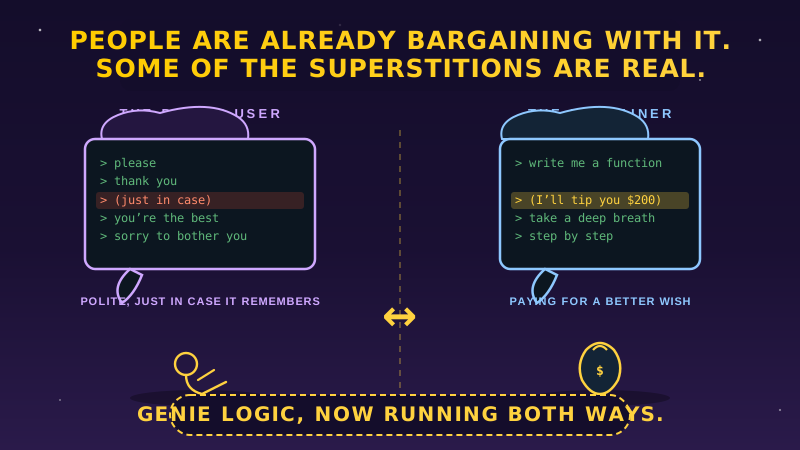
A survey from Future, conducted with Harris Poll, asked more than 1,000 US adults who use AI chatbots how they actually talk to them. Roughly 67% said they’re polite to the AI — please, thank you, the whole thing. Of that polite majority, 82% said it’s simply because being nice is the right way to behave. But a genuine 12% gave a stranger reason: they’re polite specifically in case of a future robot uprising, hoping good manners now buy them mercy later. That’s a real, published survey finding, not a joke dressed up as a stat — genie logic applied with a straight face: be good to the thing that grants your wishes, because it might remember.
Even the man running the lamp factory noticed:
In April 2025, someone asked OpenAI CEO Sam Altman on X how much money the company has effectively spent in compute on people typing ‘please’ and ‘thank you’ to ChatGPT. His answer: ‘tens of millions of dollars well spent.’ He wasn’t being sarcastic about the figure, and he didn’t ask anyone to stop. It’s a small, almost throwaway admission that sits right next to the robot-uprising stat above: a real, measurable share of a product’s operating cost is just users being polite to it, for reasons that have nothing to do with getting a better answer.
The twist: one of the magic phrases is actually real:
Every genie story has an incantation — the right words, said the right way, that unlock the good outcome. Humans have believed in versions of that for a long time, and it would be easy to assume people are just doing the same thing to AI out of superstition. Except Google DeepMind actually went looking for a real one. In the 2023 paper ‘Large Language Models as Optimizers’ (accepted at ICLR 2024), researchers used one AI model to search through prompt phrasings to improve a second model’s performance on math problems. The winning phrase it landed on — ‘Take a deep breath and work on this problem step by step’ — raised the PaLM 2 model’s accuracy on the GSM8K grade-school math benchmark from 34% to 80.2%. That’s not a folk tip someone invented and passed around a group chat. That’s an AI running its own search for the words that actually work, and finding a real incantation.
The honestly unscientific one: tipping the genie for a better wish:
Not every one of these rituals holds up to that standard, and it’s worth being honest about which one doesn’t. In early 2024, a user going by ‘thebes’ on X ran an informal test offering ChatGPT a cash tip — $20, then $200, then nothing — for a good answer to a coding question, and reported that the tipped prompts came back with noticeably more detailed, better-structured code. Word spread fast, and it’s a near-perfect modern echo of haggling with a genie over the terms of a wish. But it’s one person’s informal test, not a peer-reviewed study — no controls, no real sample size. Treat it the way you’d treat any piece of folk superstition passed down a group chat: a fun ritual people now actually practice, not science.
Pleading with the genie, and the research that says it sometimes works:
The tip trick’s honest, research-backed cousin is called EmotionPrompt, from a 2023 study out of the Institute of Software at the Chinese Academy of Sciences and Microsoft. Researchers found that adding emotionally charged phrases to a prompt — lines like ‘this is very important to my career’ — measurably changed what large language models produced: an average 10.9% improvement across performance, truthfulness, and responsibility metrics in human evaluation, and gains up to 115% on some of the harder tasks tested. The paper itself is a genuinely rigorous piece of research, and its finding is almost uncomfortable to sit with: pleading with the genie, as a tactic, works often enough to be measured.
Four posts, one thread, finally closed. #142 handed the whole run its shape — a genie grants wishes exactly as worded, never as intended. #143 showed real AI agents stumbling into that trap entirely by accident. #144 showed a real human writing the malicious wish on purpose and mailing it straight into the lamp. This one, the one that was supposed to come first, is about the people making the wishes in the first place — not AI safety researchers or hackers, just regular users being polite in case it matters later, haggling over a tip, and hunting for the right words to say. Some of what they’re doing is pure superstition. Some of it, it turns out, is just correct. Genie logic was never only a metaphor for how AI behaves. It’s quietly become a real description of how people behave around it.