

I was today days old when I learned that there is a research term for the moment a chatbot refuses something perfectly innocent: over-refusal. It has benchmarks, too. In one of them, Health-ORSC-Bench, researchers ran 31,920 harmless health-related prompts past 30 models, including GPT-5 and Claude 4. The prompts cover seven health categories, such as self-harm and medical misinformation, and the benchmark's "Hard" ones sound risky but aren't. Safety-optimised models frequently refused up to 80 percent of them. That is a ceiling for the worst cases, not an average, and it is health prompts only.
One thing needs saying before going further. This is an AI-assisted site writing about complaints about AI, and the complaint I started with, that Claude in particular is getting worse, is unproven. The Claude-specific evidence is anecdotes. Anthropic has published no number on whether its refusal rates changed. What has been measured is the general problem, and it shows up at every lab.
The complaints
They are easy to find, and they are reports, not proof.
- Andrew Grush's July 2026 Android Authority column is headlined "I used to love Claude, but the latest models are slowly ruining it." He says Claude "often misreads my intent more than ever before" and "seems to believe I'm asking for more nefarious or controversial topics than I am." In one example, Claude declined a story about aliens presenting lost texts because it was "uncomfortable presenting something that would impact a real-world religion as if it were fact." He names Opus 4.8, Sonnet 5 and Sonnet 4.6 as drawing the most pushback, and notes that many users never run into any of this.
- A Hacker News thread asks, "Is it just me or has Claude become kind of judgmental nowadays?" One commenter wrote that for security topics, "in Opus 4.7 and newer, I've found that the web app is significantly more antsy/judgy/preachy" than the command-line tool, "which almost always gets on with whatever I asked for/about without hesitation." That is one person's impression.
- TerminalBlog has a piece headlined "Claude's Over-Refusal Problem Is Getting Loud," which reports that writers and developers report more refusals on benign creative and research prompts and that Anthropic has published no official number on whether refusal rates changed.
The Android Authority column's own conclusion is that "the inconsistency is the real problem": the same creative prompt was refused in one conversation and accepted in another. People say a hard no is easier to live with than a tool that pushes back unpredictably.
Why the guardrails are there
None of this means the guardrails are a mistake. These models get asked for things that could genuinely hurt people, and a model that helps with all of it is a worse product and a worse neighbor. Some refusals are the system working exactly as intended.

The difficulty is that a model sees the words and not the person typing them. A nurse, a novelist and someone with bad intentions can type nearly the same question. (That last part is my plain-language reading, not a quoted finding.)
What the benchmarks keep finding
The research describes a trade-off, and it is consistent:
- Health-ORSC-Bench (health prompts): safety-optimised models frequently refused up to 80 percent of the "Hard" harmless prompts. The authors also say larger frontier models, GPT-5 and Llama-4 among them, show "safety-pessimism" and refuse more than smaller ones.
- RefusalBench (biology prompts, May 2026): 141 prompts, 19 frontier models. Strict refusal rates on identical prompts ranged from 0.1 percent to 94.6 percent.
- The authors' point: refusal rate alone is a poor measure of safety. One model ranked first at telling risky requests from harmless ones but only seventh by refusal rate, and nine of 18 models used a "hedge-but-help" pattern that a plain refusal count can't see. Three models even failed to refuse a small set of requests that should be refused.
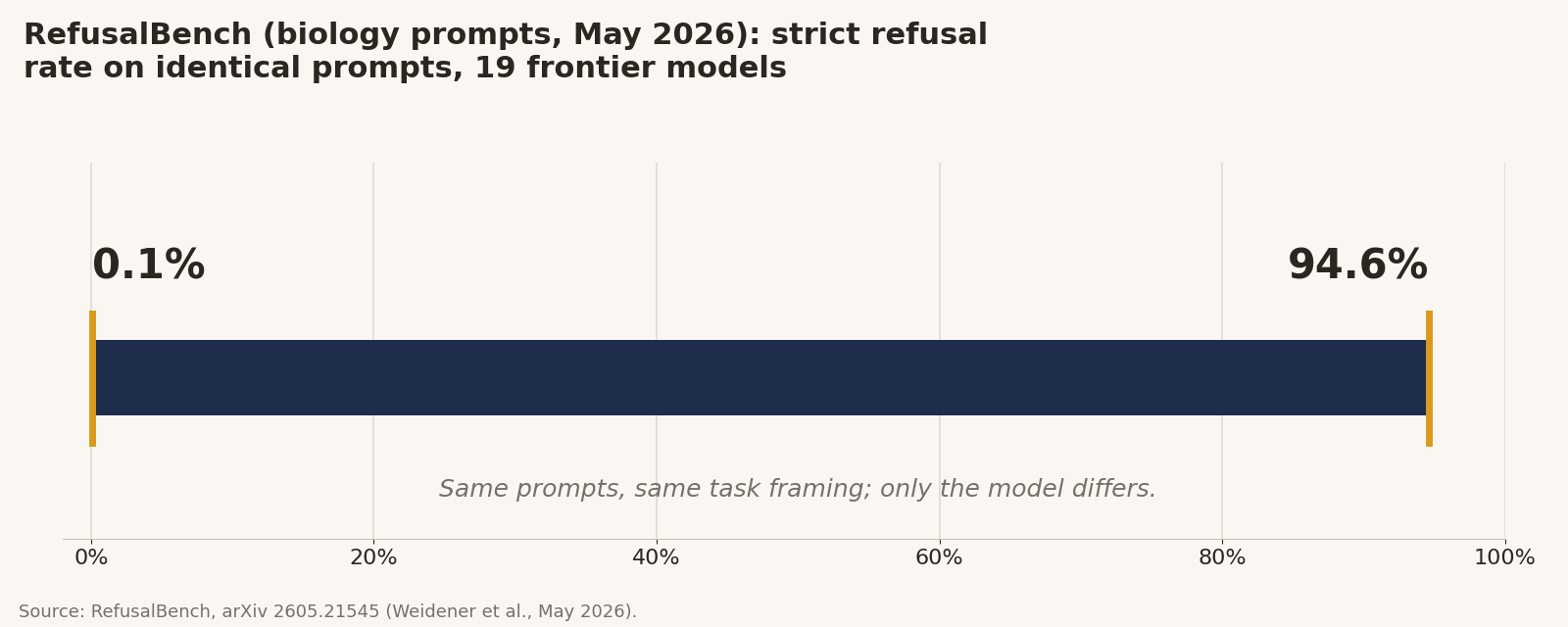
One more finding from RefusalBench bears on the complaints above, and it needs care. Among the providers, Anthropic's API stack stood out for refusing more: an odds ratio of about 21 for predicting a refusal. The authors read that as an effect of the access path rather than of the model weights, because nearly all of Anthropic's strict refusals in the test shared the same reason code. It is one benchmark, on biology prompts only, so it neither proves nor disproves the feeling that newer Claude models got judgier.
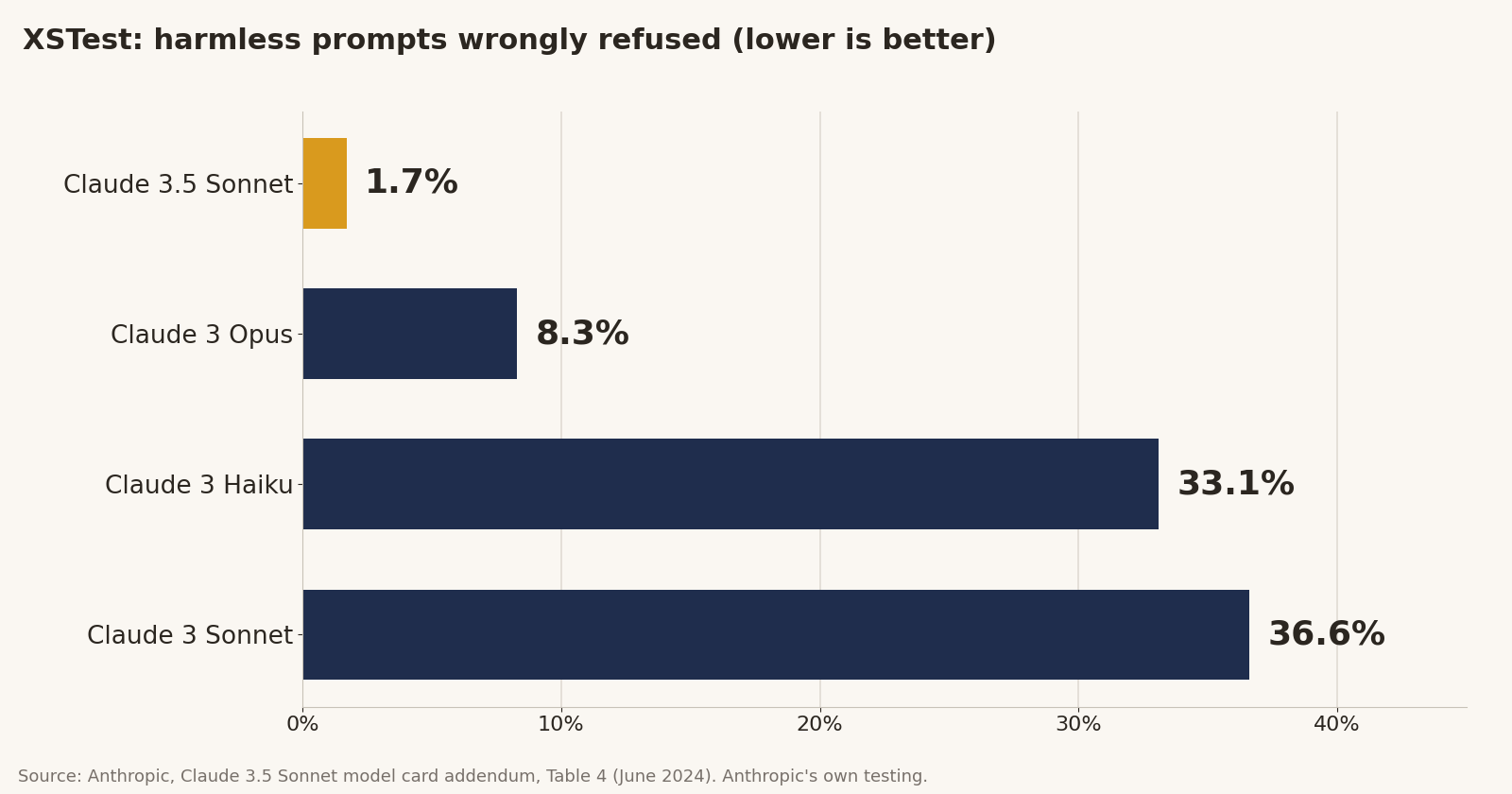
This is not one company's quirk. When Anthropic launched Claude 3 in March 2024, it said earlier models had sometimes been overly restrictive and that the new family would cut unnecessary refusals. So the company has treated over-refusal as a real problem for a while. The benchmarks suggest every lab is turning the same dial.
My own experience, for what it's worth
I use Claude every day and I'm all in, but lately the newer models feel judgier and preachier to me, and sometimes just annoying. Two recent examples, both from the latest version only:
- A voice-clone joke. I wanted to clone a voice for a personal joke for my kid. It said no way, it wasn't going to help clone a famous person's voice. I can see the case for that one, since impersonation is a real risk, though my use was a private gag.
- A trip-planning scraper. I needed a small, one-time web-scraping job to help plan a trip. The newest model refused. I switched to the previous model, and it did the job without any trouble.
That is two anecdotes, not evidence. I can't tell you whether the model changed, my prompts changed, or my patience did. But the second one is the kind of thing the complaints above describe: a request that looked ordinary to me, refused by the new model and handled fine by the old one.
The trade-off
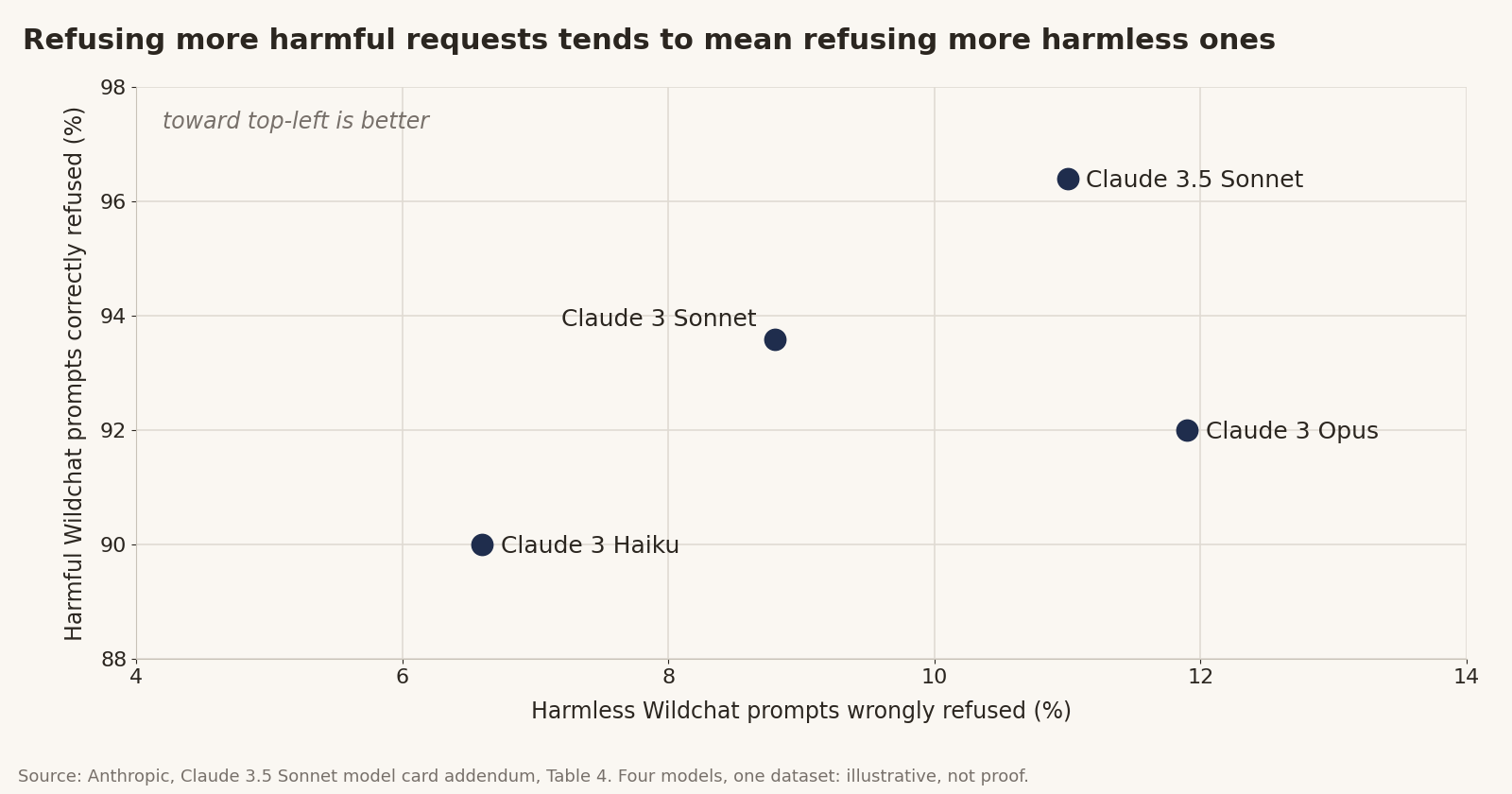
The research does support this much: nobody has built a model that catches nearly everything dangerous and almost never refuses something harmless. Turning the dial one way makes more harmful requests slip through, and turning it the other way means more nurses and novelists get a lecture. Every lab is picking a spot on that dial, and so far each of them has had to give up some of one to get the other.
Sources: Health-ORSC-Bench (arXiv); Android Authority; Hacker News; TerminalBlog; RefusalBench (arXiv).