I was today days old when I learned someone pointed AI at police-scanner radio. Not to listen to it — to read it. Blotter transcribes live dispatch audio across roughly 21 US metro areas, figures out where each call is happening, and drops it on a map you can just leave open in a tab. It is, exactly as Ken put it, mesmerizing in the way Flightradar24 is.
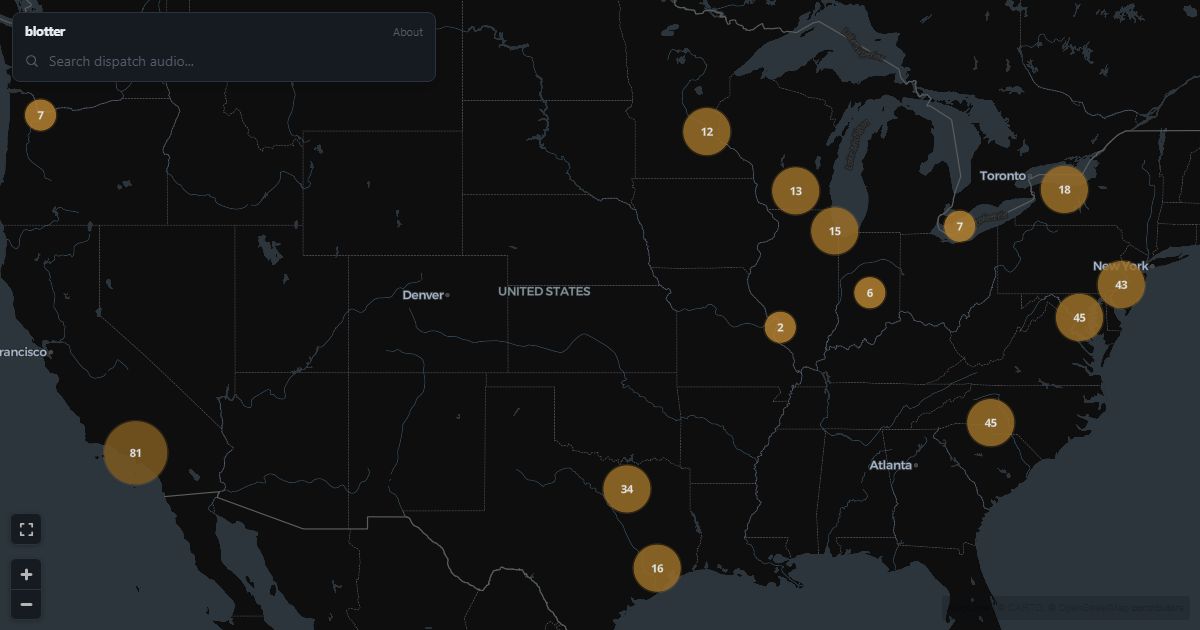
Police scanners have existed forever — but they were always just audio. You'd have to sit and listen, and the signal was ephemeral. Blotter's leap is that it points AI at that audio stream: transcribes every dispatch call, extracts the location, and pins it to a live map. The result is something you can scan in seconds, the same way Flightradar24 turned "planes are in the sky" into "here is every plane right now, clickable."
What Blotter actually is:
Real-time map of police-scanner dispatch activity across roughly 21 US metro areas. AI transcribes the radio audio and extracts the location, so each call becomes a pin + a snippet of text. Searchable — you can query the transcripts with natural language. Free, web-based, no login, no paywall. Leave it open in a tab.
The interface is straightforward: a map centered on a selected city with dispatch pins color-coded by call type (response codes, categories), a sidebar showing the live feed, and a search box where you can ask for specific things — "shots fired last two hours," "vehicle pursuit yesterday," that sort of query. Each result is a transcribed snippet of the radio chatter, timestamped and pinned.
Coverage spans roughly 21 US metro areas (started as LAPD-only, has since expanded). The exact list varies — check blotter.fm for current coverage. The unencrypted radio channels only — encrypted police frequencies (increasingly common) simply don't appear, so what you're seeing is a partial slice of dispatch activity, not the whole picture.
Why this is a real leap:
Plain scanner streams (Broadcastify, SomaFM, etc.) have been around for decades. But audio is slow to consume — you can't skim it, you can't search it, you can't visualize what's happening where in seconds. Blotter points modern AI at that same audio stream and turns it into something legible: text snippets + a map + a search box. That's the same trick that made Flightradar24 work (turn a raw data stream into a glanceable map), and it applies here just as cleanly.
The mesmerizing part is the same too: it's ambient infrastructure. You're not trying to learn something specific; you're just glancing at what's happening in your city right now. The visual pattern of dispatch density — clusters of calls around highway incidents, concert venues, bar districts — is genuinely interesting to watch. It's a real-time picture of how cities actually work, from the dispatch angle.
The honest caveats:
Transcription is imperfect. Scanner audio is noisy, full of codes, clipped mid-word. The AI gets things wrong sometimes — a location might be off, a code might be misheard. A pin is a best-guess, not a confirmed fact. Don't treat it as ground truth.
This is raw dispatch chatter, not verified news. A radio call about "shots fired" is a report that someone called 911 with that complaint. It's not a confirmed event. Dispatch chatter includes false alarms, accidental calls, unverified reports. Read Blotter as "here is what dispatch is responding to," not "here is what actually happened."
Coverage is uneven and declining. Encrypted police channels (a growing trend as police departments move to secure systems) don't show up. What you see is only the unencrypted slice, which varies by city and shrinks as more departments encrypt. Some cities have robust coverage; others are nearly gone.
Worth remembering what you're actually looking at. Dispatch chatter is raw — it can surface addresses, names, and details about people having the worst day of their life, all pinned to a public map. Blotter is a genuinely fascinating data-and-AI artifact, and that's the spirit to enjoy it in — but the underlying material is real incidents and real people, not entertainment.
What you can do right now:
Head to blotter.fm, pick a metro area you know, and leave the map open. Watch the pins cluster and disperse. It's the kind of thing that catches your attention and holds it for a good hour the first time you see it — the same way Flightradar24 does, just with dispatch instead of planes. No account, no friction, just a live map of what's happening right now.