I was today days old when I learned that a single human brain cell might already carry the computational punch of an entire deep learning network — and it’s not a loose metaphor. It’s a measured finding out of a new study from the Hebrew University of Jerusalem.
The Study
The paper, “Dendritic morphology and synaptic nonlinearities enhance functional complexity in human cortical neurons,” was published in the Proceedings of the National Academy of Sciences (PNAS) in July 2026 by Ido Aizenbud, Daniela Yoeli, David Beniaguev, Christiaan P. J. de Kock, Michael (Mickey) London, and Idan Segev, out of the Hebrew University of Jerusalem’s Edmond and Lily Safra Center for Brain Sciences (ELSC), working with Prof. Chris de Kock of the Vrije Universiteit Amsterdam. Source: PNAS.
The Method: A “Functional Complexity Index”
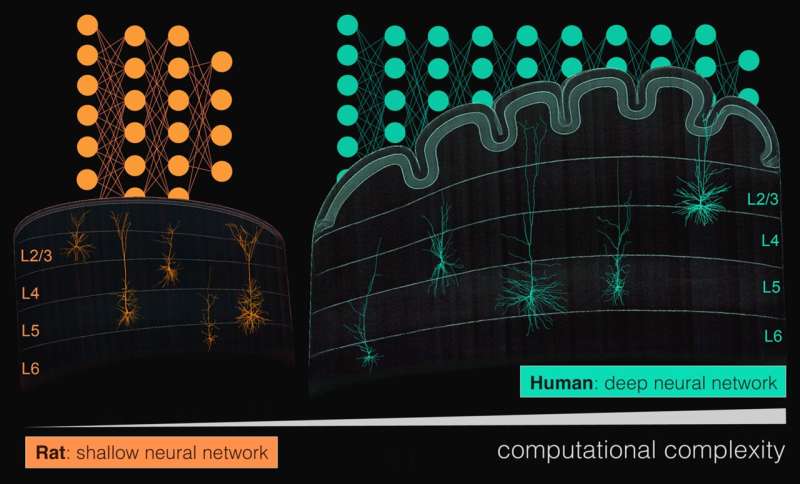
The researchers built detailed biophysical computer models of real cortical pyramidal neurons, both human and rat, then trained an artificial neural network (ANN) to reproduce each neuron’s actual input-output behavior — given the same pattern of incoming synaptic signals, could the ANN predict the same electrical response the real neuron produced? The more layers of complexity the ANN needed to fake a given neuron, the more computationally powerful that real neuron was scored as. That scoring system is the Functional Complexity Index, or FCI. Sources: SciTechDaily, Neuroscience News.
The Finding: A Species Gap
Human cortical neurons required significantly more complex ANNs to imitate than rat cortical neurons did — a measured “species gap” in single-cell computing power. Individual human neurons showed computational abilities “comparable to those of a deep neural network” — something that normally takes a whole multi-layer AI model, a single human brain cell can approximate. The researchers point to richly branched dendritic trees, more dendritic membrane area, denser branching, and heightened NMDA-receptor nonlinearity as the reason, letting one neuron combine and analyze incoming signals nonlinearly instead of just summing them like a basic on/off unit. Sources: ScienceDaily, Medical Xpress.
Building on a 2021 Discovery
This new work builds directly on a 2021 precursor study from the same research group, with overlapping authors (David Beniaguev, Idan Segev, and Michael London), titled “Single Cortical Neurons as Deep Artificial Neural Networks,” published in the journal Neuron in September 2021. That earlier paper first showed a single rat cortical (layer-5 pyramidal) neuron’s input-output behavior could be captured by an ANN with 5 to 8 layers — genuinely deep for a single cell. The new 2026 PNAS paper formalizes that finding into the FCI metric and is the first rigorous human-vs-rat species comparison, finding humans need even more layers than that 2021 rat baseline.
Why It Matters
The researchers point to real-world pattern-recognition tasks — telling images of cats and dogs apart, for instance — as the kind of task that normally requires an entire deep learning network to pull off, something a single neuron modeled this way could, in principle, approximate. The implication: some of the brain’s raw computing power may come from how sophisticated individual neurons are, not only from having roughly 86 billion of them wired together.
A single cell, doing the work of a whole network. If you want the full data behind the Functional Complexity Index, the paper is open at PNAS.