I've been a genuine Cape Fear fan for a long time — the kind of fan who has both the 1962 original and the 1991 remake queued up on a rewatch rotation, not just the one everyone's seen clips of. So when Apple TV+ quietly wrapped a brand-new 10-episode version this summer, I finally sat down and traced the whole thing properly: who made each version, who starred in it, and what actually changed across 64 years of the same story. The one detail that kept surprising me the deeper I went: Cape Fear is a real place, a river and headland in southeastern North Carolina, and in three separate productions spanning six and a half decades, not one of them has ever actually filmed there.
1962 — Cape Fear
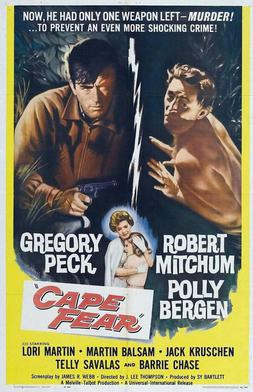
The original was directed by J. Lee Thompson, produced by Sy Bartlett, with a screenplay by James R. Webb adapted from John D. MacDonald's 1957 novel The Executioners. It starred Gregory Peck as attorney Sam Bowden and Robert Mitchum as Max Cady, the ex-convict stalking Bowden's family, alongside Polly Bergen, Lori Martin, Martin Balsam, and Telly Savalas. Bernard Herrmann composed the score. Universal-International released the film on June 15, 1962. Source: Wikipedia, Cape Fear (1962 film).
Even in 1962, the setting was more theoretical than literal: the production filmed mostly in Savannah, Georgia, and on a California studio lot, never in the actual Cape Fear region of North Carolina the story and title refer to. Source: This Is My South, Cape Fear filming locations.
1991 — Cape Fear
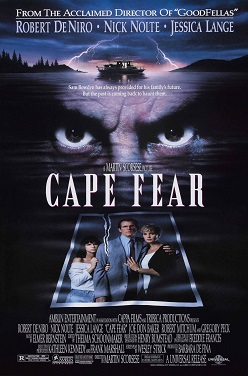
Martin Scorsese directed the remake, produced by Barbara De Fina, with Steven Spielberg, Kathleen Kennedy, Frank Marshall, and Jane Rosenthal all serving as executive producers across Amblin Entertainment, Cappa Films, and Tribeca Productions. Robert De Niro played a far more menacing, Bible-quoting Max Cady than Mitchum's original, opposite Nick Nolte, Jessica Lange, and Juliette Lewis, with Joe Don Baker rounding out the cast. In a genuinely unusual touch, Gregory Peck, Robert Mitchum, and Martin Balsam — all from the 1962 original — returned for cameos, each playing a different character than the one they'd played the first time. Wesley Strick wrote the screenplay, Freddie Francis handled cinematography, and Thelma Schoonmaker edited. Source: Wikipedia, Cape Fear (1991 film).
The score is the direct thread connecting both films: rather than commission something new, Scorsese's production reworked and adapted Bernard Herrmann's original 1962 score, the same composer scoring both versions of the same story, 29 years apart. Filming happened in the Florida Everglades — a second production in a row that skipped the real Cape Fear, North Carolina entirely. Source: This Is My South, Cape Fear filming locations.
2026 — Cape Fear (Apple TV+)
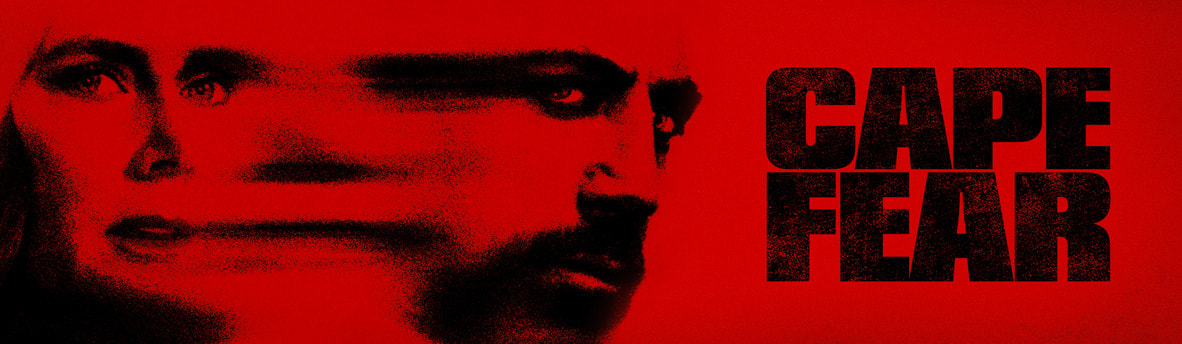
The newest version isn't a movie at all — it's a 10-episode limited series created by Nick Antosca for Apple TV+, executive produced by both Martin Scorsese and Steven Spielberg, which means Spielberg has now backed two of the three Cape Fear productions. Javier Bardem plays Max Cady, with Amy Adams and Patrick Wilson as the married couple whose lives unravel around him. Source: Apple TV+, Cape Fear press site.
The series premiered June 5, 2026 with its first two episodes and wrapped its finale on July 27, 2026, modernizing the revenge plot with cell phones, podcasters, rideshares, and the catfishing and public-shaming dynamics that didn't exist in either earlier version. Source: NPR, Cape Fear review.
And the pattern holds a third time: production filmed entirely around Atlanta, Georgia — Assembly Studios in Doraville for interiors, plus Atlanta-area locations including Inman Park and Druid Hills — making this the third Cape Fear production in a row to skip the actual Cape Fear, North Carolina completely. Source: Comic Basics, Cape Fear filming locations.
Cape Fear is a real river and headland on the North Carolina coast, and the name has now carried three separate productions across 64 years without a single one of them setting up a camera there — Georgia in 1962, Florida in 1991, and Georgia again in 2026. What does connect the three: Bernard Herrmann's score bridges 1962 and 1991 directly, and Steven Spielberg has quietly executive-produced two out of three versions of the same story, three decades apart.