You hear a siren pass your window. A helicopter circles overhead. Police lights flash three blocks down your street. What just happened? Until Citizen, your options were Twitter, the police scanner subreddit for your city, or just… waiting for the local news at 11.
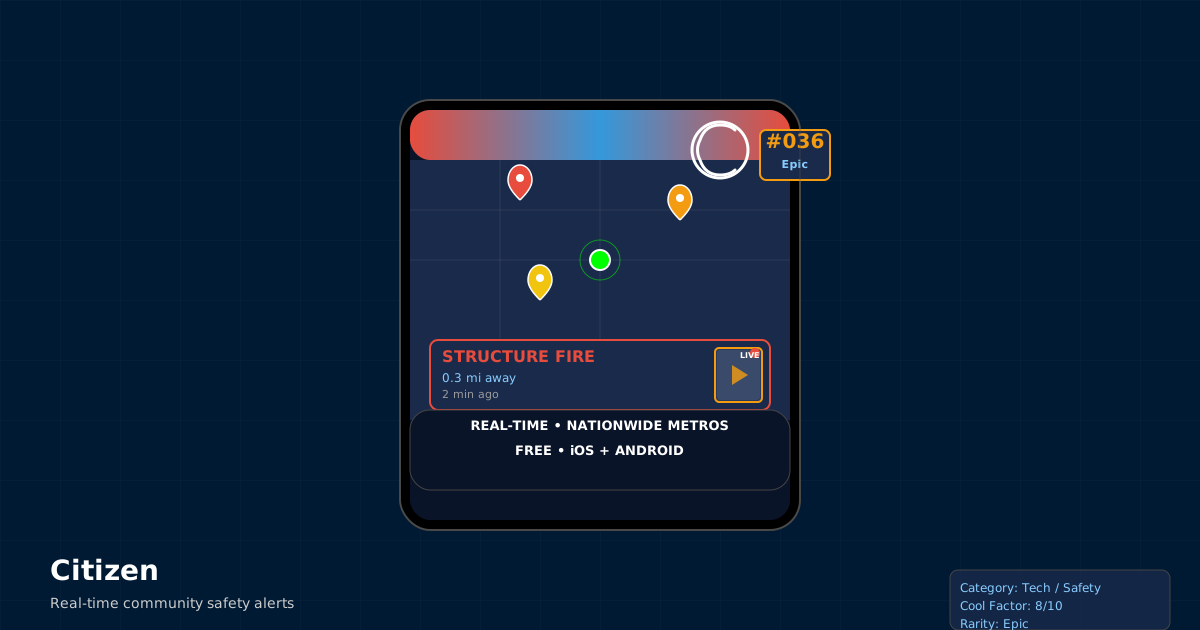
What Citizen actually does:
Go to citizen.com, download the iOS or Android app, and set your notification radius. The app then sends you push alerts whenever an incident — crime, fire, medical emergency, hazard, traffic — happens within that radius. Each alert includes the incident type, distance from you, and how long ago it was reported.
The real magic is the source: 911 scanner audio aggregated from your city, automatically parsed into structured incidents with coordinates. No human dispatcher sorting it out for you. No delay. Then, people actually at the scene upload live video straight to the app. Within 30 seconds of a fire, you can see a video of it.
The coverage is honest: major US metros and some growing cities. If you’re in NYC, LA, Baltimore, San Francisco, Austin, Phoenix, or Detroit, Citizen works well. If you’re in a smaller city, coverage is thinner. If you’re in a rural area, the app will be quiet. That’s not a flaw — it’s just geography and 911 scanner density.
Why this is useful in practice:
You’re stuck in traffic and wondering why. Open Citizen. A delivery truck hit a power line two miles up the road — now you know and can reroute. You hear helicopters circling and know they’re searching for a robbery suspect. A medical emergency happened in your neighborhood — now you know not to take that route home. A structure fire started three blocks away — you get a live video and can decide whether to close your windows and check your gutters or just watch the drama unfold in real time.
There are reports that Citizen has beaten official Amber Alerts to the scene in some cases. Hospital and emergency-response teams have noted improved situational awareness from monitoring it. The app is free. No credit card required.
The honest caveats (these matter):
Privacy and controversy: In 2021, Citizen offered a $30,000 bounty for information on a suspected LA wildfire arsonist. The person they pointed at was innocent, and the public backlash was immediate and justified. The app has since pulled back on that kind of crowdsourced-vigilantism, but it’s part of the history. Citizen went public in 2021; they’ve had to recalibrate what community safety means versus surveillance culture.
Anxiety factor: Getting pinged about every incident within a half-mile of you is not for everyone. In dense urban areas, you might get alerts every 10–15 minutes. Some people find it indispensable. Others install it, get pinged about six emergencies in an hour, and uninstall it because the constant stream of nearby chaos is psychologically taxing. Adjust your notification radius accordingly.
Why this is a today-days-old moment:
Before Citizen, you had a siren-shaped knowledge gap. Something happened somewhere near you, and you had to wait hours or days to find out what. Now you know in 30 seconds. The 911 system has existed for 50 years. Scanner radio existed. But aggregating it, parsing it, mapping it, and putting it in everyone’s pocket is new. And the live-video layer — people at the scene streaming what they see — that’s only possible in a smartphone-ubiquity world.
You probably don’t need to know about every siren you hear. But if you’ve ever wondered what that helicopter was looking for, or whether that smoke three blocks away is something you should worry about, Citizen has the answer in 30 seconds.
citizen.com — free, iOS and Android, no credit card required.