I was today days old when I learned craps’ modern rules were set by a New Orleans playboy who loved the game so much he named a street after it. This is the third post in the series on how to actually play the games this site has already toured the venues for (first Three Card Poker, Discovery #146; second Ultimate Texas Hold’em, Discovery #147). Craps looks like chaos from the rail — a crowd yelling at a shooter rolling dice down a felt pit — but the actual rules are a small, fixed structure repeated over and over.
A playboy who gambled away a fortune, and maybe a street name with it:
Around 1805, Bernard Xavier de Marigny de Mandeville — a wealthy young Louisiana plantation heir — brought the English dice game Hazard back to New Orleans and simplified it, fixing the “main” at 7 (the number that still matters most in today’s rules) to create what locals started calling “crapaud,” French slang for “toad,” eventually shortened to craps. Marigny was reportedly such a devoted player that he named a street in his own New Orleans subdivision Rue de Craps — it’s Burgundy Street today. The popular version of the story has his entire fortune collapsing from gambling losses at his own game; historians now think the truth is messier (the Panic of 1837 and failed crops did more damage than the dice did), but the street name is real, and so is the dice game it’s named after.

How a round actually works at the table:
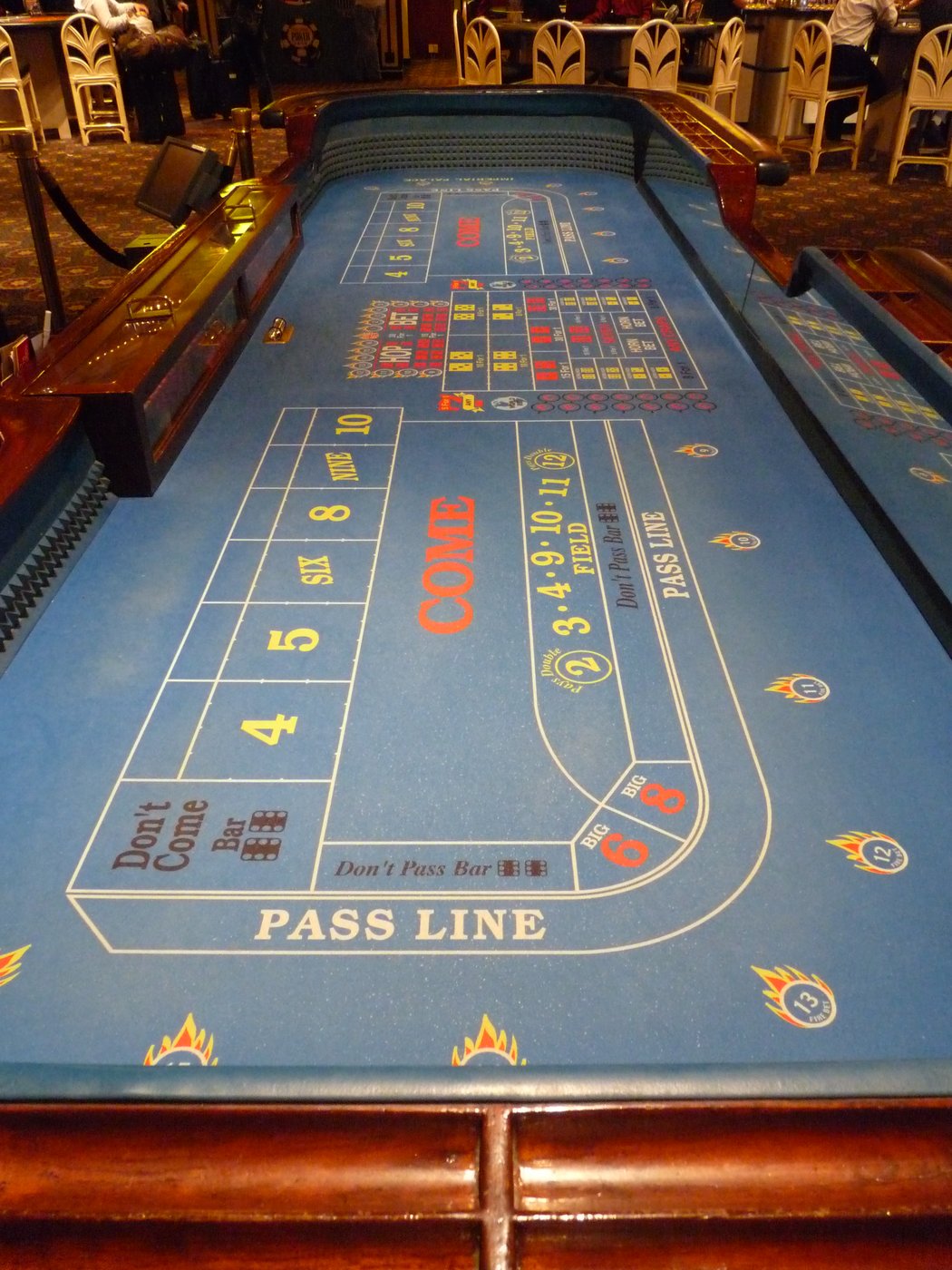
Every round starts with a come-out roll from whichever player is holding the dice (the “shooter,” a rotating role, the same idea as the dealer button in poker). On that first roll, a 7 or 11 wins instantly for anyone betting the Pass line; a 2, 3, or 12 loses instantly — “craps,” the roll the whole game is named for. Any other number — 4, 5, 6, 8, 9, or 10 — becomes “the point,” and the dealer marks it with a puck on the layout. From there, the shooter keeps rolling until one of two things happens: the point number comes up again (Pass line wins) or a 7 shows up first (Pass line loses, “seven out,” and the dice move to the next shooter). Don’t Pass bets simply flip those outcomes, betting against the shooter instead of with them.
The one bet that pays exactly what it’s worth:
Once a point is established, you can add an Odds bet behind your Pass or Don’t Pass wager — and it’s the only bet on the entire casino floor, any game, that pays out at the true mathematical probability, with zero house edge built in. Most casinos cap it at some multiple of your original bet (3-4-5x is standard: up to 3x on a point of 4 or 10, 4x on 5 or 9, 5x on 6 or 8). Take full 3-4-5x odds every time and the blended house edge on your whole Pass line bet drops to 0.374% — one of the lowest edges available anywhere in a casino, poker rooms included.
Named strategies: the 3 Point Molly, and why Iron Cross isn’t actually it:
The strategy most serious craps players settle on even has a name: the 3 Point Molly. Bet the Pass line before the come-out roll, take full odds once a point is set, then place a Come bet on the next roll and take full odds on wherever it lands too — repeat once more and you’ve got three numbers working for you at once, all backed by the same 0%-house-edge Odds bet. Run the whole thing with standard 3-4-5x odds and the blended house edge across all three numbers stays around 0.37%, the same math as a single Pass line bet with odds, just spread across more of the table at once. The other name you’ll hear thrown around the pit is the Iron Cross — a Field bet stacked with Place bets on 5, 6, and 8 that wins on every roll except a 7 — and it feels unbeatable because it almost never loses small, but it carries a meaningfully higher house edge than the Molly. It’s a fun, frequent-win way to play; it isn’t the mathematically sound one.
The bets built to lose, and why they’re still on the table:
The rest of the layout — the one-roll proposition bets in the middle — exists because the house edge there is dramatically worse: Any Craps pays 7:1 but carries an actual 11.1% house edge, a single Hardway bet (betting a specific pair, like two 4s, lands before a 7 or any other 4) runs 9.1%–11.1%, and Big 6/Big 8 (betting a 6 or 8 shows before a 7) sits at 9.09% — all of them dealt from the exact same two dice as the Odds bet that costs you nothing. They stay on the table because they’re the fast, high-payout bets that keep a crowded rail entertained between come-out rolls, not because anyone claims they’re good math.
That’s the shape of it: a come-out roll that either wins, loses, or sets a point; a shooter who keeps rolling until the point repeats or a 7 shows up; one bet behind it that costs the house nothing to offer; and a whole middle section of the table built to separate you from your money faster. Ultimate Texas Hold’em was the game in this series with real decision-tree depth; craps is the one where the best strategy is almost insultingly simple — bet the line, take full odds, and ignore the middle of the table. More of this site’s walk through the games it’s spent dozens of posts standing in front of without explaining is still to come.