
I was today days old when I learned that despite more than 6,000 confirmed exoplanets, nobody has ever confidently detected a moon outside our Solar System — until, maybe, now. A team using the European Southern Observatory’s Very Large Telescope (VLT) in Chile has turned up what ESO itself describes as evidence for a moon-like object, and it’s weirder than a straightforward first: the thing doesn’t orbit a planet, or even a star. It orbits a brown dwarf — an object too massive to be a planet and too small to be a star — which itself orbits a Sun-like star. ESO’s own headline calls it a discovery that “challenges cosmic labels,” and its own language is carefully hedged: “if confirmed, this could be the first ‘moon’ discovered outside our Solar System.” Source: ESO.
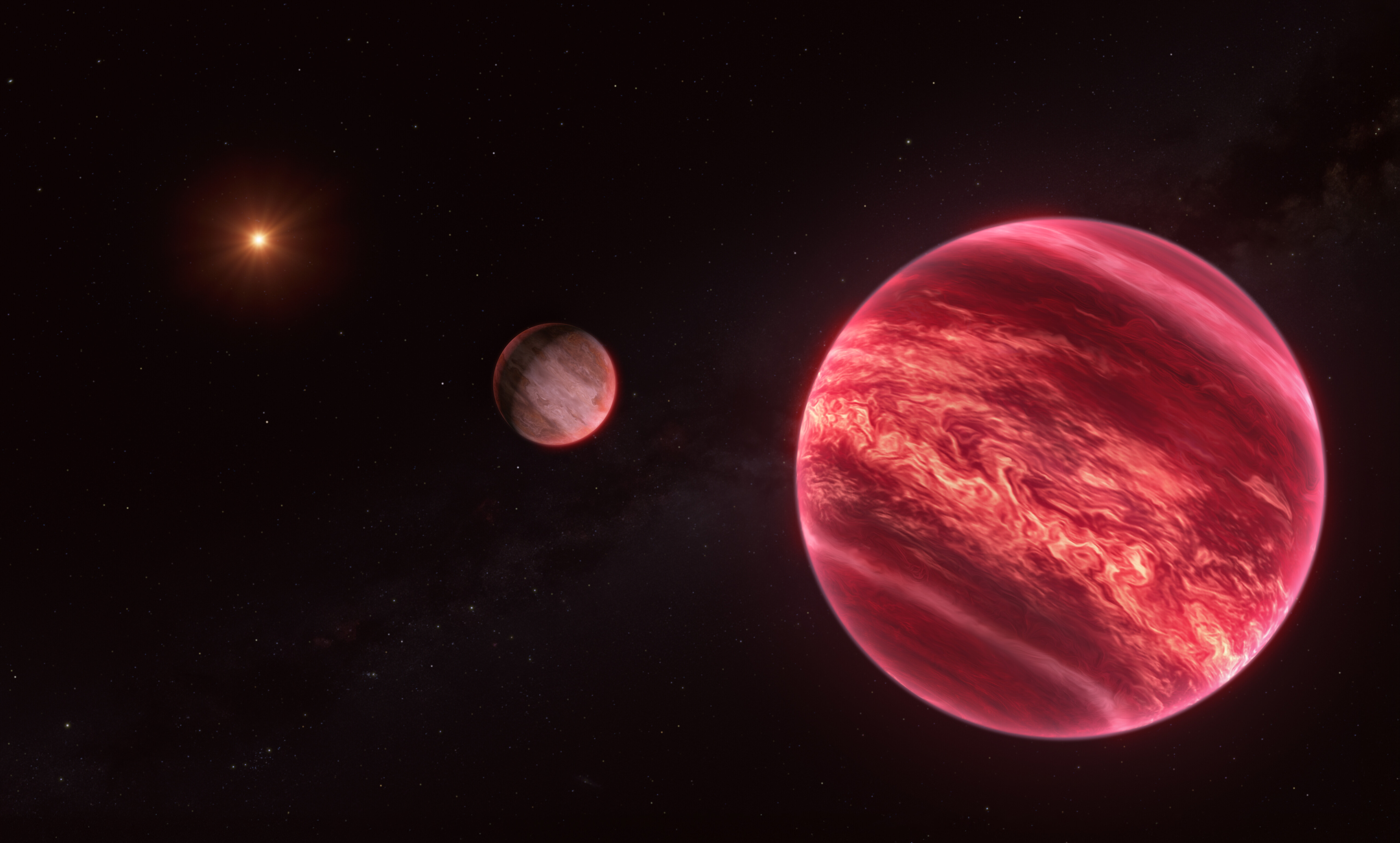
A Star, a Failed Star, and Something That Isn’t Either
The system is called CD-35 2722, and its biggest, most massive object is a young star with about half the mass of our Sun. That star is orbited by a brown dwarf — more than 30 times the mass of Jupiter, big enough that it almost became a star itself, but not quite. The newly discovered object, at least as massive as Jupiter, doesn’t orbit the star at all. It orbits the brown dwarf. ESO is calling it an “exosatellite” rather than committing to “moon,” precisely because nothing in our own Solar System looks like this: a satellite that’s massive enough to be a planet in its own right, circling an object that is itself neither a true planet nor a true star. Source: ESO.
How They Actually Found It
Lead author Kevin Hoy — an ESO student in Chile, affiliated with the Universidad Diego Portales and the Millennium Nucleus on Young Exoplanets and their Moons (YEMS) — and collaborator Alice Zurlo, YEMS Director and an astrophysicist at Universidad Diego Portales, used the CRIRES+ instrument on ESO’s VLT to apply the radial velocity method: the same technique that found the first exoplanet ever confirmed around a Sun-like star. Instead of looking at the star, they watched the brown dwarf for the tiny gravitational wobble an orbiting companion would cause, and found what the team believes is strong evidence of exactly that signal. It’s the first time, as far as the researchers know, this method has turned up evidence of a satellite around a companion brown dwarf. Sources: ESO, Nature.
Why Astronomers Can’t Even Agree What to Call It
Hoy described the system, after months spent analyzing it, as genuinely strange to classify: “This system is somewhat hard to define using Solar-System-based words like ‘planet’ and ‘moon.’” He put the core problem even more bluntly: “The exosatellite is clearly massive enough to be a planet, but it does not orbit a star, though it orbits an object that orbits a star.” Zurlo framed why our own Solar System makes this so much simpler than it has to be: “We have a clear delineation between the planets and the Sun in the Solar System, so defining things like moons is simple.” And on just how significant the team believes the find is, hedge and all: “As exotic as it is, this system is truly unique and represents a breakthrough: the first plausible detection of an exosatellite.” Source: ESO.
The Numbers — and the Honest Hedge Behind Them
The peer-reviewed paper, titled “Planetary-mass exosatellite detected around the substellar companion of a star,” published in Nature on July 22, 2026 (DOI: 10.1038/s41586-026-10751-w), gives the exosatellite a minimum mass of about 0.9 Jupiter masses and an orbital period of around 170 days — figures that come directly from the paper’s own abstract, not a secondhand estimate. The system itself sits roughly 73 light-years from Earth in the constellation Columba, per independent astronomy coverage corroborated against the star’s own Gaia parallax measurement. None of this is being sold as settled fact: the Nature abstract itself says it’s “uncertain whether this exosatellite will fulfil the presently undefined criteria for qualifying as an exomoon,” and ESO’s own release repeats that only a handful of exomoon candidates have ever been proposed, and all of them, including this one, still lack firm confirmation. Sources: Nature, Sci-News.
What’s Next
This isn’t the first attempted exomoon sighting — just months earlier, a separate team led by Quentin Kral reported hints, but no firm detection, of a satellite in the HD 206893 system using ESO’s VLT Interferometer. What makes the CD-35 2722 result notable is that it’s the first time the radial-velocity method itself has produced evidence of a satellite around a brown dwarf companion, opening a repeatable technique rather than a one-off anomaly. ESO’s upcoming Extremely Large Telescope, with its 39-metre mirror, is expected to be sensitive enough to find smaller, less massive exomoons than this one — the kind of detection astronomers say would finally settle the question for good. Source: ESO.