
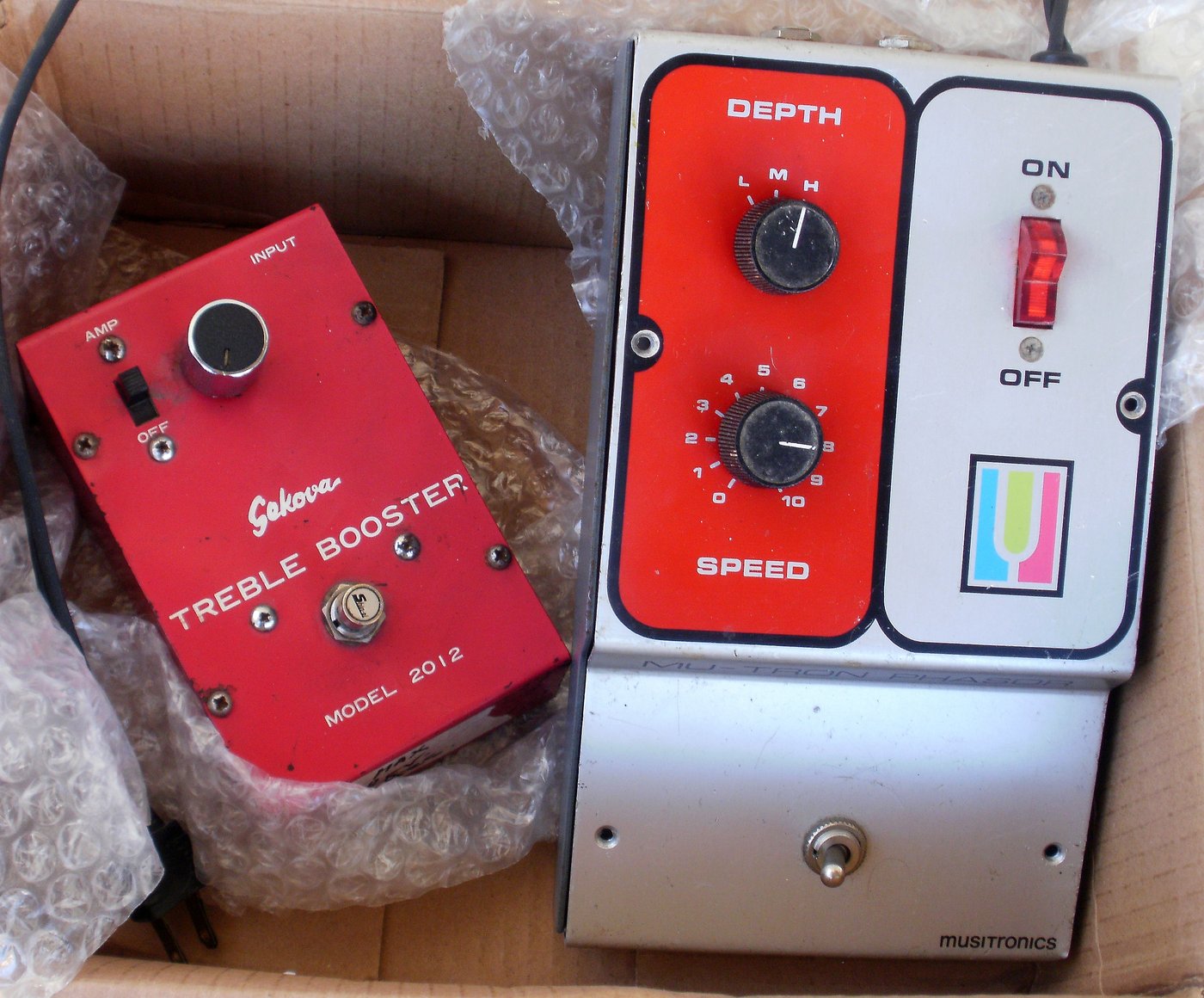
I was today days old when I learned that Kevin Godley and Lol Creme of 10cc invented a gadget that clamps onto an electric guitar and bows the strings with little motor-driven wheels, so one guitarist could sound like a string section. It was called the Gizmo, later the Gizmotron, and it worked just well enough to end up on a Led Zeppelin record and just badly enough to take down the New Jersey company that tried to mass-produce it. That company was Musitronics, maker of the Mu-Tron, whose inventor Mike Beigel died this September. Our story on Beigel is over at TheLastHeadline, and this is the gadget that wrecked his company.
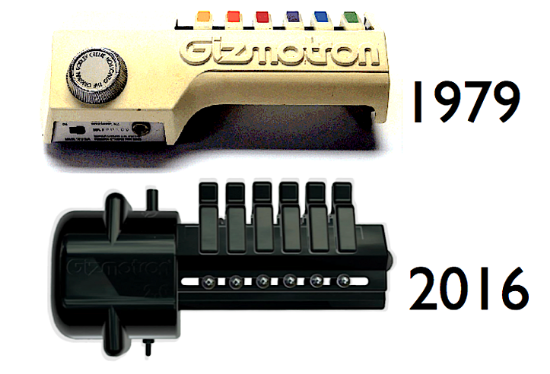
What a Gizmotron Actually Does
A small enclosure mounts on the guitar near the bridge, with one serrated wheel per string. Press a key and a motor spins that wheel against its string, bowing it continuously, so the note sustains for as long as you hold the key instead of decaying like a plucked note. Your other hand stays free to fret. When it works, you get a sustained violin- or hurdy-gurdy-like tone out of a guitar. (Wikipedia)

Eli Zeger, writing for Red Bull Music Academy in 2015, described six buttons lined up with the strings, each spinning a wheel against its string about 100 times a second, and called it, in its simplest form, a guitar version of “the grand piano’s sustain footswitch.” Godley and Creme developed it in the early 1970s by some accounts, with help from physicists in Manchester: Wikipedia credits University of Manchester physics lecturer John McConnell with the prototype, while Red Bull points to the physics department at UMIST. Either way, the two of them patented it in 1975.
Sweetest Violins, 70% Chainsaws
The motive was practical. “A string section was costly and time consuming,” Godley told Rocktimes.de, as quoted by Red Bull. So the Gizmo turned up on a run of 10cc albums starting in 1974: Sheet Music (1974), The Original Soundtrack (1975) and How Dare You! (1976), plus a B-side literally titled “Gizmo My Way,” the flip of “The Wall Street Shuffle.” (The lush bed on “I’m Not in Love,” for the record, was not a Gizmo; according to Red Bull it was more than 250 looped vocal tracks.)
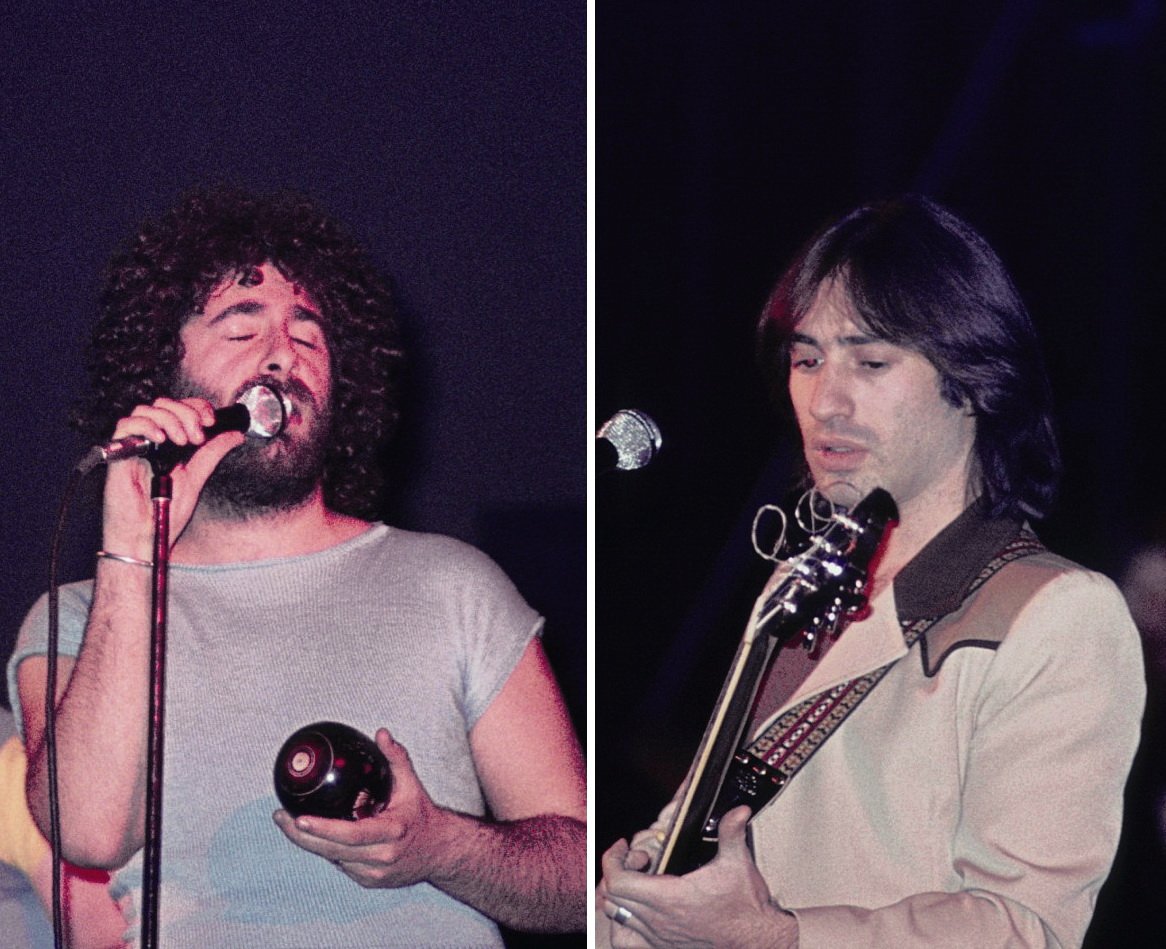
In 1977 Godley and Creme left 10cc and released Consequences, a triple album conceived largely to show off the Gizmo. It peaked at #52 on the UK albums chart and never touched the Billboard 200, per Red Bull. Godley’s own verdict, via Rocktimes.de and quoted by Red Bull: “30% of the time, it sounded like the sweetest violins and cellos... 70% of the time, it sounded like chainsaws.” He also called it “never a particularly stable piece of kit,” according to Wikipedia, and Red Bull notes most of the Gizmo parts on Consequences were heavily processed or double-tracked.
The Company That Bet Everything on It
Musitronics, founded in Rosemont, New Jersey, in 1972 by Mike Beigel and Aaron Newman, was a successful effects maker; the Mu-Tron III was its hit. In Chris Gill’s 1997 Vintage Guitar history, now hosted at mu-tron.com, Newman recalls that a sales rep named Al Marinaro introduced the company to a man who knew Godley and Creme, and the Gizmotron looked like a jackpot. “Everybody thought we were going to make a fortune from the Gizmotron so we decided to sell off Musitronics,” Newman said. The company was sold to ARP Instruments in late 1978 or early 1979, and the former Musitronics, as Gizmo Inc., put its effort into building Gizmotrons for guitar and bass.
The problem was physics. “It had these teeth that plucked the strings, but that created problems with subharmonics,” Newman told Gill. “The thing had a pitch of its own.” Worse, “you could make one if you diddled with it long enough, but you couldn’t make them in production.” They would build them and ship them, find a problem, recall them, and ship them again, all while sitting on what Newman called “tons of orders.” Wikipedia’s list of what went wrong:
- The wheels were sensitive to humidity and temperature.
- They threw off unwanted harmonics and dissonant overtones.
- Setup was extremely precise and time consuming.
- The wheels were expensive and hard to produce, and on the Musitronics version they weren’t replaceable.
- The plastic (polyoxymethylene) turns brittle with age, so working survivors are rare today. Bass versions were made in far larger numbers than guitar versions.
The company even brought in Bob Moog in 1979, after his Norlin contract ran out, to try to fix it. According to Wikipedia, Moog concluded he couldn’t make it sound good enough and advised abandoning it. Then, per Gill, February 1980 brought a massive heart attack for Newman, and about six weeks later the company’s number-two person died in a plane crash. “Godley and Creme wanted more royalties and everything fell apart,” Newman said. Gizmo Inc. went bankrupt in 1981, according to Wikipedia. Beigel’s summary, via Gill: “an R&D nightmare that basically ate up the company.” Newman’s: “Our downfall was the Gizmotron.” Beigel himself had already left in 1978 after the board kept funding the Gizmotron over his proposal to move into digital audio; he never saw a first royalty check from ARP, which went broke itself in 1981. The corporate paperwork differs a little from source to source, but the bottom line doesn’t.
The People Who Actually Made It Sing
For a device its inventor rated 70% chainsaw, the Gizmotron has a surprisingly good discography. According to Wikipedia (and Jimmy Page’s own Anthology), Page used it on the intro to “In the Evening” and on “Carouselambra” from Led Zeppelin’s In Through the Out Door (1979). Wings used one on “I’m Carrying” from London Town (1978). John McGeoch played it on Siouxsie and the Banshees’ “Into the Light” (1981), and Simon Raymonde used it on This Mortal Coil’s It’ll End in Tears (1984).


The Reboot
The gadget that actually won the “make a guitar sustain forever” market was the EBow, built by Greg Heet in 1969 and patented in 1978, which Red Bull describes as the reliable alternative. But the Gizmotron got a second life. Aaron Kipness, founder of Clavinet.com (which makes replacement parts for Hohner Clavinets), first heard the Gizmotron through Jimmy Page and built the Gizmotron 2.0, shown at Summer NAMM in 2015 and released February 3, 2016. Kevin Godley, per Red Bull, “gave us his blessing and graciously offered his support.” Kipness: “It’s really a total reboot of an idea that failed in its original implementation.”
So that’s the Gizmotron: a genuinely clever idea, 30% gorgeous, 70% power tool, good enough for Led Zeppelin and bad enough to swallow the company that made the Mu-Tron. If you own a working original, treat the plastic gently. There aren’t many left.