I was today days old when I learned there's a $99 box called Home Assistant Green that runs your entire smart home locally — no Amazon cloud, no Google cloud, no subscriptions, no one harvesting your data. You own the automations. You own the data. When Amazon decides to pivot away from smart home hardware (and they have before), your lights still work.
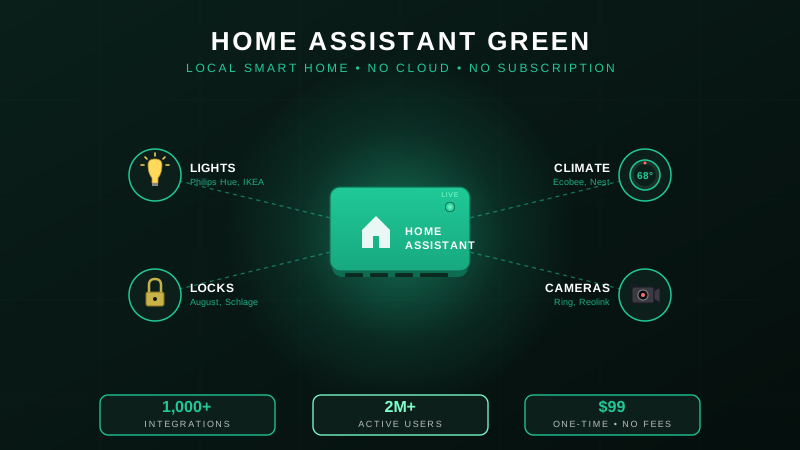
Most smart home setups are rented, not owned. Your Alexa routines live on Amazon's servers. Your Google Home automations run on Google's infrastructure. Ring cameras send footage to Amazon. SmartThings… had a rough few years. Every one of those systems can change their pricing, kill a feature, or just shut down. If you've ever had a smart home gadget go dark because the company behind it folded — and a lot of people have — you already understand the problem.
Home Assistant is the answer that the smart home industry doesn't want you to know about. It's an open-source home automation platform, built by a community of thousands, now with over 2 million active installations worldwide. It runs on your own hardware, in your own home, on your own network. The cloud is optional. The data never leaves unless you want it to.
What Home Assistant Green actually is
The Green is the official starter hardware — made by Nabu Casa, the company that stewards Home Assistant. It ships with Home Assistant OS pre-installed. You plug it into power and ethernet, open the app on your phone, and it finds your devices. Three steps. No soldering, no Raspberry Pi, no config files unless you want them.
- $99 — the cheapest purpose-built Home Assistant device. Quad-core ARM 1.8GHz, 4GB RAM, 32GB eMMC storage (no SD card — far more reliable), gigabit ethernet, 2x USB 2.0.
- Silent and tiny. No fan. No moving parts. ~1.7W idle. It sits next to your router and you forget it's there.
- 1,000+ built-in integrations. Philips Hue, IKEA Tradfri, Ecobee, Nest, Ring, Sonos, Roku, Plex, Zigbee, Z-Wave, Matter, Thread, Apple HomeKit, Google Home, Amazon Alexa. If you have a smart device, there's almost certainly an integration.
- You can migrate gradually. Keep using Alexa or Google Home as a voice layer while Home Assistant runs the logic underneath. Most people start this way and slowly stop needing the big-tech layer.
- Monthly releases, massive community. The project ships new features every single month. The community forum is enormous. Whatever you're trying to automate, someone has already done it.
What "local-first" actually means
When you tell Home Assistant to turn your lights off at sunset, that automation runs on the Green sitting in your closet. It doesn't call Amazon. It doesn't need your internet to be working. It doesn't go down because AWS had an outage. For basic home control — lights, locks, thermostat, sensors — you genuinely do not need the internet at all once it's set up. That's a different category of reliability than anything Alexa or Google Home can offer.
Who is this for
If you have a smart home and have ever felt like you don't really own it — this is for you. If you've had a device go dead because the company shut down its servers (Wink, Insteon, SmartThings Classic…) — this is for you. If you want automations that actually do complex things (turn on the porch light only if it's after sunset AND someone is on the front-door camera AND it's not already on) — this is for you. The Green is the easiest on-ramp.
Home Assistant has 2 million active installations. It's one of the most active open-source projects on GitHub. The smart home industry is not going to tell you this exists — because it means you stop paying for their subscription tiers and their cloud services. Now you know.
Go to home-assistant.io. If you want the easiest hardware entry point, the Green is at amazon.com/dp/B0CXVKSG19 for $99.