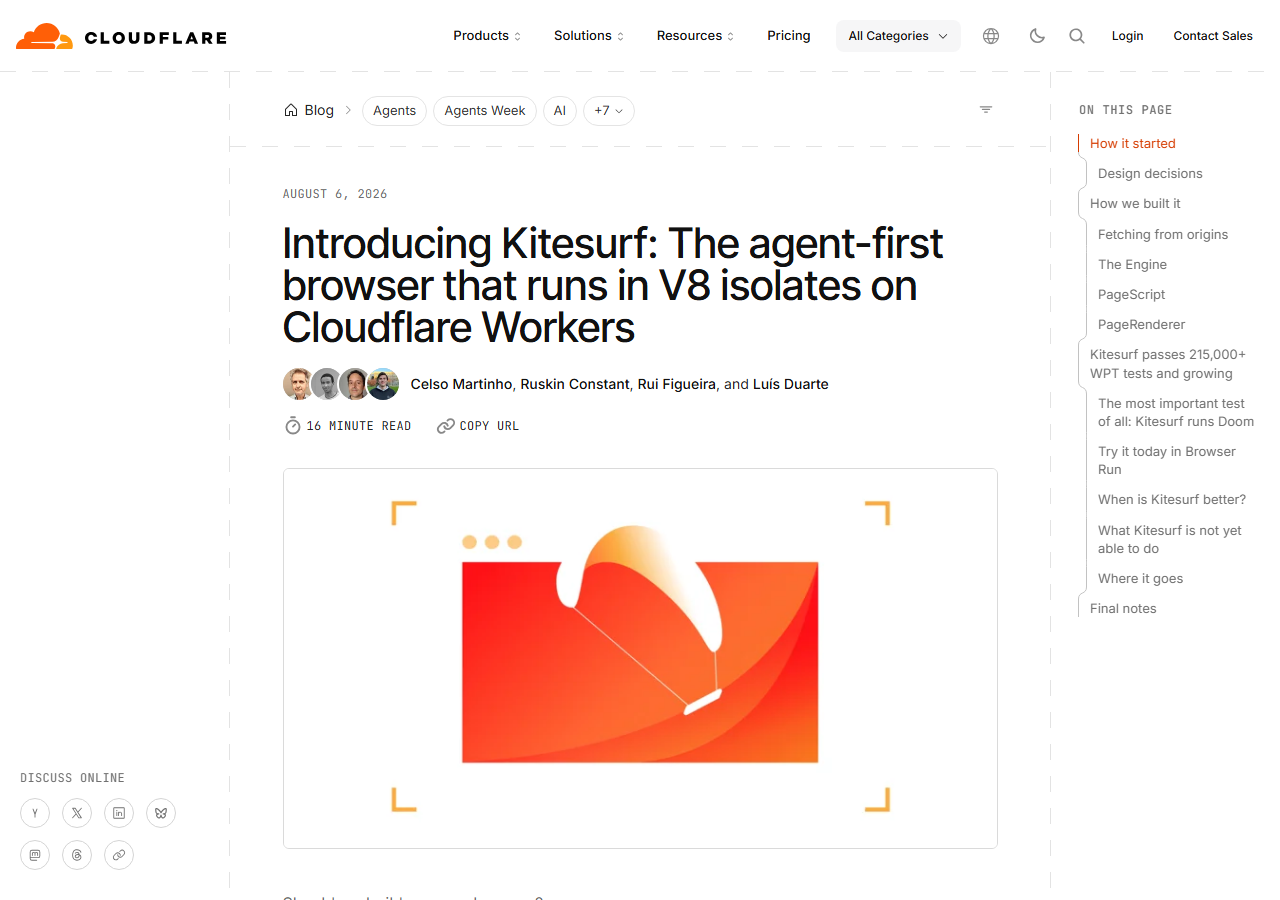
I was today days old when I learned Cloudflare built an entire browser from scratch — not a plugin, not a wrapper around Chromium, an actual rendering engine — designed only for AI agents to use, and it runs completely inside their own Workers platform instead of spinning up a separate browser process somewhere. It’s called Kitesurf, and Cloudflare announced it on August 6, 2026 in a long, genuinely technical blog post from engineers Celso Martinho, Ruskin Constant, Rui Figueira, and Luís Duarte. Source: Cloudflare Blog, “Introducing Kitesurf”.
Why Build a Browser Just for Robots?
Cloudflare says the question “should we build our own browser?” had come up internally every few months for years and always got shelved — until AI agents changed the math. Chromium and other browser engines were built for humans, and that comes with overhead an AI model doesn’t need: it doesn’t care about tabs, themes, extensions, or smooth 60fps scrolling, but it does care a lot about token count, context window size, scalability, and cost. Giving every agent its own full Chromium instance is expensive enough that it locks smaller or cheaper AI applications out of large parts of the web. Cloudflare also points out the threat model is different for agents than for humans — prompt injection and tool safety are now front-and-center security concerns a browser has to account for. Twelve weeks before the announcement, the team greenlit the project for real, with the first commit landing in May 2026. Source: blog.cloudflare.com.
How It Actually Works
Kitesurf doesn’t launch a separate Chromium binary at all — it runs entirely inside Cloudflare Workers isolates, built mostly in Rust and compiled to WebAssembly. Three components do the work: the Engine is the only public-facing piece, and it speaks the Chrome DevTools Protocol (CDP), the same protocol Puppeteer, Playwright, and chrome-remote-interface already use, so existing automation code can point at Kitesurf with no rewrite. PageScript spins up a fresh, isolated Worker per page (using a newer Cloudflare primitive called Dynamic Workers) to parse the HTML and CSS and run the page’s JavaScript, using parts of a rendering engine called Blitz and Stylo, which is Firefox’s own CSS parser. PageRenderer turns the resulting page object into an actual image, called over Workers’ built-in RPC system. Because native eval still isn’t supported in Workers, Kitesurf runs a small JavaScript engine of its own, called Boa JS, just to handle the occasional eval call it runs into on real pages. Source: blog.cloudflare.com.
The Real Numbers — 3 to 7x Less CPU and Memory Than Chromium
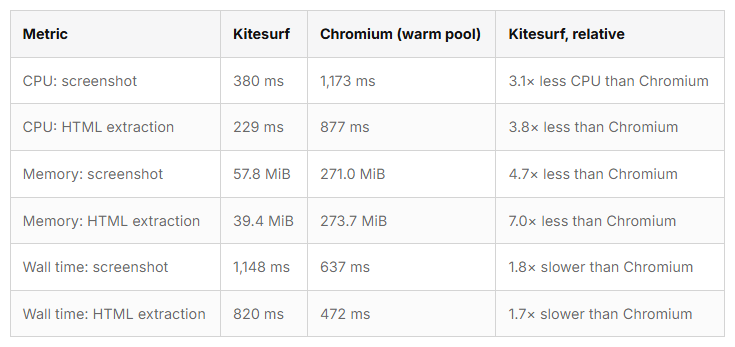
This is the headline claim, and it checks out against Cloudflare’s own published benchmark table: across five runs of a 14-URL test corpus, Kitesurf used 3.1x less CPU than Chromium for taking a screenshot and 3.8x less CPU for extracting HTML, plus 4.7x less memory for a screenshot and 7.0x less memory for HTML extraction — the “3-7x” range Cloudflare advertises is accurate to those two specific tasks, not a single flat multiplier across the board. The one place Chromium still wins is raw wall-clock speed: it’s about 1.7-1.8x faster in real time, because a warmed-up Chromium JIT that has already seen a page beats a colder software renderer, mostly during image rasterization and encoding. Cloudflare’s own framing is blunt about the tradeoff: Kitesurf wins on the two things that actually drive your bill — CPU and memory — not on the stopwatch. Source: blog.cloudflare.com.
On test coverage, Cloudflare’s own post states Kitesurf “already passes around 215,000+” of the Web Platform Tests (WPT), the standard W3C conformance suite for browsers, and says it’s adding hundreds more passing tests every week — that’s the number straight from the primary source as of publication, not the 235,000+ figure that had been floating around before this post was researched, so we’re going with what Cloudflare itself actually says. Given the pace they describe, the real total has likely climbed since August 6. Source: blog.cloudflare.com.
What It Can (and Can’t) Do Yet
Cloudflare says Kitesurf already correctly renders real, non-trivial pages — TodoMVC in its vanilla, React, Vue, Angular, and Preact versions, Wikipedia, Hacker News, the Cloudflare Blog itself, and much of the Cloudflare dashboard — and is well suited to one-shot tasks like extracting content from a page, screenshots, or generating PDFs on compatible sites. It’s honestly not there yet for everything: Cloudflare lists playing video, rendering WebGL, negotiating a bot-challenge handshake that needs a real TLS fingerprint, or holding a ten-minute authenticated session with persistent state as things Kitesurf isn’t ready for. For those cases, Cloudflare says to just use Browser Run’s existing default option, which is still powered by Chromium. Source: blog.cloudflare.com.
It Runs Doom, Because Of Course It Does
Cloudflare’s post makes a point of calling this “the most important test of all”: no browser project is complete until Doom runs on it, and Kitesurf does, loading a WebAssembly Doom port at silentspacemarine.com right inside the new engine. It’s a small detail, but it’s also a genuine compatibility flex — a browser rendering a real, interactive, JavaScript/WebAssembly-heavy game entirely from V8 isolates on Workers, with no Chromium underneath it at all. Source: blog.cloudflare.com.
Free to Try, Open Source Coming
Kitesurf is available today, free while in beta and subject to per-account limits, as an option inside Browser Run, Cloudflare’s existing headless browser automation product. Since it speaks CDP, any existing Puppeteer, Playwright, chrome-remote-interface, or MCP-speaking AI agent setup already works against it — you just add a browser=kitesurf parameter to the relevant Browser Run endpoint. Cloudflare also runs a public playground where you can point Kitesurf at any URL and watch it render, with Chrome DevTools embedded directly in the page, including a Memory panel that reports the actual WebAssembly footprint of each isolate. Cloudflare says it plans to open source Kitesurf once it’s ready, so any customer could eventually run their own copy on their own account. Source: blog.cloudflare.com.
Read Cloudflare’s full announcement at blog.cloudflare.com — free to try in Browser Run while Kitesurf is in beta.