I was today days old when I learned that astronomers have never actually confirmed a rocky planet holding onto an atmosphere in another star’s habitable zone — not once, in thousands of exoplanet discoveries — until now. A Harvard-led team just caught helium actively leaking from LHS 1140 b, a super-Earth 48 light-years away, and it’s being called the first confirmed atmosphere ever found on a rocky, habitable-zone world around any star. Source: ScienceDaily.
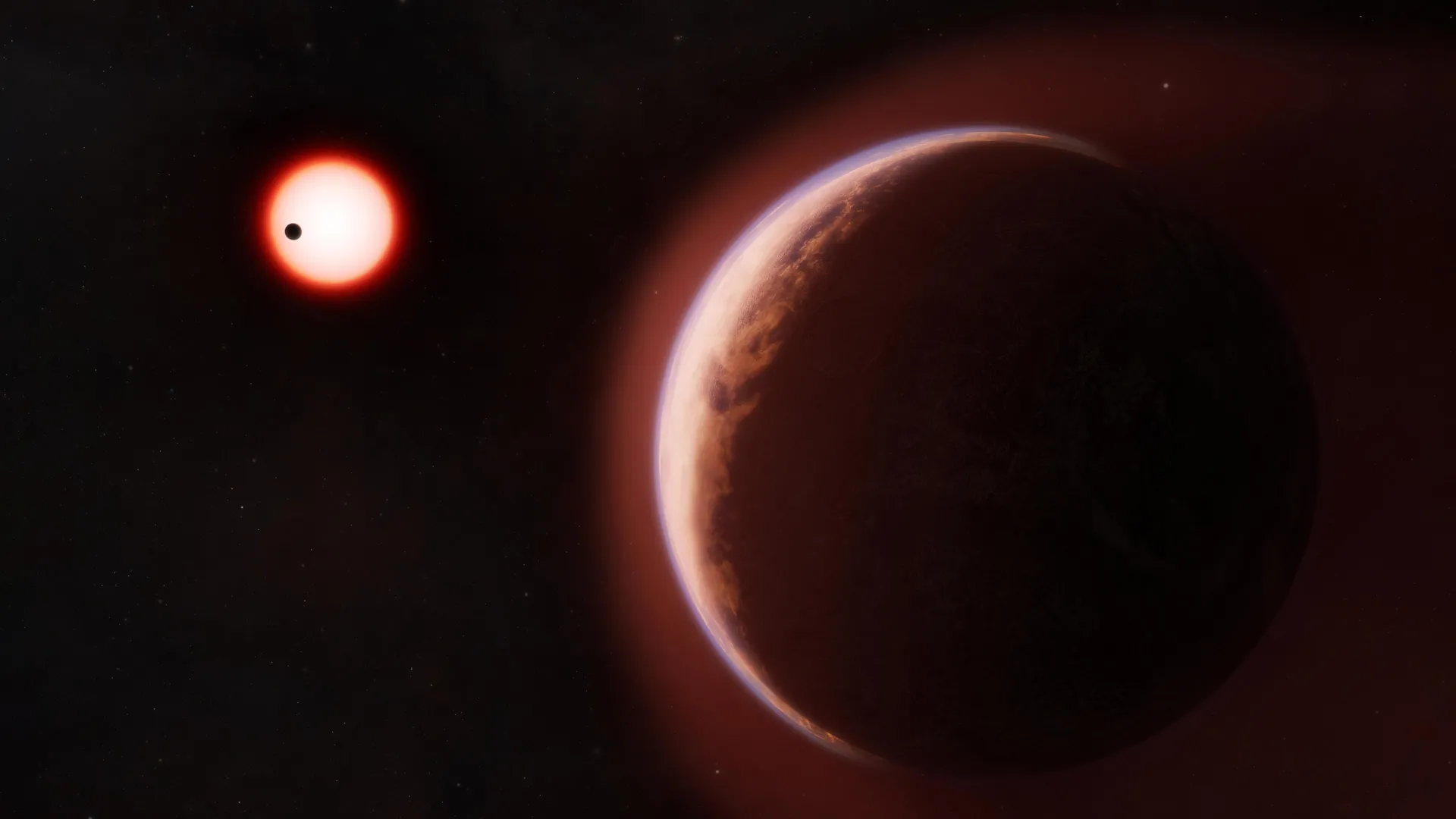
The Planet That Checks Every Box
LHS 1140 b is a “super-Earth” roughly 1.73 times Earth’s radius and 5.6 times Earth’s mass, orbiting a red dwarf star within that star’s habitable zone — the band of distance where surface temperatures could allow liquid water. Its mass and radius together point to a rocky bulk composition plus some lower-density component, which researchers now believe is at least partly an atmosphere. It’s been one of the most closely studied rocky exoplanet candidates since its 2017 discovery, and its host star is old and relatively quiet, more than three billion years into its life. Sources: EarthSky, TechTimes.
How They Actually Caught the Helium Leaking
This detection didn’t come from the James Webb Space Telescope. Harvard astronomers, led by Collin Cherubim, first built a first-principles model predicting that LHS 1140 b’s upper atmosphere would be helium-rich and slowly bleeding into space — then tested that prediction using the Magellan Clay Telescope at Las Campanas Observatory in Chile, with its WINERED (Warm Infrared Echelle Spectrograph) instrument tuned to a precise near-infrared helium signature. During one observing run, LHS 1140 b and a neighboring planet, LHS 1140 c, happened to cross their star on the same night: LHS 1140 c showed no helium signal at all, while LHS 1140 b showed a clear one, giving the team a direct built-in comparison. JWST does factor into this story, but as later, more targeted follow-up work rather than the detection itself. Sources: CNN, TechTimes.
Why This Matters More Than It Sounds
Red dwarf stars are the most common type of star in the galaxy, but they're also known for intense flares and stellar wind that can strip a close-in planet's atmosphere away entirely over time — which is exactly why nobody had ever confirmed a rocky, habitable-zone planet actually keeping one. As Harvard's Robin Wordsworth put it: “Twenty years ago we wondered whether other terrestrial-type planets even existed. Then we learned they’re common, and found some in the habitable zone. The next question was whether any of them had managed to keep an atmosphere. Now we know at least one has.” Lead author Collin Cherubim was blunter about the stakes: “An atmosphere is essential for a planet to support life as we know it. This is the first time anyone has found an atmosphere on a rocky planet in the habitable zone of another star.” Published in the journal Science in mid-July 2026. Source: ScienceDaily.
What’s Next
LHS 1140 b is already part of a joint James Webb Space Telescope and Hubble Space Telescope observation program targeting rocky worlds around dwarf stars. The next observation phase will search for water, carbon dioxide, and other gases lower in the atmosphere — the helium detected so far only confirms the upper layer, and can’t say anything yet about what’s happening closer to the surface, or whether liquid water is actually present. That's the follow-up work JWST is built for, on a planet that just became one of the best real candidates in the search for life beyond our solar system. Source: TechTimes.