I was today days old when I learned that the largest Megalodon fossils ever found were considered lost for more than three decades, sitting the entire time in a jumbled box of unlabeled remnants on a museum shelf in Denmark, until a curator finally opened it and realized exactly what he was looking at. Sources: ScienceDaily, The Conversation.
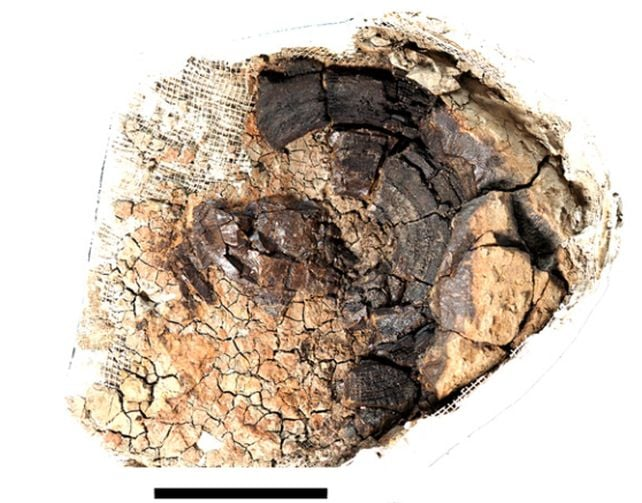
Vertebrae Thought Destroyed in a 1989 Move
The fossils are several enormous vertebrae from a single 11-million-year-old Megalodon (properly Otodus megalodon) found in Denmark, and they’re the largest known vertebrae of any Megalodon specimen ever recovered, at 23 cm (9 inches) in diameter. Shark skeletons are mostly cartilage rather than bone, so aside from teeth and jaws, vertebrae almost never survive as fossils — and unlike a tooth, a vertebra gives researchers a much more reliable read on an animal’s actual size. These particular specimens were believed destroyed during a 1989 move from the Geological Museum of Copenhagen (now folded into the Natural History Museum of Denmark) to the Museum of Southern Jutland, with nothing left behind but old photographs and written descriptions. Sources: SciTechDaily, ScienceAlert.
Sitting in a Box for Over 30 Years
Instead of being destroyed, the vertebrae ended up sitting unrecognized in a jumbled box of remnants for more than three decades. Vertebrate paleontologist and curator Bent Erik Kramer Lindow, of the Natural History Museum of Denmark, spotted the box in 2017 and realized what he was actually looking at — not scrap, but the very specimens the scientific record had long assumed were gone. It then took years of careful reassembly and analysis before the findings were ready to publish in 2026. That moment reopened a research window photographs and old descriptions alone could never have provided. Sources: ScienceAlert, Phys.org.
What the Fossils Revealed About Megalodon’s True Size
Fresh analysis of the rediscovered vertebrae, published in Palaeontologia Electronica, strengthens earlier evidence that this individual Megalodon could have exceeded 24 meters (79 feet) in length and lived for nearly a century. For comparison, even the most exaggerated movie sharks in the Jaws franchise topped out at 10.5 meters (34 feet) — less than half that size. The study, authored by Kenshu Shimada, Mette Elstrup, Henrik Lauridsen, Trine Sørensen, and Mikael Siversson, is one of the few analyses ever built on actual Megalodon vertebrae rather than teeth alone. Sources: ScienceDaily, SciTechDaily.
Newborns Bigger Than a Grown Adult
Maybe the single strangest number to come out of the new analysis: researchers estimate this Megalodon’s newborns may have measured roughly 3.6 meters (12 feet) at birth — bigger than a fully grown adult human, on day one. It’s a reminder of just how far outside normal scale this species operated at every stage of life, and it's a data point that simply wasn't available before these particular vertebrae resurfaced. Source: ScienceAlert.
How Museums Lose (and Occasionally Recover) Their Own History
The rediscovery is also a reminder of how fragile museum collections really are. War has destroyed major fossil finds before — the original Spinosaurus specimens were lost in a 1944 Allied bombing raid on Munich, and a shipment of Alberta dinosaur fossils sank with the SS Mount Temple in 1916. Sometimes it's simpler than that: with an estimated 80 million objects in its collection alone, even an institution like the Natural History Museum in London is bound to misplace something eventually. This time, the story has a happy ending — the box got opened, the vertebrae got recognized, and one of the largest predators to ever swim the Earth's oceans just got a little more scientifically real. Source: The Conversation.