I was today days old when I learned NASA will let me fly through the solar system from a browser tab — past every probe it has out there right now, in real time, for free, no account, no download. Eyes on the Solar System is a free 3D visualization of the entire solar system built from actual NASA mission and trajectory data. You can open it in a tab right now, fly out to Voyager 1 at the edge of the solar system, ride along with Perseverance on Mars, or zoom out and watch the planets in their orbits. That's it. That's the discovery.
What it actually is:
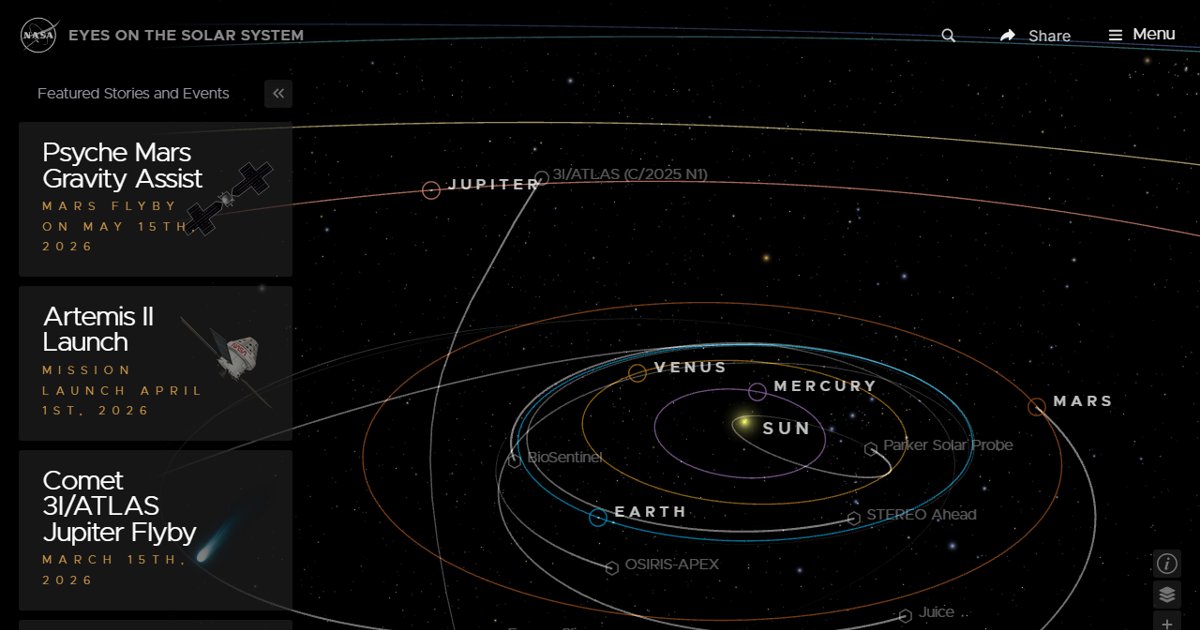
NASA Eyes on the Solar System is a free, browser-based 3D app at eyes.nasa.gov. No account. No download. Just open it in a tab. The interface is a full 3D space with the sun at the center, the eight planets in their orbits, and every active NASA spacecraft flying around in real time. Use your mouse to orbit, zoom, pan. Or select a spacecraft and the camera rides along with it, following its trajectory through space.
The data is real. The spacecraft positions, planet positions, orbital mechanics — all drawn from the actual trajectory data NASA navigators use to fly the missions. When you open it at 3 PM on May 19, the positions reflect where things actually are. You can scrub time forward and backward, fast-forward through the orbits, or set it to "now" and watch live.
The active roster you see right now:
Voyager 1 and Voyager 2 (both launched 1977, still transmitting from interstellar space — Voyager 1 alone is now more than 15 billion miles from the Sun). Perseverance rover on Mars. JWST (James Webb Space Telescope) at the L2 Lagrange point. Parker Solar Probe (diving into the sun's corona). New Horizons (in the outer reaches of the solar system). And more — a snapshot of every active deep-space mission in one visualization. The discovery is how *many* there are and how far flung they've become.
Why this matters:
There is something genuinely awe-inspiring about opening a tab and flying out to Voyager 1, which crossed into interstellar space and is somehow still sending signals back after nearly 49 years. Or riding the trajectory of the Parker Solar Probe, which is literally diving into the sun's corona and swinging back. Or watching Perseverance on Mars, a rover the size of an SUV that's been rolling around collecting samples for a mission that won't be finished until humans arrive.
Eyes on the Solar System is built with WebGL, a 3D graphics standard that runs natively in modern browsers — no plugin, no installation. The rendering is smooth, the controls are intuitive, and the scale is genuinely humbling. You can zoom out until Earth is a blue dot and the sun is a glowing sphere, then zoom in and watch an individual spacecraft.
There are sibling "Eyes" apps — Eyes on the Earth (showing satellites and weather systems orbiting Earth), Eyes on Exoplanets, Eyes on Asteroids. But Eyes on the Solar System is the main event. It's the one that makes you realize how much is actually out there right now, and how much data NASA is managing to keep flowing back from all of it.
Open it and fly:
Head to eyes.nasa.gov/apps/solar-system/. It'll take a few seconds to load the 3D scene. Pick a spacecraft from the list or just float around and click things. Zoom out until you're looking at the whole solar system, then zoom back in on a specific mission. The discovery is just that this exists, it's free, and you can do it right now from a tab.