I was today days old when I learned that Ötzi the Iceman — the 5,300-year-old mummy found frozen in the Alps in 1991 — is still hosting living microbes today, and that researchers actually managed to grow four species of yeast straight out of his ancient remains. Sources: ScienceDaily, CNN, Science News.
Three Microbial Timelines in One Mummy
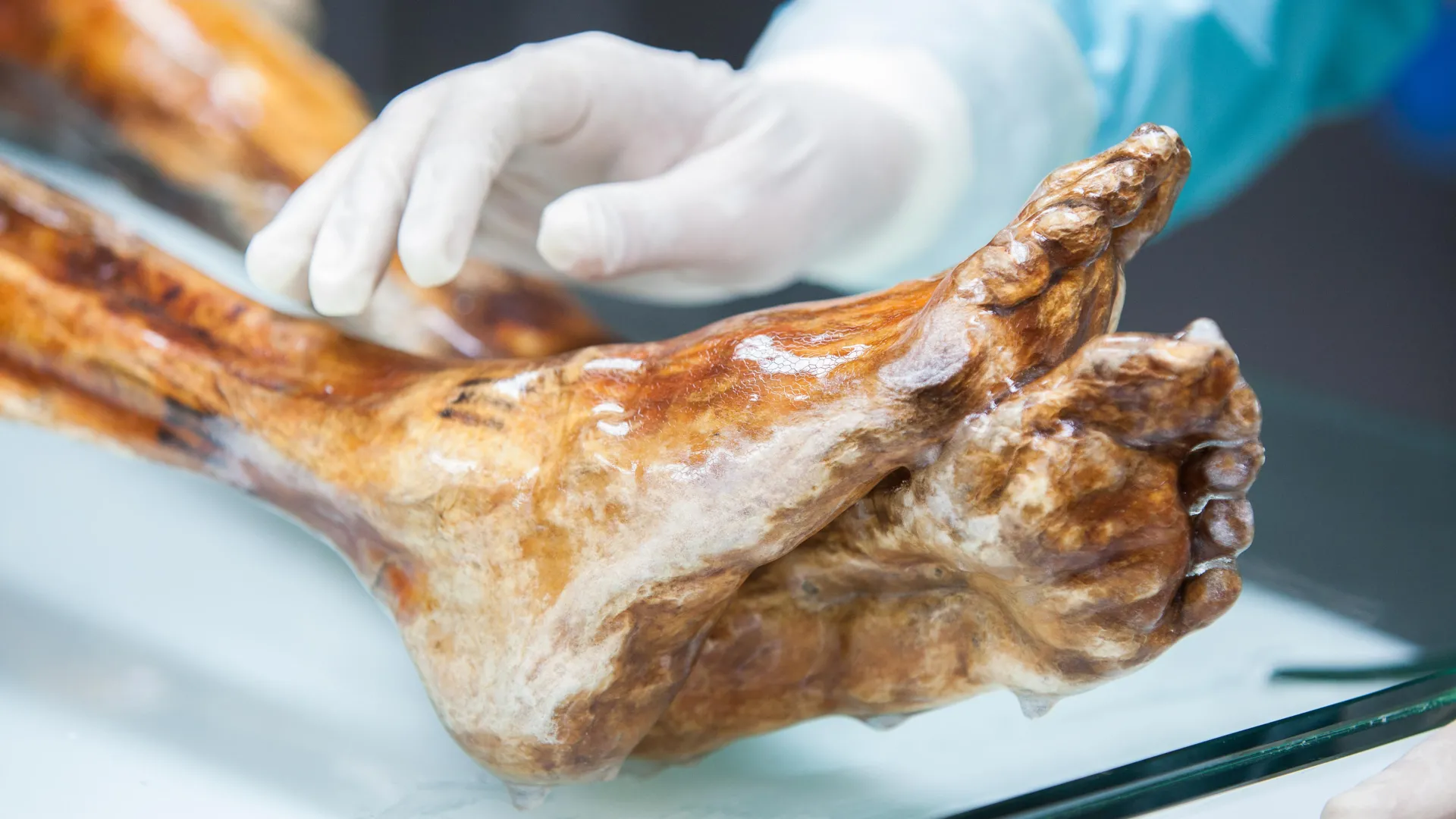
The study comes out of Eurac Research’s Institute for Mummy Studies in Bolzano, Italy, led by senior author Frank Maixner and published June 3, 2026 in the journal Microbiome. The team set out to map Ötzi’s entire microbial community and sort it into three distinct sources: ancient gut microorganisms from his actual lifetime, recovered from internal tissues and stomach contents and matched against a prior 2019 study; microbes that colonized him after death and during his long entombment in the glacier; and modern contamination introduced by more than 30 years of handling and museum storage since hikers found him in 1991 — which turned out to be the dominant signal on his external surface, mostly ordinary human-associated bacteria like Methylobacterium and Sphingomonas. Sources: CNN, ScienceDaily.
Cold-Loving Fungi Still Growing Right Now
Researchers identified several cold-adapted (psychrophilic) yeast species tied to the glacier environment where Ötzi died, and found that one of them, Glaciozyma, was more abundant in the new samples than it had been in a prior 2010 sampling round, with less DNA damage — a sign it may still be slowly replicating inside micropockets of moisture on the mummy today. That growth is happening inside a refrigeration chamber at the South Tyrol Museum of Archaeology, held at a constant -6°C (21°F) and 99% relative humidity specifically to mimic the glacier that once held him. Sources: CNN, Science News.
Four Living Yeast Species Grown From 5,300-Year-Old Remains
When the team tried to culture Ötzi’s ancient microbes in the lab, four distinct yeast species came back alive — Glaciozyma, Goffeauzyma, Mrakia, and Phenoliferia — recovered from swabs, internal meltwater, and stomach-content samples. The researchers describe them as “relicts,” or living time capsules, of the exact microbial world that colonized Ötzi in the years after his death, over 5,300 years ago. Notably, attempts to culture his actual ancient gut bacteria, the microbes that lived inside him while he was alive, did not grow; that lineage survives only as recovered genetic material, not as a living culture. Sources: Science News, EurekAlert.
What a 5,300-Year-Old Yeast Could Be Good For
Beyond the novelty, the find has a practical angle: cold-adapted microorganisms like these are already of interest for energy-efficient industrial processes, including low-temperature fermentation, since organisms that function well in the cold can cut the energy costs normally baked into processes that require heating. Sources: ScienceDaily, Phys.org.
A Mummy That Keeps Changing, Even in Storage
The study’s authors sum it up by writing that Ötzi “is not a static relic but a dynamic biological interface” — and the growth patterns raise real conservation questions, since several of the surviving yeasts carry genes that let them feed on compounds once used to help preserve ancient remains. Sorting out which microbes are genuinely ancient versus later contamination also gives researchers a cleaner baseline for future studies on other archaeological remains, human and animal alike. More than three decades after he was found, Ötzi is still turning out to be one of the most studied — and apparently still-changing — mummies on Earth. Sources: CNN, EurekAlert.