I was today days old when I learned there's a free research site, run out of Oxford, that has a fully interactive, deeply sourced chart for almost every major problem on Earth — and every single one is free to read, share, embed, and download.
What Our World in Data is:
Our World in Data is a non-profit research project at the University of Oxford, founded by economist Max Roser in 2011. The site publishes hundreds of data-driven articles on long-run trends in human welfare — covering health, poverty, education, food, climate, war, energy, population, and more — with every chart backed by peer-reviewed data and every dataset available for download.
It doesn't have a paywall. It doesn't have ads. It doesn't have a subscription tier. It's funded by grants and reader donations, and everything it publishes is free.
What it actually looks like:
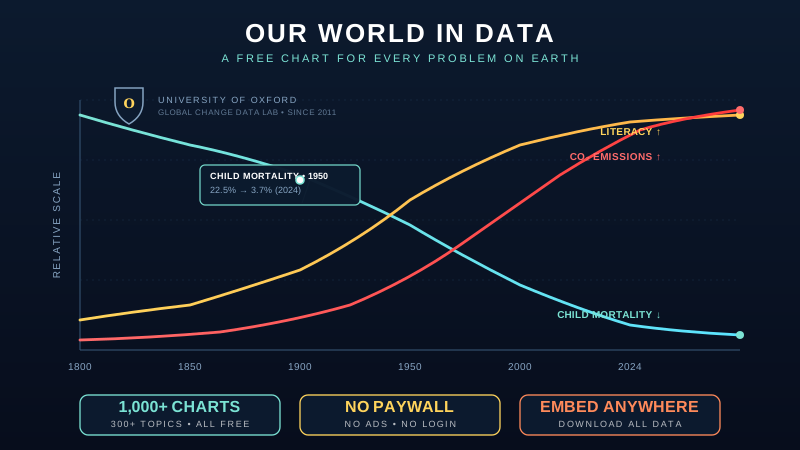
Every article is built around interactive charts. Not static images — actual interactive charts where you can hover for exact numbers, add or remove countries, change the time range, switch between absolute values and per-capita views. A chart about child mortality in 1800 vs. today doesn't just show you the line — it lets you drill into any country, any decade, and see the numbers behind it.
The charts embed anywhere. Every chart on the site has a share and embed button. Journalists, researchers, and teachers use them constantly. If you've read a long-form NYT or BBC piece about global poverty, climate trends, or vaccine coverage, there's a good chance the chart in the middle came from Our World in Data.
Why it exists — and why the data matters:
Max Roser started Our World in Data because he believed people fundamentally misread how the world is changing. Surveys consistently show that most people think global poverty, child mortality, and illiteracy are getting worse when, by most long-run measures, they've improved dramatically over the past 200 years. At the same time, people underestimate the real scale of climate change, biodiversity loss, and inequality. Our World in Data is the corrective — evidence-first, no editorial slant, just the numbers and what they actually mean.
Some of the topics covered:
- Poverty and income — What share of the world lives on less than $2.15/day? (Down from 38% in 1990 to under 9% now — but with major regional variation.)
- Health and disease — Child mortality rates by country since 1800. Cancer survival rates. COVID outcomes. Life expectancy.
- Climate and energy — CO₂ by country, per capita, and per dollar of GDP. Renewable energy capacity growth. Sea level trends.
- Food and agriculture — Calories per person globally. Land use. Food waste. How much land would go back to nature if everyone went vegetarian.
- War and conflict — Battle deaths per capita over time. Nuclear warhead counts. State fragility.
- Education — Global literacy rates since 1800. Share of children in school by country.
Each topic gets its own research page with multiple charts, primary source citations, and explanatory text. It's built like a good academic paper but readable like journalism.
Who makes it:
Our World in Data is produced by a team of ~50 researchers, data scientists, and engineers at the Global Change Data Lab — a registered charity in the UK — in partnership with Oxford University. Contributors include Roser, Hannah Ritchie (who writes the Substack 'Sustainability by Numbers'), Charlie Giattino, and Edouard Mathieu. Roser has written about why the project exists in a way that's unusually honest about what it's trying to do: counter motivated reasoning on both the optimist and pessimist sides of the big-picture-of-the-world debate.
A few weird things hiding on the same site:
For all the heavy topics, OWID is also full of charts that are just oddly fun to look at. Some of the things you'll stumble on while clicking around:
- "How much land would go back to nature if the world went vegetarian?" Spoiler: roughly the size of North America plus Brazil. They have the actual map.
- Average human height by country, over time. The Dutch became the tallest people on Earth in about 100 years. There's a chart for it.
- Chocolate consumption per capita. Switzerland, Germany, and Belgium are predictably high. The US isn't even close to the top.
- Probability of dying from various causes. Includes 'terrorism' (vanishingly small), 'lightning' (less than you'd think), and 'meteorite' (yes, there is a number).
- Books published per million people. Iceland is wildly off the chart — more books per capita than any country on Earth.
- Beer consumption per capita. Czech Republic stomps everyone, year after year, and it's not close.
- Working hours per year. Mexico tops most-hours; Germany has been falling toward 1,300 hours/year while keeping productivity.
- Sleep duration by country. The Japanese sleep significantly less than everyone else and have for decades.
Pick one of those, click the chart, and you'll be there for an hour. That's the rabbit hole.
What to look at first:
Go to ourworldindata.org and pick any topic you have an opinion about. Climate. Poverty. Wars. Vaccines. Life expectancy. Find the chart that covers it. Then drag the time slider back 200 years. That's the thing that tends to shift people's priors.
The Our World in Data SDG Tracker is also worth a look — it maps every UN Sustainable Development Goal against current data by country. Bookmark it the next time you hear someone say 'nobody's making progress on any of this.'