I was today days old when I found a data-journalism site whose entire output is gorgeous scrolly visual essays on questions like “are pop lyrics getting more repetitive?” — and you scroll through the answer like a story.
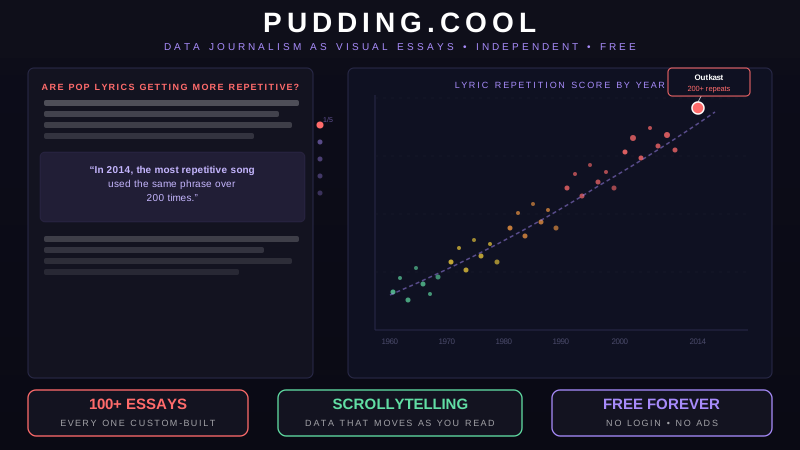
Most data journalism looks like this: a reporter has a finding, a designer drops it into a bar chart, the chart gets embedded in an article. You look at it for ten seconds and scroll past.
Pudding.cool does none of that. Every piece they publish is built from scratch — a fully custom interactive experience designed around the specific question they’re trying to answer. The visualization and the story are the same thing. You don’t read the article and look at the chart. You scroll, and the chart moves.
What “scrollytelling” means in practice:
The format is called scrollytelling, and Pudding has become one of its best practitioners. As you scroll down the page, the visualization updates to match where you are in the narrative. A sentence says “in 2014, the most repetitive song used the same phrase over 200 times” — and right as you read it, a single data point lights up on the chart. The data doesn’t illustrate the story. The data “is” the story.
Each article can take weeks to build. The team (small, independent, based in the US) calls themselves visual journalists, not writers or designers. The writing, the data work, and the code are all handled by the same people.
The pieces that made Pudding famous:
“Are Pop Lyrics Getting More Repetitive?” (2017) used data compression algorithms to measure the repetitiveness of Billboard hits going back to 1958. The answer: yes, dramatically, and the piece shows you exactly how and when. It went viral among musicians, linguists, and data nerds simultaneously — three different audiences, one article.
“Women’s Pockets Are Inferior” (2018) is exactly what it sounds like: a team physically measured the actual usable pocket dimensions of 80 pairs of pants across 20 brands and built a visualization comparing men’s and women’s pockets side by side. A mundane frustration, turned into data, turned into something people forwarded to everyone they knew.
“Film Dialogue From 2,000 Screenplays, Broken By Gender” analyzed who actually speaks in Hollywood films — broken down by year, genre, and Bechdel test score. Not an opinion piece about representation. An actual count.
“The Largest Vocabulary in Hip Hop” ranked rappers by unique word count across their lyrics, then let you explore where each artist sits relative to Shakespeare. Interactive, searchable, shareable, and genuinely interesting if you’ve ever argued about who’s lyrically the most gifted.
The through-line: they find a question that sounds like a bar argument, gather the actual data, and build something that lets the data answer it.
How it’s different from #023 (Our World in Data):
Our World in Data (#023 in this archive) is a research database — 1,000+ charts covering every long-run global trend, all downloadable, all shareable, all sourced from peer-reviewed research. It’s a tool you use when you need a specific chart.
Pudding is a publication. You go there to read something that makes you think differently about something small — pocket sizes, song lyrics, how screenwriters write women. The scope is narrower per piece, but the storytelling is richer. They’re doing different things.
The practical stuff:
Free. No login. No subscription. No ads in the articles themselves. Independent. The team has been publishing since around 2017 and has over a hundred pieces in the archive, all still live, all still interactive. The oldest ones hold up because they were custom-built — there’s no CMS template to go stale.
Why it’s a today-days-old moment:
There are a lot of websites with charts. There are very few that treat data as a medium for storytelling rather than as decoration for an article. Pudding is one of the best examples of what it looks like when visual journalists build the whole thing themselves — question, data, code, design, story — and refuse to separate any of those parts.
If you’ve never spent an afternoon just browsing their archive, you’re missing something that has no direct equivalent anywhere else on the web.
Go explore it at pudding.cool.