
I was today days old when I realized that “too close to call” and “not done counting” are two completely different things, and that this week we are mostly watching the second one. As of Thursday, Nov. 5, the 2026 midterms have been over for two days. NBC News reports Democrats have won majorities in both chambers, having flipped seven Senate seats; only the Mississippi and Alaska Senate races remain uncalled (NBC News). And yet the Mississippi Senate race is sitting at a margin that, depending on the outlet and the minute you refresh, was reported earlier this week as anywhere from 43 votes to 1,138 and, as of about 10 p.m. ET Thursday, is about 1,800 votes. Nobody has called it. Nobody can. An estimated 10,000 to 15,000 provisional ballots, plus late-arriving mail, haven’t been counted, and no amount of staring at the number changes that.
Source: AP figures as reported by NBC News, Yahoo News.
The thing I’d never really internalized is that none of this is the race being close in the usual sense. It’s the calendar being long.
What changed Thursday night
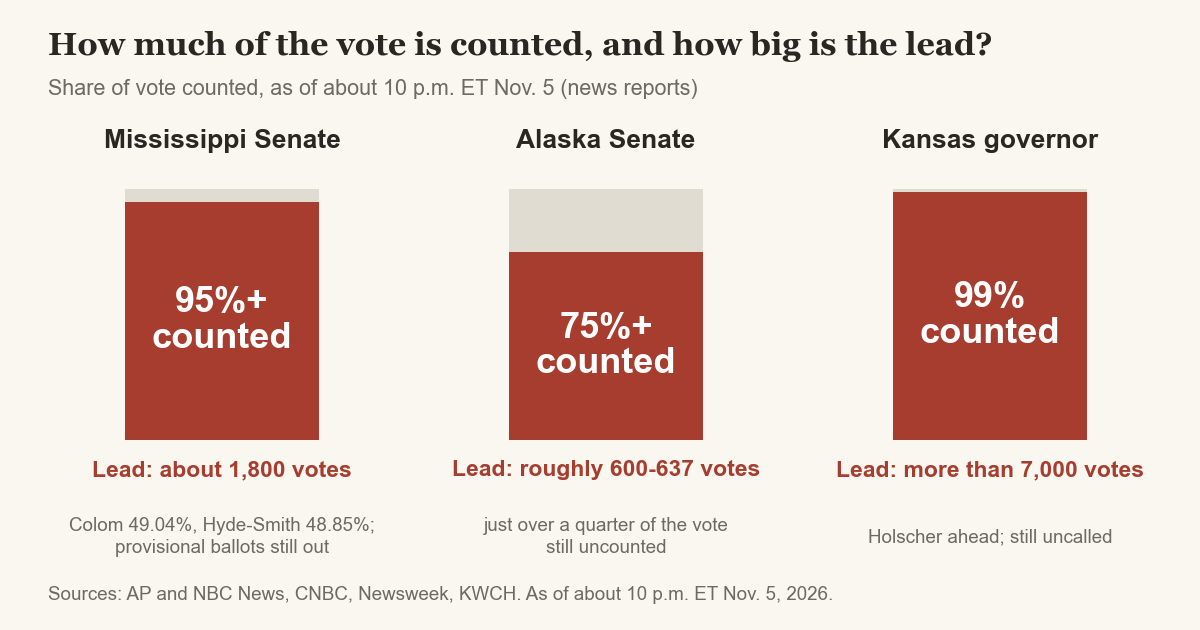
- Mississippi: Colom 49.04%, Hyde-Smith 48.85%, about 1,800 votes apart. Estimated outstanding: 10,000 to 15,000 provisional ballots plus late mail (a Republican-side estimate says about 20,000). Provisional voters have five business days to cure their ballots.
- Mississippi dispute: Hyde-Smith’s campaign sent letters to all 82 counties demanding provisional ballots be separated. Colom’s lawyers called the demand “unlawful and extraordinary.” A Colom win would be the first Mississippi Democratic Senate win since 1982. Sources: CNBC, TIME.
- Kansas governor: Holscher up by more than 7,000 votes with 99% counted, still uncalled. Holscher has declared victory and Masterson has not conceded. Kansas has a mandatory close-race audit, which is not a recount. Sources: NBC News, KWCH, FOX4.
- Alaska Senate: roughly 600 to 637 votes with just over 75% counted. Alaska uses ranked-choice voting, so the final result also depends on that tabulation. FairVote’s preliminary ranked-choice tally shows Sullivan ahead 51% to 49% after transfers, though FairVote says its figures do not match the state’s, so the outcome is unsettled (FairVote). A Justice Department lawsuit over a candidate who shares the name Dan Sullivan (about 1.7%) was dismissed and has been appealed. Source: Newsweek.
- House: NBC’s results page showed 249 Democratic, 158 Republican and 28 uncalled, with a projected final of 258 or 259 Democratic seats (time not shown by the source; Thursday night or Friday morning).
- Not re-checked in this update: California’s seven-day rule and the 38% figure, which is from a CBS report on past general elections, not 2026.
The rule: when does a vote count?
Every state has its own answer to a surprisingly basic question: if you mailed your ballot before Election Day but it lands in the county office after, does it count? About fourteen states and the District of Columbia say yes, within a grace period. The rest say no; it has to be in hand by the time polls close.
Source: Votebeat.
That grace-period group is the reason some states look “done” on election night and others look like they’re stalling. They aren’t stalling. They are legally required to wait for the mail. And it isn’t a trivial number of ballots: Votebeat found that more than 745,000 absentee ballots arrived after Election Day in 2024 across 11 of the 15 jurisdictions it analyzed. That’s a lot of envelopes, though in no state did they add up to more than roughly 3 percent of the vote. Enough to matter in a close race; not enough to matter in most races.
Source: Votebeat.
Three states, three clocks
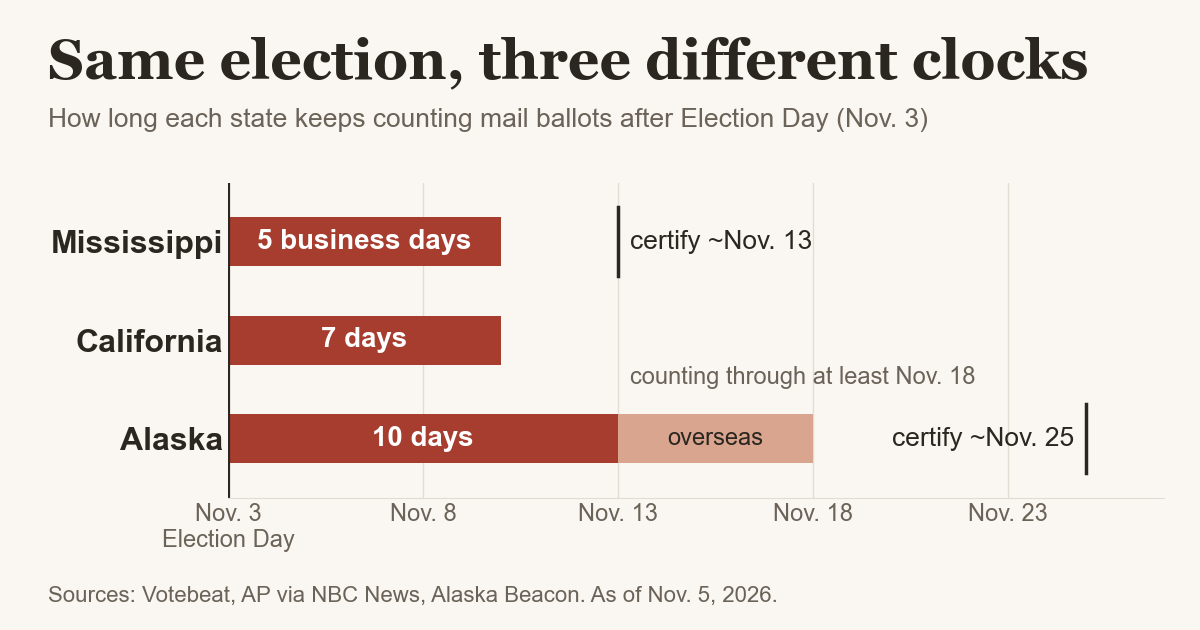
Mississippi is the closest. As of Thursday night, Democrat Scott Colom is narrowly ahead of Republican Sen. Cindy Hyde-Smith, 49.04% to 48.85%, a margin of about 1,800 votes, with more than 95% counted by AP’s estimate. (Earlier reports ranged from 43 votes to 1,138.) Independent Ty Pinkins has about 2.1%. Mississippi counts mail ballots postmarked by Election Day that arrive up to five business days later. Here’s the twist that surprised me: Mississippi has no automatic recount for close statewide races. If somebody wants one, they’ll need a court order. Certification is due around Nov. 13.
Source: AP figures as reported by NBC News, NBC Chicago, Yahoo News.
Alaska is on an even longer clock. Democrat Mary Peltola leads Republican Sen. Dan Sullivan by roughly 600 to 637 votes, depending on the outlet, with just over 75% counted, which is a different situation entirely: about a quarter of the vote hasn’t been tallied yet. Per Alaska election officials’ reporting, mailed absentee ballots count if postmarked by Election Day and received within 10 days domestically (Nov. 13) or 15 days from overseas (Nov. 18), so counting continues until at least Nov. 18, and the state aims to certify around Nov. 25. The Nov. 18 overseas date and the Nov. 25 certification target are reported, not confirmed against the Alaska Division of Elections; news reports support the postmark-by-Election-Day rule and receipt within 10 days (Nov. 13). FairVote’s preliminary ranked-choice tally (FairVote) shows Sullivan ahead 51% to 49% after transfers, a different picture from the first-choice margin, and FairVote says its figures do not match the state’s, so the outcome is unsettled. The race may well still be uncalled when you’re eating Thanksgiving leftovers.
Source: AP figures as reported by NBC News, Alaska Beacon.
California is the slow one by design. The state mails a ballot to every registered voter and counts any postmarked by Election Day that arrive within seven days. Since everyone has a ballot, officials genuinely cannot know how many are still in transit. A CBS report on past general elections (not this one) put the share of California’s vote tabulated after Election Day at an average of 38% over five recent cycles. That’s why several California House races are still open, and why AP’s House tally as of 5 a.m. ET Thursday stood at Democrats 240, Republicans 147, with 48 seats still to be called. NBC News’s results page, checked Thursday night or Friday morning (the page does not show a time), listed 249 Democratic seats, 158 Republican and 28 uncalled, with a projected final of 258 or 259 Democratic seats.
Source: AP figures as reported by NBC News, ABC7, PBS NewsHour.
One more California wrinkle worth saying plainly. The late-counted ballots there have tended to lean Democratic, because Republicans more often vote in person or return mail ballots early, and those get counted first. So a Republican lead on election night that shrinks over the following week isn’t evidence of anything sinister. It’s the order the envelopes get opened in. The effect is timing, not fraud.
Source: NBC News, ABC7, PBS NewsHour.
Meanwhile the Kansas governor’s race had Democrat Cindy Holscher ahead of Republican Ty Masterson by 0.51 points with about 98% counted on Thursday morning. By Thursday night, Holscher was up by more than 7,000 votes with 99% counted, still uncalled, which is the kind of margin that makes everyone very interested in how many ballots are actually left.
Source: AP figures as reported by NBC News, Yahoo News.
What the Supreme Court said in June
Those grace periods nearly didn’t make it to this election. In Watson v. Republican National Committee, decided June 29, 2026, the Supreme Court ruled 5-4 that nothing in federal law prevents states from counting absentee ballots that arrive after Election Day, as long as they were cast and mailed by Election Day. The case was specifically about Mississippi’s five-business-day window, the same one at the center of this week’s Senate count. Justice Amy Coney Barrett wrote the majority opinion, joined by Chief Justice Roberts and Justices Jackson, Kagan, and Sotomayor. Her line: “The electorate’s choice is made when voting is complete, not when ballots are received.”
Source: Votebeat.
The dissent, from Justice Alito, warned that the ruling “creates a serious risk of further undermining public confidence in our elections and our system of self-government.” RNC chair Joe Gruters said Democrats are “inviting chaos at the ballot box” and that the RNC will keep fighting for elections to end on Election Day. Mississippi Attorney General Lynn Fitch urged the state legislature to end the grace period. So the law is settled for now; the politics are not.
Source: Votebeat.
I’ll note what I’m leaving out: a 2022 Brennan Center analysis described which states let officials pre-process mail ballots before Election Day and which make them wait, which is the other big reason some states report fast. Those rules change, and I haven’t verified the 2026 version for any specific state, so check your own state’s rules rather than taking my word.
How to read “not called yet”
Two numbers tell you almost everything. First, how many ballots are still outstanding, or at least how much of the vote is counted. Second, the margin. Mississippi at more than 95% counted with a margin around 1,800 is a tight race with a meaningful pile of provisional ballots left. Alaska at just over 75% counted with a margin of roughly 600 is barely a race yet; there’s too much uncounted to say anything. California at “we don’t know how many ballots exist” is just California.
If the outstanding ballots can’t mathematically flip the margin, the race gets called. If they can, it doesn’t, and everybody waits for the mail. That’s the whole system. It isn’t a bug, and it isn’t a plot. It’s a calendar.
So the next time a race is still open on Friday, or the Friday after that, I’m going to resist the urge to read anything into it. The voters finished on Tuesday. The post office and the county clerks are just now catching up.