I was today days old when I realized the app I built in 1998 — a spinning globe you could click to hear live radio from any city on Earth — finally exists at web scale, for free, for everyone.
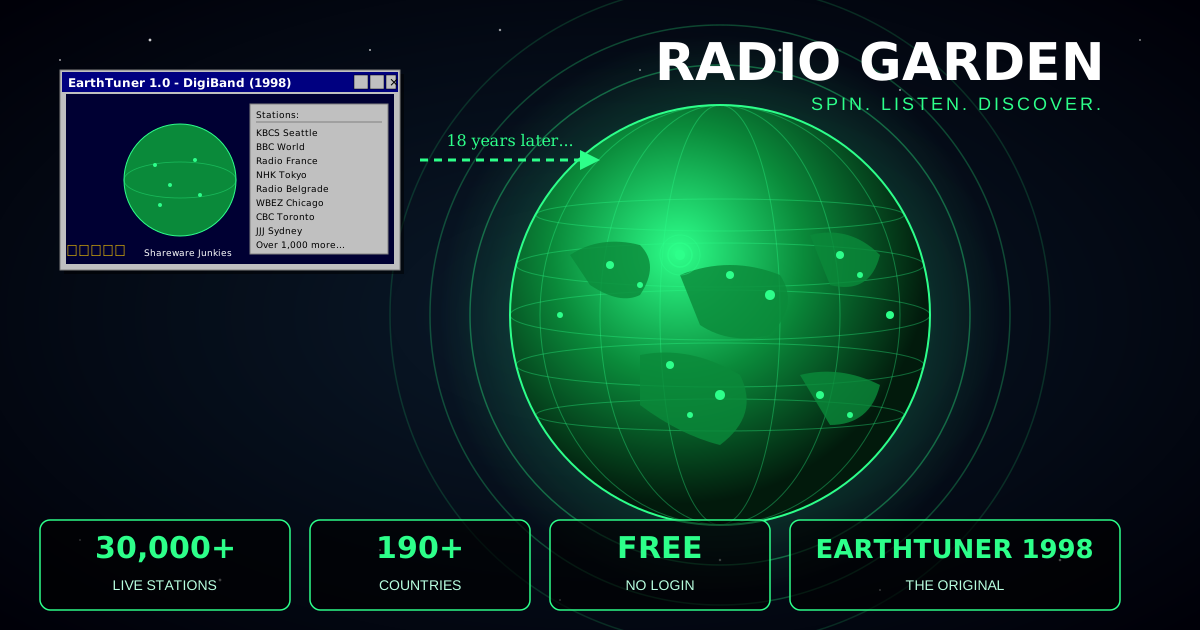
Quick personal backstory. In 1998, I released a Windows shareware app called EarthTuner under my company DigiBand. The pitch: an animated globe interface. Dots for radio stations around the world. Click a dot, hear that station stream live. Over a thousand stations, browsable by geography instead of by genre or by name. It used RealAudio (this was 1998; we used what we had). Shareware Junkies reviewed it and gave it 5/5 stars across the board — performance, user-friendliness, cost, installation, support. It sold for $29.95 with a 15-day trial, which was the going shareware rate at the time.
It was a small hit in the shareware world. It was also about eighteen years ahead of the infrastructure.
In 2016, a team at the Dutch public broadcaster NPO/VPRO launched Radio Garden. Spinning 3D globe. Glowing green dots for every broadcasting station on Earth. Click one. Hear it. Free. No login. Works in any browser. My app was the proof of concept, built with 1998 tech and about $0 of budget. Radio Garden is the fully realized version, built with WebGL and the modern internet and a team that could actually scale it.
I have no affiliation with Radio Garden. I don't know the team. I just think they built exactly the thing I wanted to build, and they built it better than I ever could have with 1998 tooling, and I'm genuinely delighted every time I open it.
What Radio Garden actually is:
- 30,000+ live radio stations across 190+ countries, all on one interactive 3D globe.
- Every glowing green dot is a city with at least one station broadcasting. Zoom in, the dots resolve into neighborhoods. Zoom out, the whole world pulses.
- Click the dot, the stream starts. No login, no signup, no paywall. You don't even have to know what you're looking for.
- Search is there if you want it — by station name, by city, by country — but the fun is spinning the globe blind and landing somewhere you've never been.
- Mobile apps exist too (iOS and Android), and they work well. The web version is still the canonical one.
What it's like to use. It's disorienting in the best way. Tokyo morning-commute DJs. Reykjavik jazz at midnight. Nigerian gospel stations. Brazilian funk. Rural Idaho country. Bavarian oompah. Radio is still happening, everywhere, all the time, in every language, with local DJs talking about local weather and local traffic and local elections — and Radio Garden is the one place where all of that is browsable at once, just by pointing at the map.
That was always the point of EarthTuner, too. The thing I couldn't have articulated in 1998 was: radio is fundamentally a place-based medium. Every station is someone in a room, in a city, talking to the people around them. When you browse by genre, you flatten all of that out. When you browse by geography, you get the place back. Radio Garden is geography-first radio, at global scale, running in your browser.
The tech: Radio Garden uses WebGL for the 3D globe. It's maintained by a small Dutch team with support from cultural-heritage funding. The core experience is free and ad-light. It runs on basically any modern browser.
Why this one matters: Radio Garden is what the internet is supposed to feel like. Something that makes the world feel smaller and stranger and more alive than it did before you opened the tab. It's one of those rare things you can show anyone — a kid, a grandparent, someone who hates technology — and they'll immediately get it, and immediately want to click on Reykjavik.
Go do this now: open radio.garden. Spin the globe. Pick a random continent. Pick a random glowing dot on that continent. Listen for five minutes. That's all it takes.
EarthTuner, wherever it lives on an archived CD-ROM somewhere, says hello.