I was today days old when I learned there's a puzzle game where one wrong move collapses your entire attempt — and the whole world solves the same puzzle every day.
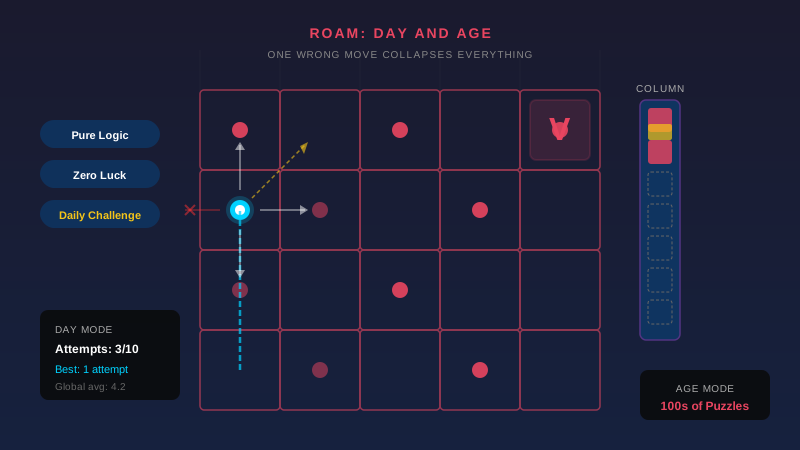
It's called Roam: Day and Age, by a small studio called Odonata Interactive, and it's one of those games that looks deceptively simple until you're five moves in and realize you've already lost. No luck. No randomness. No "close enough." Either your logic is perfect, or the whole thing falls apart.
Here's how it works:
- You start with four directions: up, down, left, right. That's it. Your goal is to reach the Victory marker (V) on the board. Along the way, you collect dots — but you don't need all of them, only the ones that open the path you need. Every move you make fills a square on a "Column" tracker based on which direction you moved. Fill two adjacent squares on the Column and something interesting happens: a new square appears between them, unlocking diagonal movement in that direction. The game is about figuring out which dots to collect, in which order, to unlock the moves you need to reach V.
- Zero partial credit. Make one wrong move — collect the wrong dot, move in the wrong direction, take a path that locks you out of a future move — and the puzzle collapses. You start over. There's no undo button, no hint system, no "you were 90% right." It's binary: solved or not. This sounds frustrating until you realize it's what makes the game addictive. Every failed attempt teaches you something about the logic of the board.
- Age Mode: hundreds of handcrafted puzzles. This is the main campaign. The puzzles start simple enough — four directions, a few dots, a short path to V. But the difficulty ramps steadily. New movement types unlock as you progress. Boards get bigger. The number of valid paths shrinks while the number of ways to trap yourself multiplies. By the later levels, you're planning six or seven moves ahead and holding the entire decision tree in your head.
- Day Mode: the daily global challenge. This is where it gets really interesting. After you complete Age level XVI, Day Mode unlocks. Every day, every player in the world gets the same puzzle. You compete on fewest attempts and fastest solve time. You get 2 extra attempts per day (max 10 stockpiled). When you finish, you can share your results and see global stats — just like Wordle's daily mechanic, but for a spatial logic puzzle instead of a word game.
- Free on iPhone and Android. No subscription, no energy system, no "watch an ad to continue." Just download it from the App Store or Google Play and start solving.
What makes Roam different from the ocean of mobile puzzle games is the purity of it. There are no power-ups to buy, no lives to refill, no mechanics designed to frustrate you into spending money. The puzzles are handcrafted, not procedurally generated, which means every single one has been designed to have a specific logical solution. The game respects your intelligence — it assumes you can figure it out, and it doesn't hold your hand while you do.
The Day Mode is the killer feature. There's something satisfying about knowing that thousands of other people are staring at the exact same board you are, making the same mistakes, having the same "wait, what if I..." moments. If you got hooked on Wordle's daily ritual — one puzzle, same for everyone, compare your results — Roam's Day Mode scratches that same itch, but for the part of your brain that thinks spatially instead of verbally.
The "today days old" moment here is that this has been quietly sitting on the App Store and Play Store, made by a tiny indie studio, and it's legitimately one of the best-designed puzzle games I've seen on mobile. No marketing budget, no viral TikTok moment, just a really well-made game that rewards you for thinking clearly.
Download it: App Store (iPhone) · Google Play (Android)
Learn how to play: Odonata Interactive