
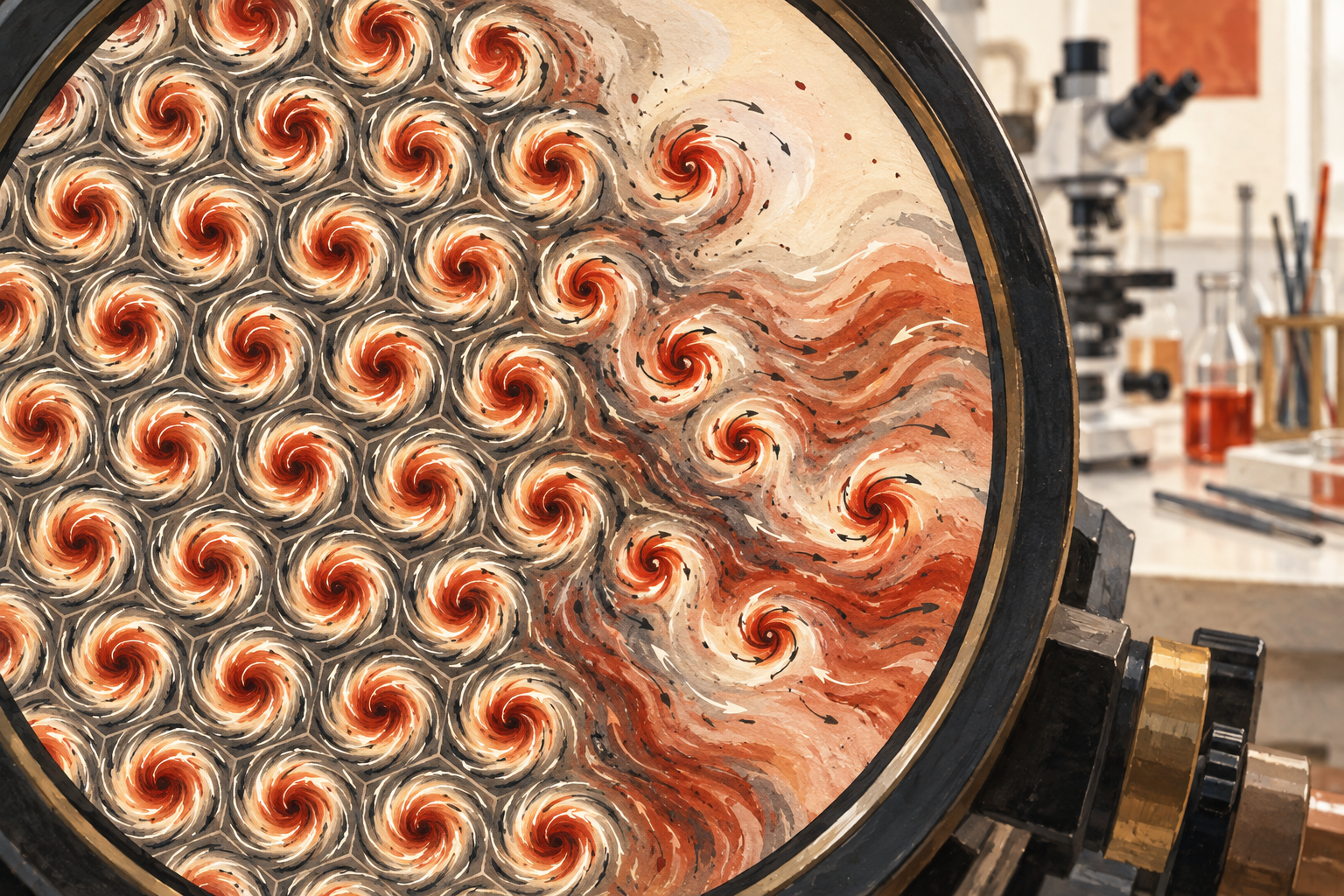
I was today days old when I learned that magnets can have weather. Not literally, but close: inside certain ultra-thin magnetic films, the magnetization can twist itself into tiny, stable whirlpools called skyrmions, and under the right conditions those whirlpools pack themselves into a neat, repeating grid, the way atoms line up in a crystal. On October 26, 2026, a team led by the Norwegian University of Science and Technology, with Johannes Gutenberg-Universität Mainz and Singulus Technologies AG, announced they had filmed that grid melting — individual skyrmions breaking loose from their assigned spots — in real time, for the first time ever. Previous work could only infer that this happens. Now there is footage. Source: ScienceDaily, Nature Nanotechnology.
First, What a Skyrmion Actually Is
Picture the magnetization in a thin magnetic film as a field of tiny compass needles. Normally they all point the same way, or settle into large regions called domains that each point one way. A skyrmion is a knot in that field: a small, swirling vortex where the needles twist around a center point in a pattern that, once formed, is surprisingly hard to untangle. That stability is the whole appeal. Each skyrmion can stand in for a bit of information, and because they're far smaller than the magnetic domains today's hard drives use, and take far less energy to nudge around, they've been a serious candidate for next-generation memory and logic for years. Source: ScienceDaily.
Watching a Crystal Melt — a Magnetic One
When enough skyrmions crowd together under the right conditions, they stop behaving like loners and arrange into a skyrmion lattice, an orderly repeating pattern directly analogous to a crystal. The team used a technique called dynamic Kerr microscopy, which reads magnetization off a surface by the way it subtly rotates the polarization of reflected light, to watch that lattice as it came apart. On video, you can see skyrmions leaving their grid positions and the orderly pattern dissolving into a disordered, liquid-like state. It's the magnetic equivalent of watching ice turn into water, except the "molecules" are whirlpools of magnetization and the ice is a few atoms thick. Source: ScienceDaily, Nature Nanotechnology.
The Twist: It Melts in Two Steps, Not One
Here's the part physicists will care about most. The melting wasn't a clean jump from solid lattice to disordered liquid. In between, the skyrmions passed through an intermediate “hexatic” phase: a state where the skyrmions have come unglued from their fixed positions, but their arrangement still keeps a kind of directional orientation, like a crowd that's stopped standing in rows but is still mostly facing the same way. This solid-to-hexatic-to-liquid sequence is a two-step melting process that shows up in some two-dimensional physical systems more broadly, and it had been expected for skyrmions too — but this is the first time it's been confirmed directly, by watching it, rather than deduced from indirect measurements. Source: ScienceDaily, Nature Nanotechnology.
They Could Also Steer the Skyrmions While Filming
The result that turns this from a nice physics observation into an engineering foothold is what the researchers could do while the camera was rolling. By tuning parameters like the skyrmion size and the system's effective temperature, they could change the shape and size of individual skyrmions on the fly, in real time, while watching the result. That's the difference between studying a material and controlling one. Source: ScienceDaily.
Why This Matters for Brain-Like Computers
Neuromorphic chips, the ones designed to work more like a brain than a conventional processor, need components that can hold a state, shift it, and interact with their neighbors the way neurons and synapses do. Skyrmions have long looked like a plausible building block for that, because they're small, stable, cheap to move, and naturally interact with one another. The catch has been that nobody could watch how they order, disorder, and influence each other directly, so device designs were, to some degree, built blind. Being able to film the lattice forming and melting, and adjust individual skyrmions while doing it, gives researchers a real-time handle on exactly the behaviors a skyrmion-based memory or logic device would depend on. Source: ScienceDaily.
The Honest Version
Nobody is shipping a skyrmion chip next year. What the team has is a measurement technique, a confirmed two-step phase transition, and a demonstration that skyrmions can be tuned live under the microscope. That's foundational work, the kind that makes a future device possible to design rather than the device itself. The headline is "could help" for a reason. But "we can finally see what the bits are doing" is a bigger deal than it sounds, and it's the sort of milestone that tends to show up in the first paragraph of the papers that come after it. Source: ScienceDaily.