I was today days old when I learned that the next total solar eclipse is only nine days away — and that its path of totality barely touches land at all, tracing a narrow, roughly 5,130-mile arc across a remote stretch of Siberian Russia, eastern Greenland, the west coast of Iceland, and northern Spain and Portugal before running out of daylight over the Atlantic. It happens on August 12, 2026. Source: NASA.
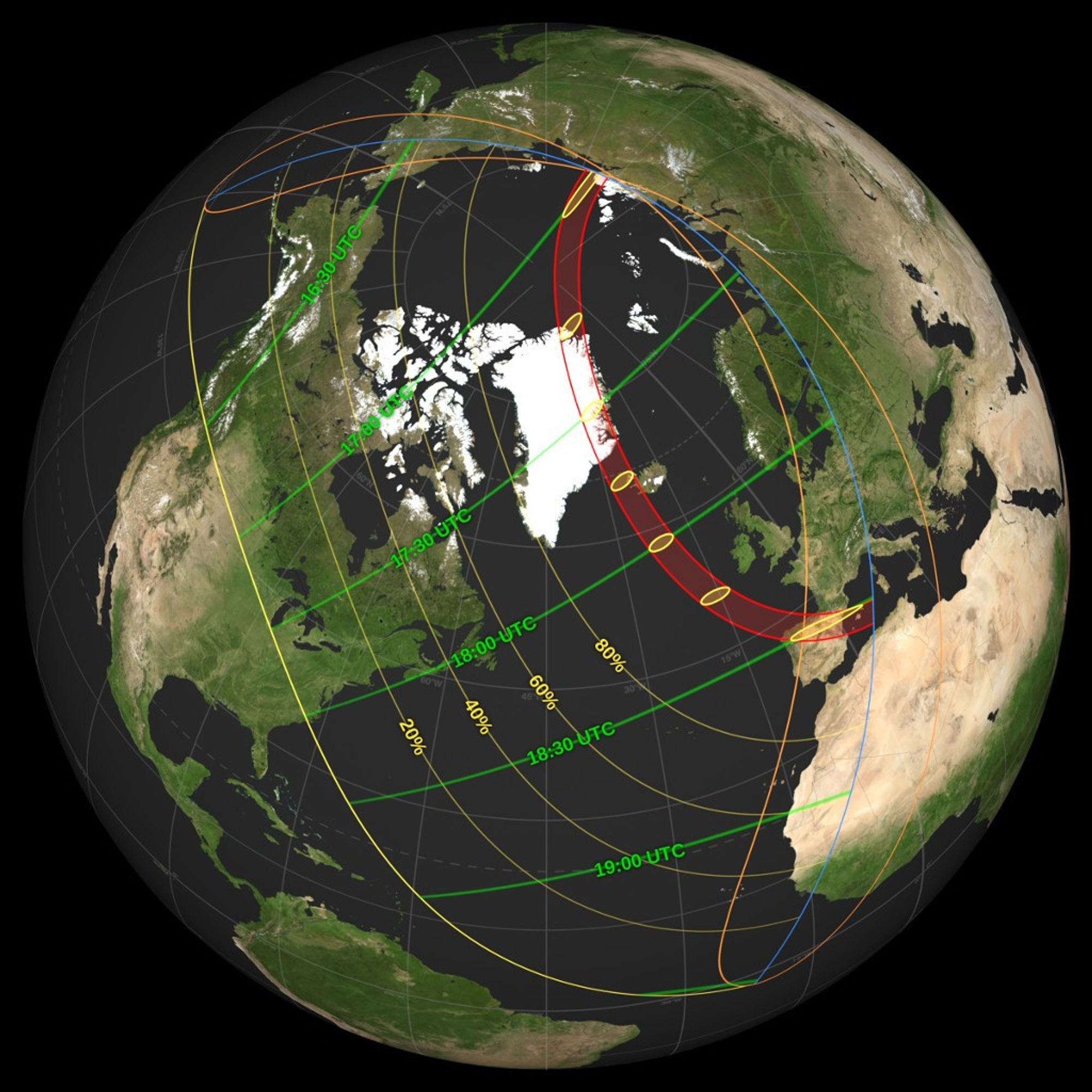
Where the Path Actually Goes
The Moon's shadow first touches down over a remote part of Siberian Russia, then arcs northwest across eastern Greenland, clips the west coast of Iceland, and finally crosses into northern Spain and Portugal just before local sunset — almost the entire path passes over open ocean or sparsely populated ground, which is part of why this one isn't shaping up to be a mass-tourism event on the scale of 2017 or 2024's US eclipses. Sources: National Eclipse, timeanddate.com.
The Timing Is All Over the Map (Literally)
Because the path runs west to east across so many time zones, the local experience of the eclipse varies wildly depending on where you're standing. It's the middle of the day in the remote part of Russia where the Moon's shadow first makes landfall, late afternoon to early evening by the time it reaches Greenland and Iceland, and shortly before sunset when it finally crosses into Spain and Portugal. Start to finish, the umbra takes roughly an hour and a half to race the full 5,130-mile (8,260 km) path. Source: timeanddate.com.
2 Minutes 18 Seconds, Peaking Over the Atlantic
Maximum totality on this eclipse is 2 minutes 18 seconds, and the single point of peak duration falls off Iceland's west coast — mostly over open Atlantic water, not over any city or even much land. That's short by eclipse standards (2017's "Great American Eclipse" peaked at 2 minutes 40 seconds, and some eclipses run well past 4 minutes), but still enough for a full, unmistakable totality experience for anyone who gets under the path. Source: NASA.
A Much Wider Partial View
You don't have to be inside the narrow path of totality to see something. A wide partial eclipse will be visible across most of the Northern Hemisphere well beyond that path — NASA's own reach map puts the partial view across the eastern US (from Alaska to North Carolina), most of Canada, much of Europe, and northwestern Africa. It won't look like the total blackout the path-of-totality crowd gets, but with proper eclipse glasses it's a real, visible bite taken out of the Sun for a huge share of the hemisphere. Source: NASA.
What to Watch For
This posts nine days ahead of the actual eclipse, so consider it the "here's what to watch for and where" version rather than the recap. If you're anywhere near the path — Iceland and northern Spain are the two most reachable, land-based options — August 12 is the day to have plans. If you're in the much larger partial-view zone, including most of the eastern US and Canada, keep eclipse glasses handy and check your local circumstances against NASA's and timeanddate.com's interactive maps for exact local timing. Sources: NASA, National Eclipse, timeanddate.com.