I was today days old when I learned there’s a free in-browser planetarium that shows the exact night sky for any location on Earth at any date in history — or any date you want in the future. No install. No login. And the brain behind it has been quietly maintained as open-source software since 2001.
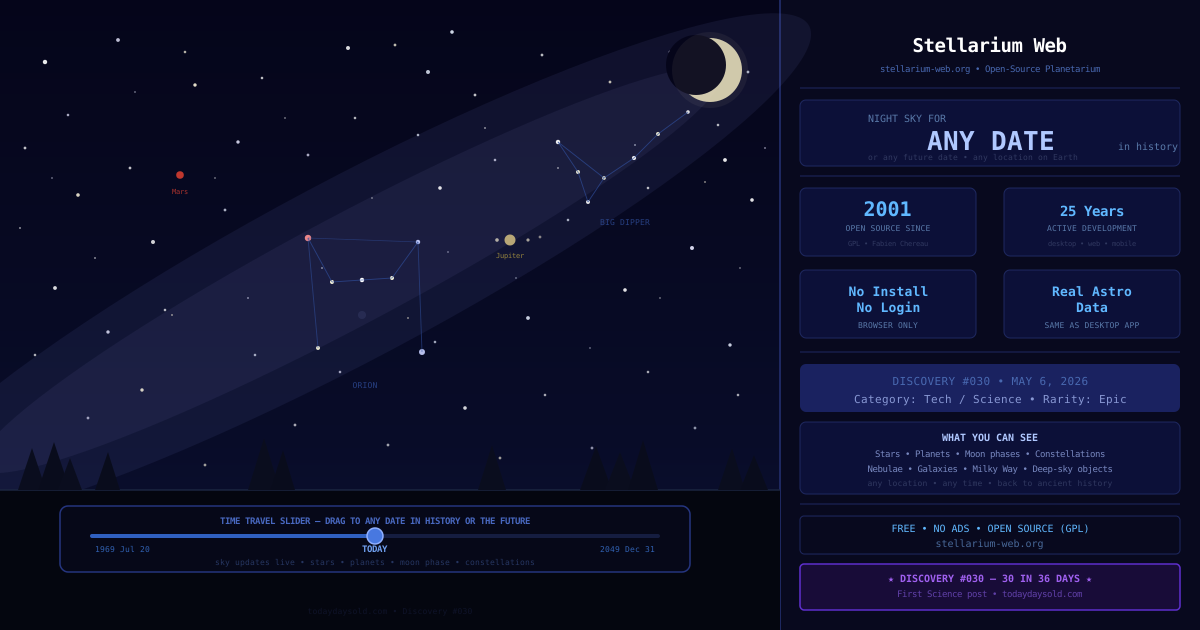
Open the site. Allow location (or just type your city). Now drag the time slider.
The sky overhead recomputes in real time. You can see the exact star positions on the night of your birthday — any year. Drag back to July 20, 1969 and see the sky over the Sea of Tranquility the moment Neil Armstrong stepped onto the moon. Drag forward to March 2029 and watch Venus and Jupiter nearly overlap on the western horizon just after sunset. The solar system doesn’t care what year your phone thinks it is.
What it shows on screen:
The full realistic night sky: stars with their proper motions, the moon at its correct phase for the date, planets in their actual positions — Mercury, Venus, Mars, Jupiter, Saturn, Uranus, Neptune — each labeled and individually clickable for stats and orbital data. Constellation outlines are toggleable; turn them on if you’re learning, off if you want the raw sky. Deep-sky objects: the Andromeda Galaxy, the Orion Nebula, the Pleiades. The Milky Way as a soft diagonal glow across the sky, not a painted flat texture. Realistic twilight gradients around sunrise and sunset, and light pollution simulation if you want to compare a clear rural sky to the washed-out view from a city.
It’s the kind of thing where you open it to check one fact and end up forty minutes later watching the Egyptian star-clock constellation Sahu rise over Giza at 2600 BCE.
Who built it:
Stellarium started in 2001 as a personal project by Fabien Chereau, a French programmer and astronomer. He open-sourced it under the GPL. By the mid-2000s it was being used in college astronomy courses and actual planetarium projector systems worldwide. The desktop version — free for Windows, macOS, and Linux — is still what astronomy students use. Stellarium Web (this site) is the browser port, maintained by Stellarium Labs, run by Fabien and his brother Guillaume Chereau. Same astronomical data engine, same rendering, delivered in a browser tab.
Mobile apps exist too: Stellarium Mobile on iOS and Android has a free tier. The web version is in active beta — there are occasional rendering quirks on older browsers — but on modern desktop and mobile browsers it loads and runs cleanly.
What it’s not:
It’s not a “point your phone at the sky and identify that star” app. That’s Sky Map, Star Walk, or Skyview — those are optimized for real-time AR overlays. Stellarium Web is built for sitting down and actually exploring the sky, especially across time. If you want the phone camera overlay, use one of those. If you want to know what the sky looked like over Rome on the night Julius Caesar was assassinated, or where to look for the next bright meteor shower, this is the right tool.
Why it’s a today-days-old moment:
Twenty-five years of open-source astronomy software, accessible for free in a browser tab, and most people have never heard of it. The time-slider is one of the more genuinely mind-bending interactive features on the internet — pull it back a few thousand years and watch the stars slowly drift as Earth’s axial precession shifts the sky, pull it forward and plan the next eclipse you want to drive to see. This is also discovery #030, the first one with a Science category. Thirty posts in thirty-six days, and we finally get to the category that’s been sitting there waiting since day one.
Open it at stellarium-web.org.