I was today days old when I learned there's a free, interactive map of every undersea fiber optic cable that carries the global internet — and once you've seen it, you can't un-see it.
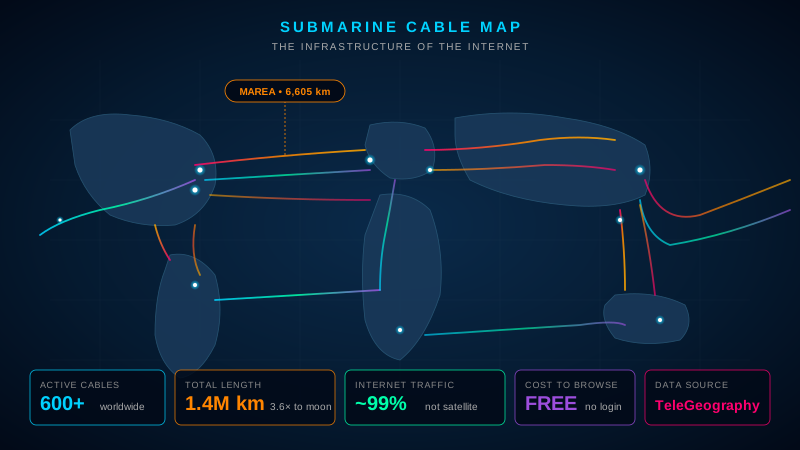
It's called Submarine Cable Map, made by the telecom research firm TeleGeography. Open it up and you're looking at the actual physical wires that make the internet work. Every cable. Every route. Every cable landing station where the wire crawls out of the ocean and plugs into a building.
Here's what blew my mind:
- Roughly 99% of intercontinental internet traffic runs through these cables. Not satellites. Not 5G. Wires. When you load a website hosted in another country, the request travels as light pulses down a glass thread roughly the thickness of a garden hose, sitting on the floor of an ocean. Satellite internet (yes, including the modern stuff) handles the tiny remaining sliver.
- There are 600+ active cables totaling around 1.4 million kilometers. That's roughly 3.6 trips to the moon, laid out along the ocean floor. The map shows every single one as a colored line connecting continents, with little glowing dots marking the cable landing stations on each end. You can click any cable to see its name, length, owners, and the year it went into service.
- The cables have great names. 2Africa. MAREA. Curie. Dunant. Faster. Hawaiki Nui. Each cable is a multi-year, multi-billion-dollar engineering project, usually owned by a consortium of telecom companies (and increasingly, by Google, Meta, Amazon, and Microsoft, who now own or lease enormous chunks of the global internet backbone). The map lets you filter by owner, which is a fascinating rabbit hole.
- Cable landing stations are real, vulnerable buildings. They're often in unassuming little towns — Bude in Cornwall, Virginia Beach, Sesimbra in Portugal — where the cables come ashore and connect to the terrestrial network. The map highlights each one. Some towns are landing points for half a dozen major cables; cut them and you'd cripple a chunk of the global web.
- It's all free, no account, runs in your browser. Pan, zoom, click, filter. There's no premium tier you're being upsold to. TeleGeography sells expensive enterprise telecom data to carriers and governments; the public map is essentially their gift to the curious.
The thing the map captures, that text descriptions never quite do, is just how physical the internet is. We talk about "the cloud" and "wireless" and "the network" like the internet is some abstract thing floating in the ether. It's not. It's a finite, mappable, human-built grid of cables on the seabed, designed and installed by ships that quite literally drag thousands of kilometers of wire across the bottom of the Atlantic.
And once you see the map, you start noticing geography in a new way. Why does so much of South America's traffic still route through Miami? (Because that's where the cables land.) Why is a big new cable from Europe to India a geopolitical event? (Because it changes who controls the data flow between two continents.) Why was the Red Sea cable damage in 2024 such a big story? (Because four major cables got cut at once, and a noticeable chunk of Asia-to-Europe internet traffic had to reroute around Africa.)
If you've enjoyed our other "infrastructure of the internet" curiosities — like Windy.com (#009), which shows the actual physical atmosphere as data — this is the same kind of "wait, that's how it really works?" moment, but for the network itself.
Explore it: submarinecablemap.com