I was today days old when I learned there’s a free live map showing every oil tanker on Earth — and right now you can watch what happens to a major shipping lane when conflict breaks out near the Strait of Hormuz.
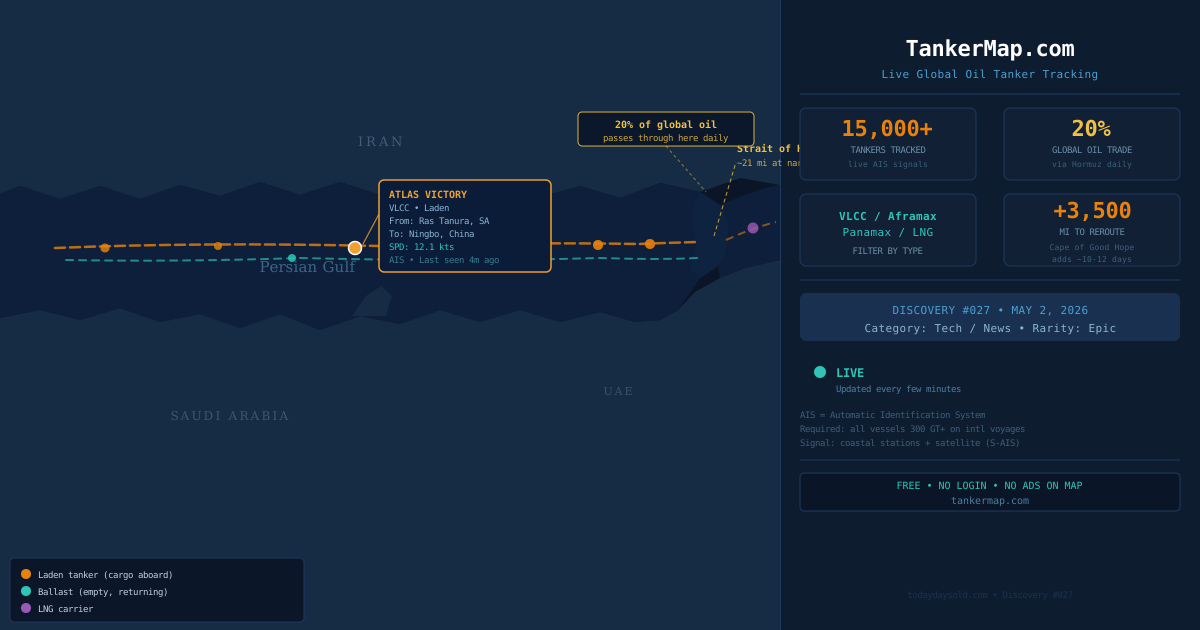
TankerMap is a live AIS (Automatic Identification System) tracking platform for the global tanker fleet. Every vessel carrying crude oil, LNG, LPG, or refined petroleum products that’s broadcasting its position appears on the map — orange for laden (cargo aboard), teal for ballast (returning empty). Click any dot and you get the vessel name, flag state, cargo type, origin, destination, ETA, speed, and heading.
How it works:
AIS is a mandatory broadcast signal. Any vessel over 300 gross tons on an international voyage is required by international maritime law to continuously transmit its identity, position, speed, and heading. TankerMap aggregates these signals from a global network of coastal receivers and satellites to build a near-real-time picture of where every tracked tanker is on Earth. “Near-real-time” because satellite AIS polling has a small lag — some vessels update every few minutes, others less frequently — and some vessels in contested waters deliberately turn off their transponders. When a dot disappears, that’s usually why.
The Strait of Hormuz, right now:
The Strait of Hormuz is roughly 21 miles wide at its narrowest navigable point. Approximately 20% of the world’s total traded oil and around 20% of global LNG passes through it every day. It is, in terms of energy infrastructure, the single most consequential chokepoint on the planet.
When there’s sustained military tension in the region, shipping companies have to make a hard call: transit the Strait and accept the risk, or reroute around the Cape of Good Hope — adding roughly 3,500 miles and 10–12 days to the voyage. Right now, on TankerMap, you can watch those decisions play out. Which routes are quieter than usual. Which anchorages near the Strait are unusually busy. Where laden VLCCs are clustering or dispersing. The map makes the global oil supply chain legible in a way that commodity price tickers alone never do.
What the filters let you do:
TankerMap isn’t just a dot map. You can filter by vessel type: VLCC (Very Large Crude Carriers, 200,000+ deadweight tons), Aframax (80,000–120,000 DWT), Panamax, Suezmax, LNG carriers, LPG carriers, and product tankers. You can filter by region, zoom into any port, and pull up voyage history for individual ships. If you want to know how many laden VLCCs are currently queued near a Saudi export terminal or how many product tankers are transiting the Red Sea, you can find out in about thirty seconds.
How this is different from Flightradar24 (#021):
Flightradar24 is about individual aircraft — you use it to track a specific flight or watch a specific incident unfold in the sky. TankerMap is about patterns. The interesting thing isn’t any single tanker; it’s the aggregate movement. Are laden VLCCs still transiting the Strait on their normal schedule? Are more ships taking the long southern route? Is there an unusual cluster of vessels at anchor in the Gulf of Oman, waiting for conditions to change? Those are questions about logistics and risk, not about one vessel, and TankerMap is the tool that answers them.
The practical stuff:
Free, no login required. The live global map is fully accessible without an account. TankerMap also offers a paid tier for commercial users with historical voyage data, port analytics, and fleet tracking tools, but the live map — which is the reason to visit — is completely free. No ads on the map itself.
Why it’s a today-days-old moment:
There are a lot of things happening in the world right now that involve oil prices, shipping costs, and the physical infrastructure that moves energy from where it’s produced to where it’s consumed. TankerMap is the free tool that lets you watch that infrastructure move in real time. It’s one of those sites that looks like a geography toy until you realize you’re looking at the supply chain that heats homes, fuels planes, and sets the price at the pump.
If you’ve been watching oil market news and want to see what the physical impact looks like on the water — this is it.
Go explore it at tankermap.com.