
I was today days old when I wondered how long it would take before an AI’s answer started getting quietly shaped by an advertiser — and then found out the question is already behind the news. It didn’t happen quietly, either. It happened loud, in public, with disclosure, inside the first seven weeks of 2026. OpenAI announced on January 16, 2026 that it would test ads in ChatGPT, and officially rolled them out on February 9. Nine days after that rollout went live, Perplexity — a company whose entire pitch is being an ‘answer engine’ — announced it was walking away from advertising entirely. Same week, Anthropic went further still, publicly pledging Claude would never carry ads at all. Three companies, one window of time, three different answers to the same underlying question: can a company that answers questions for a living sell ad space next to the answer without the answer itself becoming suspect?
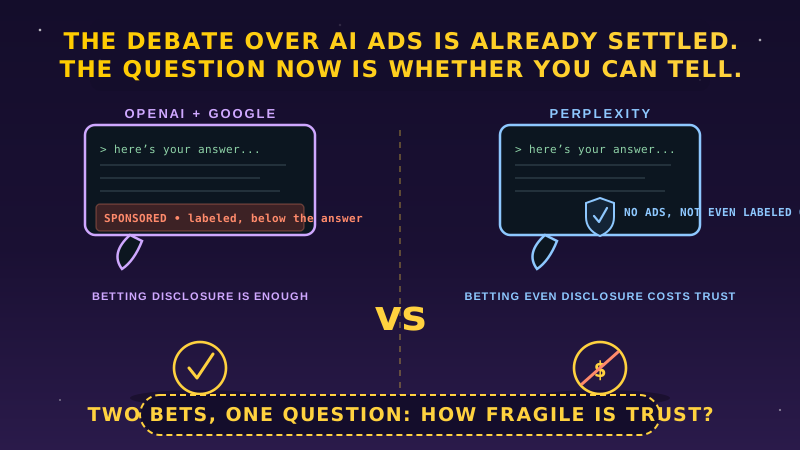
OpenAI’s bet: disclosure is enough.
OpenAI’s ads show up for Free and Go-tier ChatGPT users, labeled ‘sponsored’ and placed at the bottom of a response rather than woven into it. Per OpenAI’s own help-center documentation, the ads don’t influence what the model actually writes, exclude sensitive categories, and conversations are not sold to advertisers; users can opt out of ad personalization, and Plus, Pro, Business, Enterprise, and Edu subscribers see no ads at all. OpenAI frames the whole rollout around five stated principles: mission alignment, answer independence, conversation privacy, user choice and control, and long-term value — explicitly not optimizing for how long someone stays engaged in a chat. Source: OpenAI Help Center, Ads in ChatGPT; Forbes, OpenAI Brings Ads to ChatGPT as Costs Mount, January 20, 2026; TechCrunch, ChatGPT Rolls Out Ads, February 9, 2026.
- Mission alignment — ads shouldn’t work against the point of the product
- Answer independence — sponsorship doesn’t change what the model tells you
- Conversation privacy — chats aren’t sold to advertisers
- User choice and control — personalization can be turned off, and paid tiers skip ads entirely
- Long-term value — not optimized for maximizing time spent in a chat
Google is running the same basic playbook at a much larger scale: ads labeled ‘Sponsored’ now appear inside AI Overviews and AI Mode, announced at Google Marketing Live 2026. Ads are already rolling out broadly across AI Overviews, and ChatGPT has reportedly seen fast advertiser adoption in the weeks since launch — though specific adoption percentages and dollar figures circulating about both rollouts traced back to secondary marketing blogs rather than a primary source, so they’re left out here rather than repeated unverified.
Perplexity’s bet: even a disclosed ad is too risky.
Perplexity had already been testing sponsored follow-up questions since late 2024 — a smaller, more contained ad format than what OpenAI just shipped. On February 18, 2026, it announced it was stopping altogether, walking away from advertising as a business line entirely in favor of subscriptions running $20 to $200 a month, plus enterprise sales. Per reporting from the Financial Times, company executives said the real risk wasn’t the ad itself — it was clearly labeled, after all — it was that even a disclosed ad risks making a user wonder whether a commercial incentive shaped the answer they just got. For a company whose entire product is supposed to be a trustworthy answer, that doubt was judged not worth the ad revenue. Source: Search Engine Land, Perplexity Stops Testing Advertising, February 18, 2026; Campaign, Perplexity Pulls the Plug on Ads, Citing Trust Concerns for AI.
Anthropic’s bet: never start at all.
Anthropic didn’t test ads and then walk them back like Perplexity — it never ran any in the first place, and on February 4, 2026, it made that a formal policy. In an essay titled ‘Claude is a space to think,’ Anthropic pledged Claude will stay ad-free, ruling out all three of the usual forms at once: no ‘sponsored’ links sitting next to a conversation, no advertiser influence over what Claude actually tells you, and no unsolicited third-party product placement. The company frames the pledge as necessary for Claude to act ‘unambiguously in our users’ interests’ as a ‘genuinely helpful assistant’ — language that draws a direct, unmissable contrast with the ad-supported model OpenAI had just announced weeks earlier. Anthropic backed the words with a jab, too: that same week it ran a Super Bowl commercial mocking ChatGPT’s ads, showing a man asking about his mother and getting an unwanted cougar-dating ad in return. It’s worth being precise about what the pledge actually is, though — a stated policy commitment Anthropic chose to make, not a structural or legal constraint it’s locked into, and one that’s easier to hold given Anthropic’s revenue already runs roughly 80% enterprise and API, not consumer ad-adjacent traffic. Source: Anthropic, Claude Is a Space to Think, February 4, 2026; MacRumors, Anthropic Pledges No Ads in Claude, February 4, 2026; The Register, Anthropic Rules Out Advertising in Claude, February 4, 2026.
The part that actually matters going forward:
Nobody is seriously debating anymore whether AI answers get monetized — that question is settled, and it’s happening right now, in the open, with disclosure attached. The real open question is whether the next phase is quieter than this one: not a separate labeled block sitting beside or below an answer, but an ad blended directly into the wording of the answer itself, with no obvious seam to point at. Perplexity’s decision is the tell here, and Anthropic’s pledge is useful context alongside it. A company that makes its entire living by answering questions looked at a disclosed, clearly labeled ad — the most honest version of monetized AI output that exists right now — and decided it was still too risky to its core trust proposition to keep. That says something about how fragile that trust actually is, and it’s worth remembering the next time an AI answer feels a little too conveniently on-brand.