
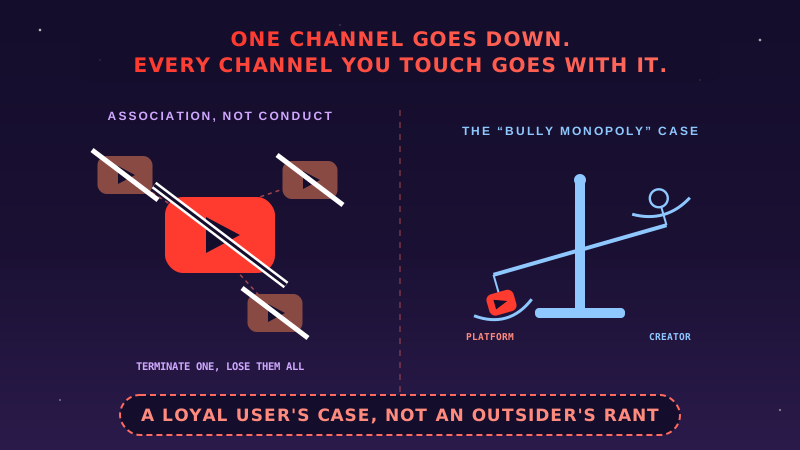
I was today days old when I realized that on YouTube, a strike against one channel you own can end up killing a completely different channel you own — one that never broke any rule on its own — and that this isn’t a bug in the system. It’s the system working exactly as designed. After watching it happen to two of my own channels in the space of a few weeks, I’m calling it what it feels like from where I’m sitting: a bully monopoly. That’s my own characterization, not a legal finding, and I’ll be upfront about that distinction the whole way through — but I think the case for it is real, and I want to walk through exactly how I got here.
My own story, in order
For about a year, I’ve been experimenting with AI-made YouTube videos: live sports dashboards, recap videos of events and odd topics built around social-media posts with AI text-to-speech narration, and travel videos. I ran all of it through a single channel at first, because I didn’t know any better yet — this was genuinely a learning process.
A few months in, one of those videos got published with something in it that shouldn’t have been there, and it drew a content strike. That was the moment I realized mixing every content type on one channel was a mistake, so I split things up: a travel channel, an events-and-odd-topics recap channel, and a separate channel for the rougher AI-experiment stuff I was using purely to learn the tools. Each one got its own lane.
The travel channel and the events channel were solid. The AI-experiment channel wasn’t so lucky — something else went wrong on one of its videos, and that channel got terminated outright. It went from one strike to a full, permanent ban with no specific explanation of what actually tripped it. Fine, I thought: it was all experimental anyway, and I’d learned the lesson I needed from it.
Then, two weeks ago, the travel channel — the one with real production value, real ad spend behind it, and genuinely close to monetization — got a copyright strike. The cause was a roughly 7-second speedboat clip pulled from a tweet, buried inside a 30-minute travel video that was already months old by the time it struck. I’d long since changed how I sourced clips, but it had never occurred to me that I needed to go back and scrub old videos for footage like that.
One strike, I figured, I could survive. Then the real blow landed: the travel channel was terminated by YouTube’s automated enforcement system, and the stated reason wasn’t a new strike on the travel channel’s own content at all. It was “circumvention” — the travel channel got swept into the ban because of its association with the AI-experiment channel I’d already lost months earlier.
The policy mechanics — this is how it’s designed to work
This isn’t a misunderstanding or a one-off automation glitch. It’s YouTube’s own published policy, stated plainly: “If your YouTube channel is terminated, you are prohibited from using, possessing, or creating any other YouTube channels… This applies to all of your existing channels, any new channels you create or acquire, and any channels in which you are repeatedly or prominently featured.” Source: YouTube Help, Terminated channels.
Read that again: “all of your existing channels.” Not the channel that broke a rule. All of them. That’s the clause that actually killed my travel channel — not its own conduct, but its owner’s association with a separately-terminated channel.
And the appeal path is effectively closed for a case like mine. YouTube launched a “Second Chance” pilot on October 9, 2025, letting some terminated creators request a brand-new channel after waiting a full year. But the pilot explicitly excludes copyright terminations and what YouTube calls “Creator Responsibility” terminations — which is exactly the category my situation falls into. Source: YouTube Blog, Second Chances on YouTube.
So that travel channel — the one near monetization, with real subscribers, real watch hours, and real ad dollars spent building it — is gone. And by the same logic, it’s only a matter of time before the same automated reasoning reaches whatever I touch next.
This happens to other people too
My story isn’t an edge case. A gaming creator with roughly 190,000 subscribers and about a decade on the platform had their channel permanently banned over a single clip — footage from the game Hellraiser: Revival flagged for explicit content — despite the creator’s own efforts to censor it before uploading. YouTube upheld the ban with no stated recourse. Source: The Tech Edvocate.
That’s not an isolated enforcement quirk, either — it’s the general mechanism my own story is just one instance of. YouTube’s three-strikes policy terminates not just the offending channel but “any associated channels,” and permanently bars the person behind it from ever creating a new one. Source: YouTube Help, Community Guidelines strikes basics.
The monopoly case — and the honest hedge
Here’s where I want to be careful, because I think this is the part people overstate. I am not saying YouTube has been legally found to be an illegal monopoly. It hasn’t. What I can point to is real, ongoing, unresolved litigation and scrutiny that makes the case worth making.
Rumble Inc. has an active antitrust suit against Google, and a federal judge has allowed claims to proceed that Google uses its search dominance to self-preference YouTube over competing video platforms. That case is not decided. Source: Bloomberg Law.
Separately, the FTC reportedly has an investigation in its “final stages” as of late 2025, examining whether YouTube’s account-suspension, content-removal, and appeals practices amount to unfair or deceptive terms of service under consumer-protection law — which is close to exactly the kind of enforcement I’m describing here. That probe is also unresolved. Source: Outlook Business.
So: both the Rumble case and the FTC probe are ongoing and unresolved as of this writing. Neither one is a ruling that YouTube is an illegal monopoly. “Bully monopoly” is my own label and my own argument built on top of that unresolved litigation — not an adjudicated legal fact. I think the evidence supports making the argument. It doesn’t yet support stating it as settled.
The “traditional public forum” argument — and why it’s normative, not legal
The second half of my thesis is that YouTube has become so dominant and so essential that it has effectively replaced the steps of city hall as a place where people should be able to speak freely — a modern “traditional public forum” in the First Amendment sense. I need to be just as careful here, because this is the part most likely to be flatly wrong if I overstate it.
There’s real language to lean on. In Packingham v. North Carolina (2017), the Supreme Court called social media “the most important places for the exchange of views” and effectively described it as the modern public square, while striking down a law that barred sex offenders from using it.
But current controlling law runs the other way. In Manhattan Community Access Corp. v. Halleck (2019), the Supreme Court explicitly held that a private company operating a forum open to public speech is not bound by the First Amendment, because it isn’t a state actor. That’s the opposite of my thesis, and it’s current controlling law, not a side note.
So I want to state this plainly rather than bury it: current Supreme Court precedent, under Halleck, does not support treating a private platform like YouTube as a constitutional public forum. Packingham’s “modern public square” language was rhetorical, describing how important social media has become — it was not a holding that binds private platforms to the First Amendment. My “traditional public forum” argument is a normative one, about what I think should be true given how dominant and essential this platform has become to how Americans actually communicate — not a claim about what the law currently says. The law currently says the opposite.
Why this isn’t an outsider’s rant
I want to be clear about where I’m coming from, because I think it matters. I’m not writing this as someone looking for a reason to hate Google. My life runs on Google — I carry a Pixel phone, Gmail is the only email address I’ve used in years, and outside of live sports I watch significantly more YouTube than I watch television. I love the product. That’s exactly why this is so infuriating: this isn’t an outside critic taking a shot at a company he doesn’t use. It’s a loyal, daily user watching a platform he depends on erase years of real work and real ad spend over association with a separate, already-closed matter, with no individualized explanation offered and, per YouTube’s own policy, effectively no appeal available.
So here’s the open question I’d leave you with: if a single platform has become this central to how people build an audience, make a living, and speak publicly, and it can erase every channel you’ll ever own over one unrelated association with almost no individualized explanation — at what point does “it’s their platform, their rules” stop being a sufficient answer?