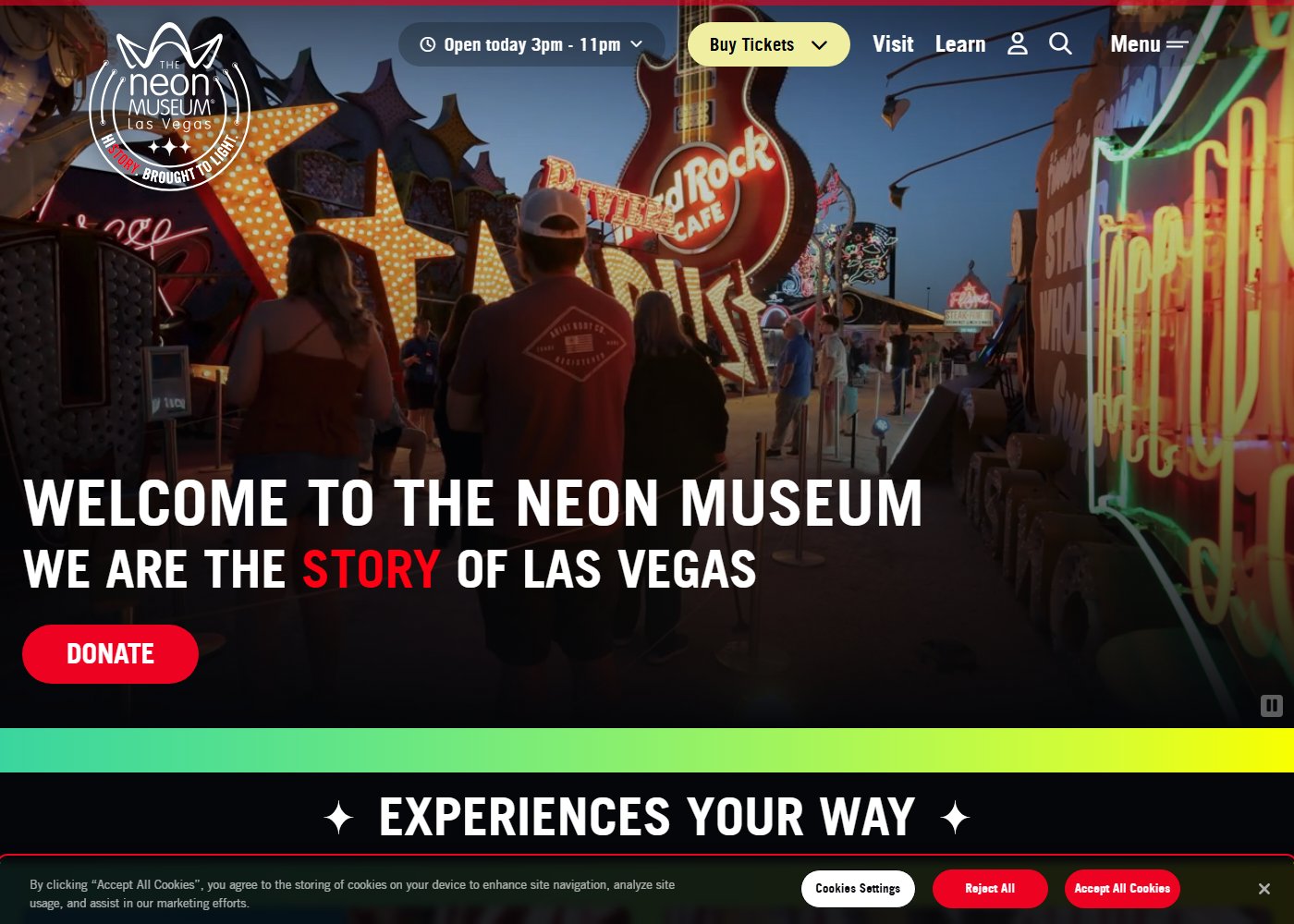
Day 4 of the Vegas mini-series that started with AREA15 (#120), the 18b Arts District (#121), and Fremont Street (#122): the Neon Museum, the nonprofit a mile or so north of Fremont that Discovery #122 pointed forward to instead of deep-diving on the spot. Founded in 1996 and accredited by the American Alliance of Museums since 2021, the museum’s 2.27-acre campus holds more than 250 rescued neon signs across three connected spaces — the outdoor Neon Boneyard, the adjacent North Gallery, and a visitor center built inside a genuinely famous piece of Las Vegas architecture. One honest, current caveat up front, verified directly against the museum’s own site: in 2024 the Neon Museum announced plans to relocate within the 18b Arts District, then dropped that plan in 2025 and is now considering three other downtown sites instead — so everything below describes the museum as it exists today at 770 North Las Vegas Boulevard, not necessarily where it’ll be in a few years. Every stop was checked directly against neonmuseum.org or Wikipedia rather than a generic listicle. Sources: Wikipedia, Neon Museum; neonmuseum.org.
9. The Neon Night Flight Spectacular Tour — a Helicopter Ride Over the Strip, Then a Guided Walk Through the Boneyard
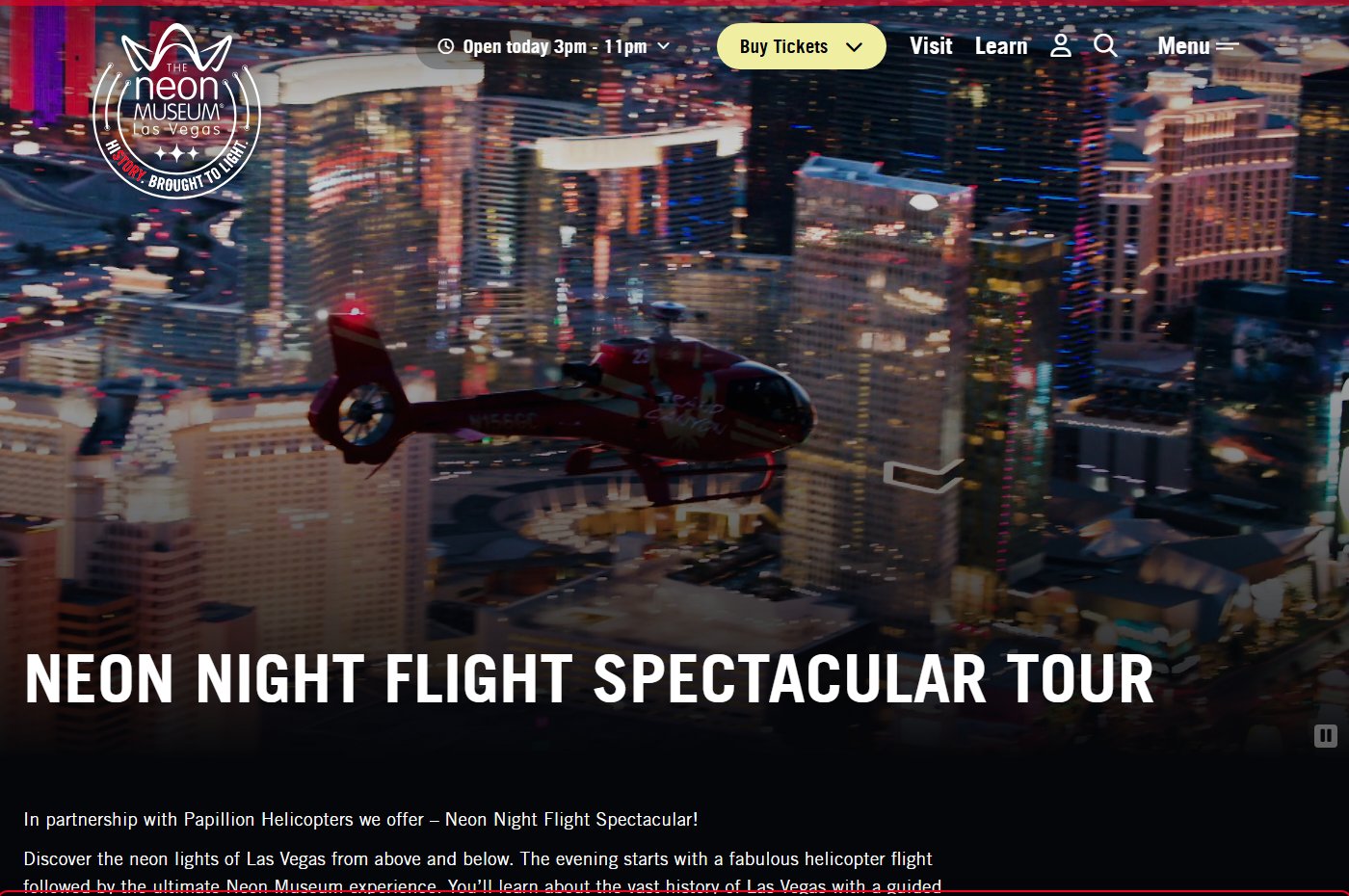
In partnership with Papillon Helicopters, the museum’s own site describes this as starting with “a fabulous helicopter flight” over the neon lights of Las Vegas, followed by a guided tour through the Main Boneyard and closing with the Brilliant! Jackpot show — a genuinely different experience than just walking in. It’s one of several ways to see the collection: standard Daytime Admission (from $25, daily 3-5pm, offered only September through May per the museum’s own site) walks the Boneyard in daylight; Evening Admission (from $35, nightly 6-11pm) is the only way to see the collection lit up after dark and add Brilliant! Jackpot; and a docent-led History Tour, offered in English or Spanish, traces Las Vegas history through the signs themselves, from the mob era through the Civil Rights Movement to today. One practical, honestly-sourced note straight from the museum’s own FAQ: tickets release only 60 days in advance, the museum offers no refunds, and it’s a fully cashless venue. Source: neonmuseum.org, Your Visit.
8. The Hacienda’s Horse & Rider — the Very First Sign the Museum Ever Restored, Back in 1996
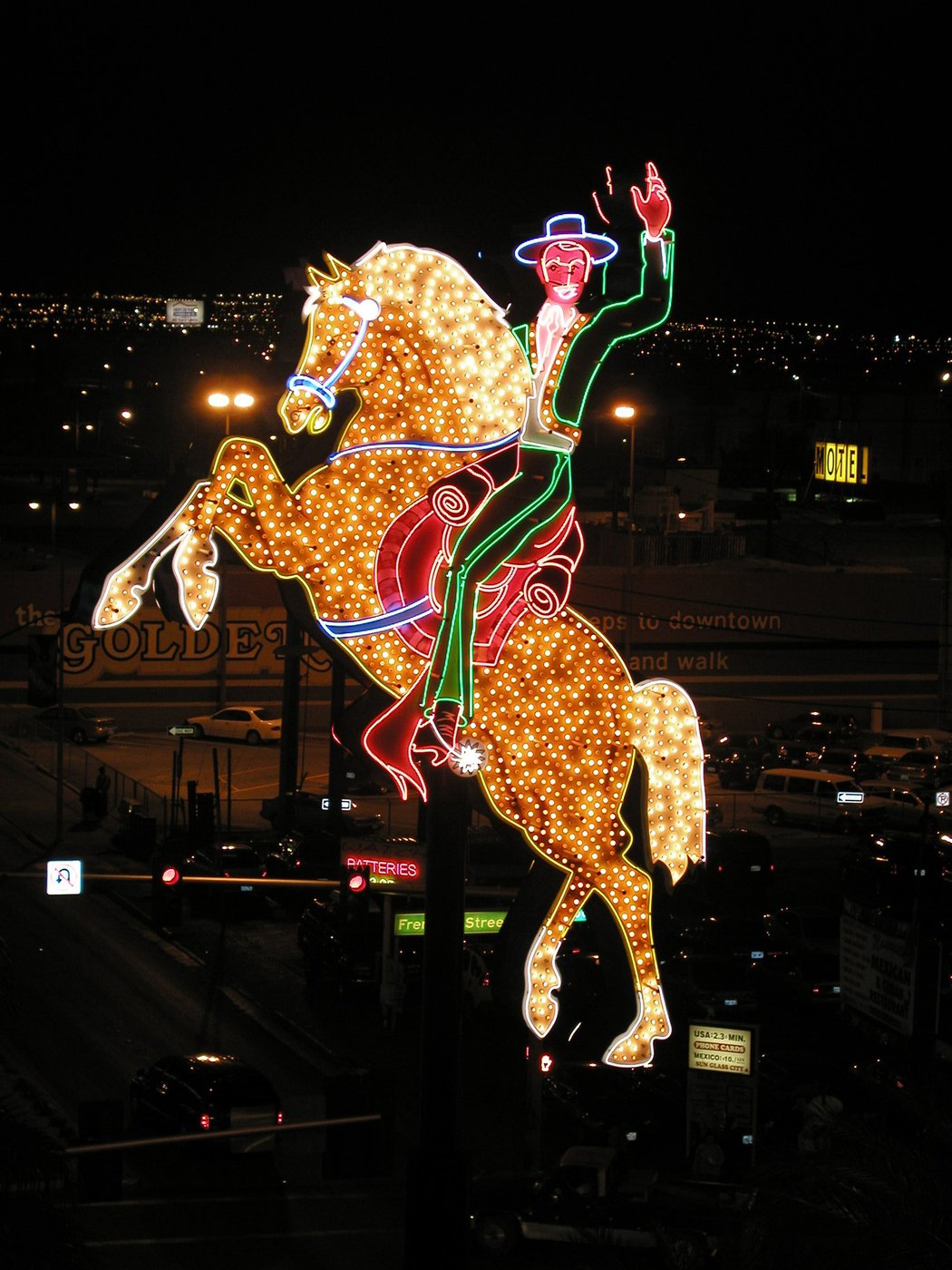
Long before the Neon Museum had a physical boneyard, its very first project was restoring the Hacienda hotel-casino’s neon cowboy — commonly called the Horse & Rider or, per the museum’s own site, “Caballero on a Palomino” — which had sat in storage for years after coming down from the Strip. The museum spent $60,000 refurbishing it, and on November 13, 1996 it was re-installed and relit at the intersection of North Las Vegas Boulevard and Fremont Street, marking the newly formed Neon Museum’s first-ever public-art project, per Wikipedia. Today it’s one of 15 restored signs installed as public art along that same stretch of Las Vegas Boulevard as part of what the museum calls the Las Vegas Signs Project, on a corridor that’s been a federally designated National Scenic Byway since 2009. Source: Wikipedia, Neon Museum; neonmuseum.org, About Us.
7. The Stardust Sign — Kermit Wayne’s Atomic-Era Icon, Still Lit Every Night
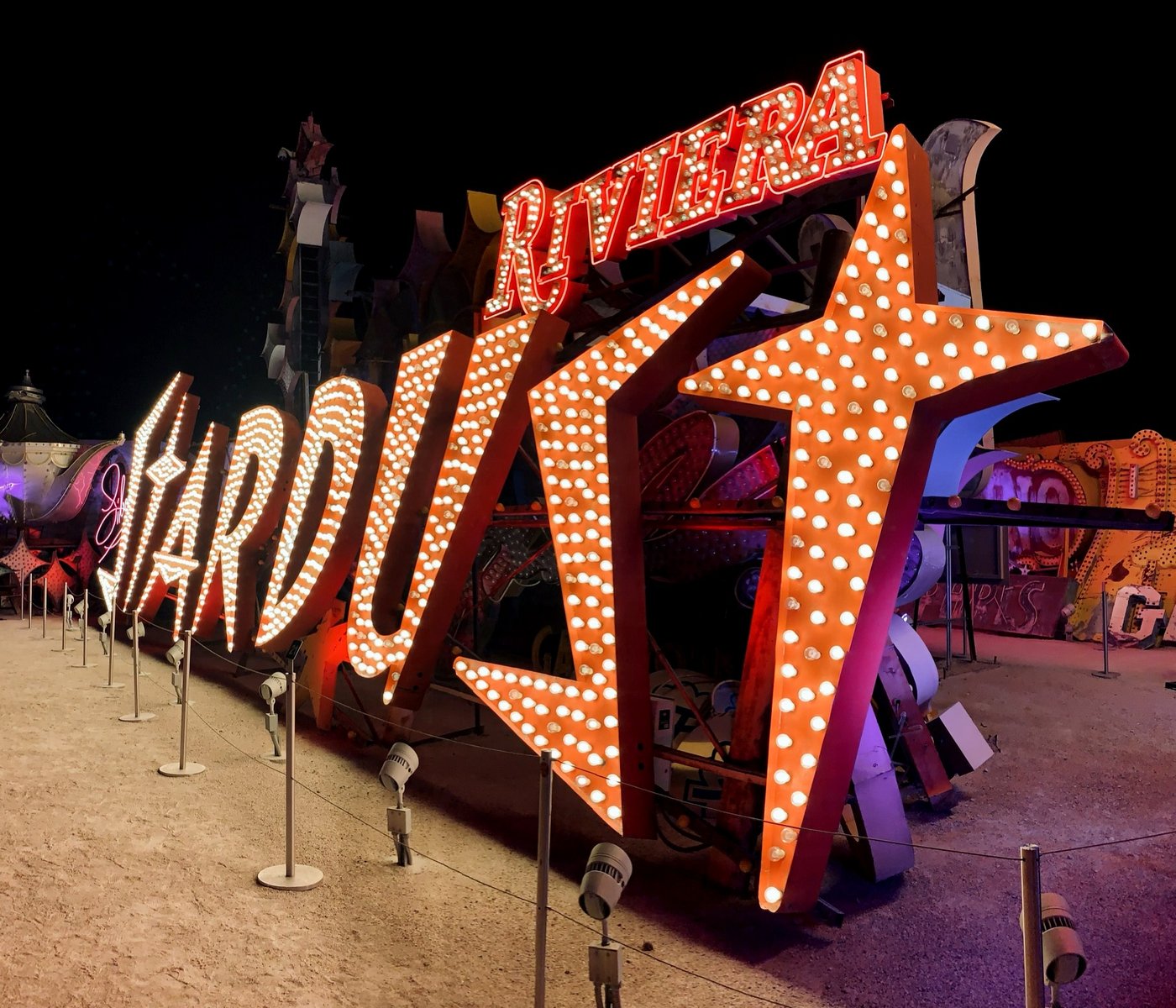
Designed by Kermit Wayne — the same YESCO artist behind the Golden Nugget’s sign, per the museum’s own History Tour page — the Stardust sign is one of the pieces the museum specifically calls out to visitors as marking Las Vegas’s “atomic testing era.” It’s also one of the relatively small number of signs in the outdoor collection that are fully electrified and lit every night rather than left dark: the museum’s own pages put that number at roughly 28 to 31 out of the more than 250 signs on the property, with the rest unrestored and illuminated only by ground lighting — which makes seeing one of the genuinely working pieces, at this scale, a real highlight rather than the default experience. Source: neonmuseum.org, History Tour; neonmuseum.org, Neon Boneyard.
6. The Moulin Rouge Sign — Betty Willis’s Design for the Nation’s First Desegregated Casino
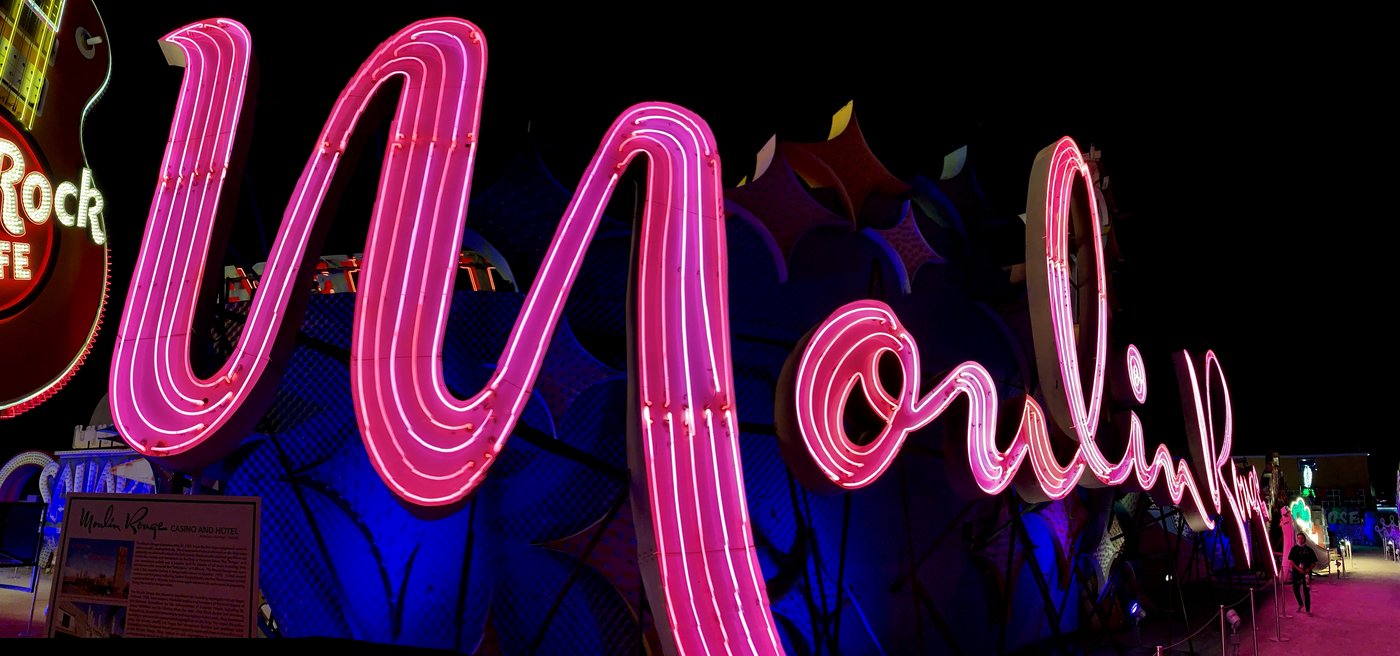
Designed by Betty Willis — the same designer credited with the City Center Motel sign — the Moulin Rouge Hotel opened May 24, 1955 as, per Wikipedia, the first desegregated hotel-casino in the country, a hugely significant piece of Las Vegas’s Civil Rights history rather than just a pretty sign; the property itself only operated about six months before closing that October, which makes the surviving sign one of the only physical traces left. An on-site information panel at the Neon Museum tells the property’s story directly next to the restored piece. Source: Wikipedia, Moulin Rouge Hotel; neonmuseum.org, History Tour.
5. The Neon Boneyard Park’s “NEON” Sign — Four Letters, Each Modeled on a Different Famous Sign
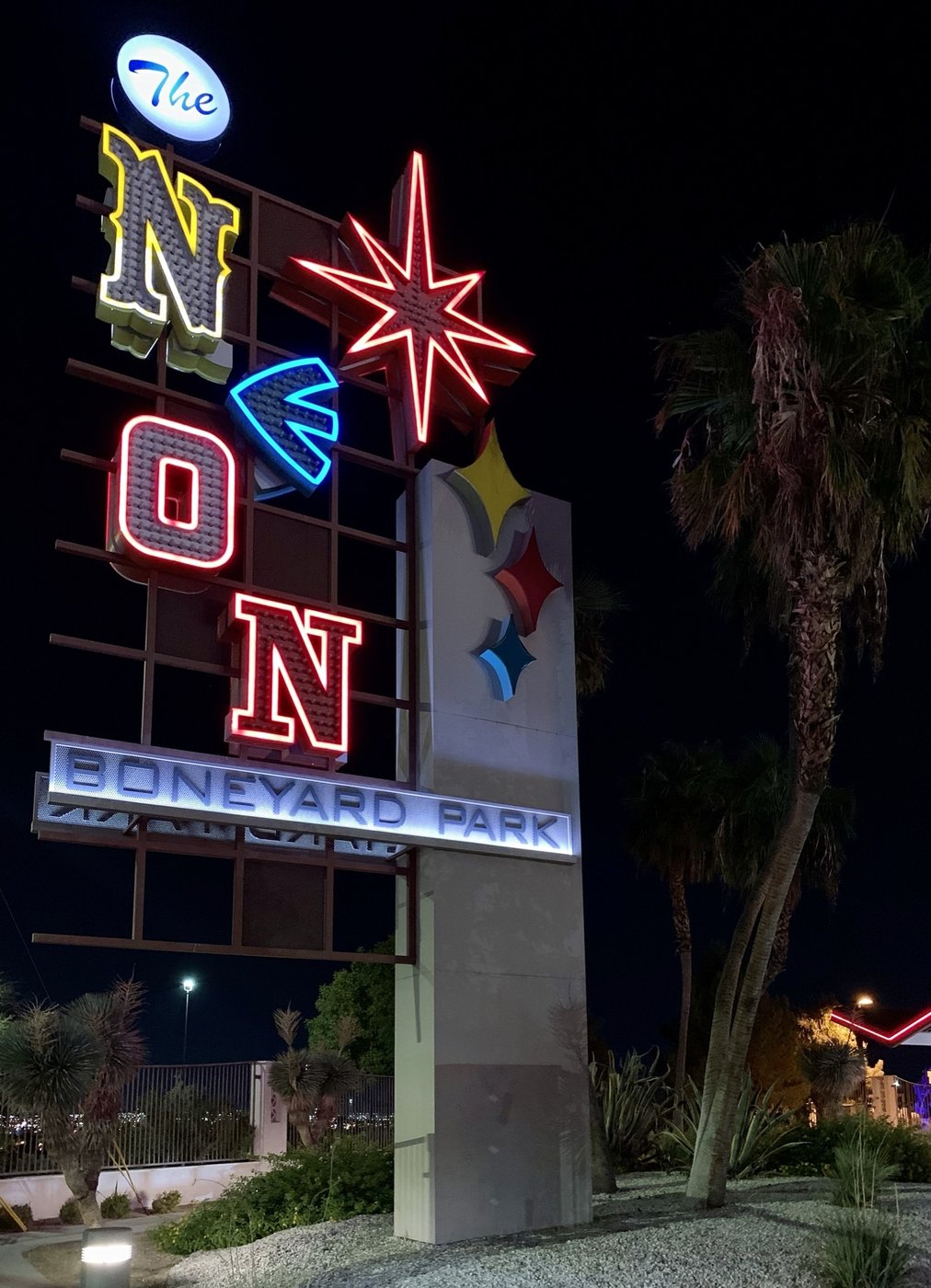
Built by Federal Heath for the museum’s half-acre Neon Boneyard Park (added in 2010 at a cost of $1.9 million, per Wikipedia), this entrance sign is a clever piece of design in its own right: each of its four letters is shaped after a different real Las Vegas sign already in the museum’s collection — the “N” after the Golden Nugget, the “E” after Caesars Palace, the “O” after Binion’s Horseshoe, and the second “N” after the Desert Inn — a single sign that quietly name-checks four Strip and downtown legends at once, right at the park entrance. Source: Wikipedia, Neon Museum.
4. The La Concha Motel Visitor Center — a 1961 Shell Designed by the First Black Fellow of the AIA
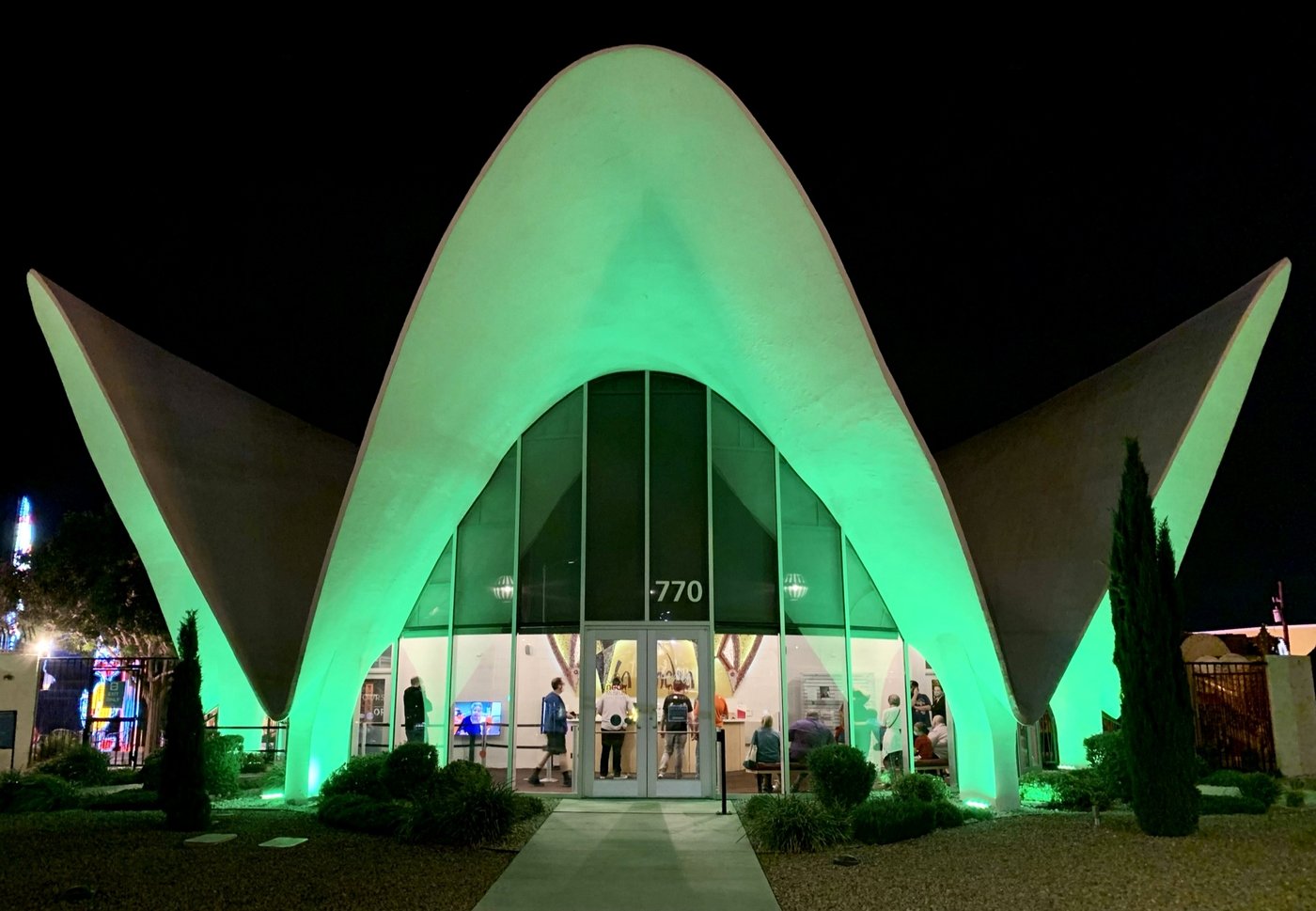
Every visitor passes through this building before reaching the Boneyard: the shell-shaped lobby of the former La Concha Motel, built in 1961 on the Strip next to the Riviera and designed by architect Paul Revere Williams — who, per the museum’s own about page, became the first Black member of the American Institute of Architects in 1923 and, in 1957, its first Black fellow. When the motel closed in 2004 and the rest of the property was demolished, the Doumani family donated the lobby rather than let it go too; it was cut into eight pieces, moved 3.5 miles north, and reassembled at a cost of nearly $3 million, reopening as the museum’s visitor center on October 27, 2012 — the same day the museum eliminated its old appointment-only system. The original 1961 mosaic lobby sign by Ben Mayer is still inside. Source: Wikipedia, La Concha Motel; neonmuseum.org, About Us.
3. The North Gallery & the Las Vegas Luminaries Mural — 115 More Signs and an 808-Square-Foot Tribute
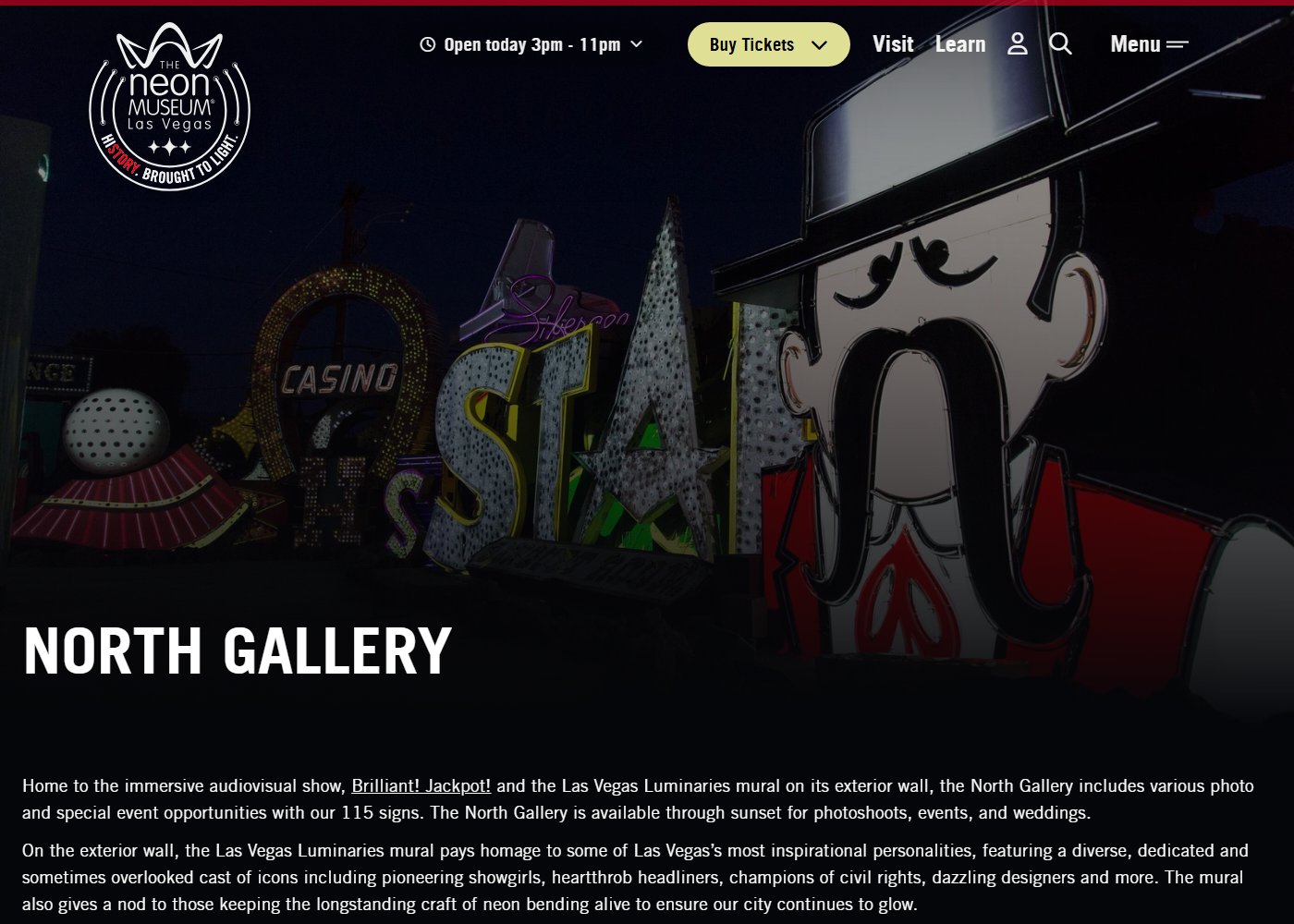
Adjacent to the main Boneyard, the North Gallery holds another 115 signs and doubles as the setting for Brilliant! Jackpot after dark. On its exterior wall is the Las Vegas Luminaries mural, an 808-square-foot piece designed and installed in December 2021 by the Las Vegas artist couple Nanda Sharif-pour and Ali Fathollahi, honoring 11 people who shaped the city’s cultural history — pioneering showgirls, headliners, civil rights figures, and sign designers, including Liberace, Sammy Davis Jr., and Betty Willis (the same designer behind item #6’s Moulin Rouge sign) — with a QR code visitors can scan for each person’s story. Source: neonmuseum.org, North Gallery.
2. Brilliant! Jackpot — a 45-Minute Show That Reanimates 40 Signs Too Damaged to Ever Relight
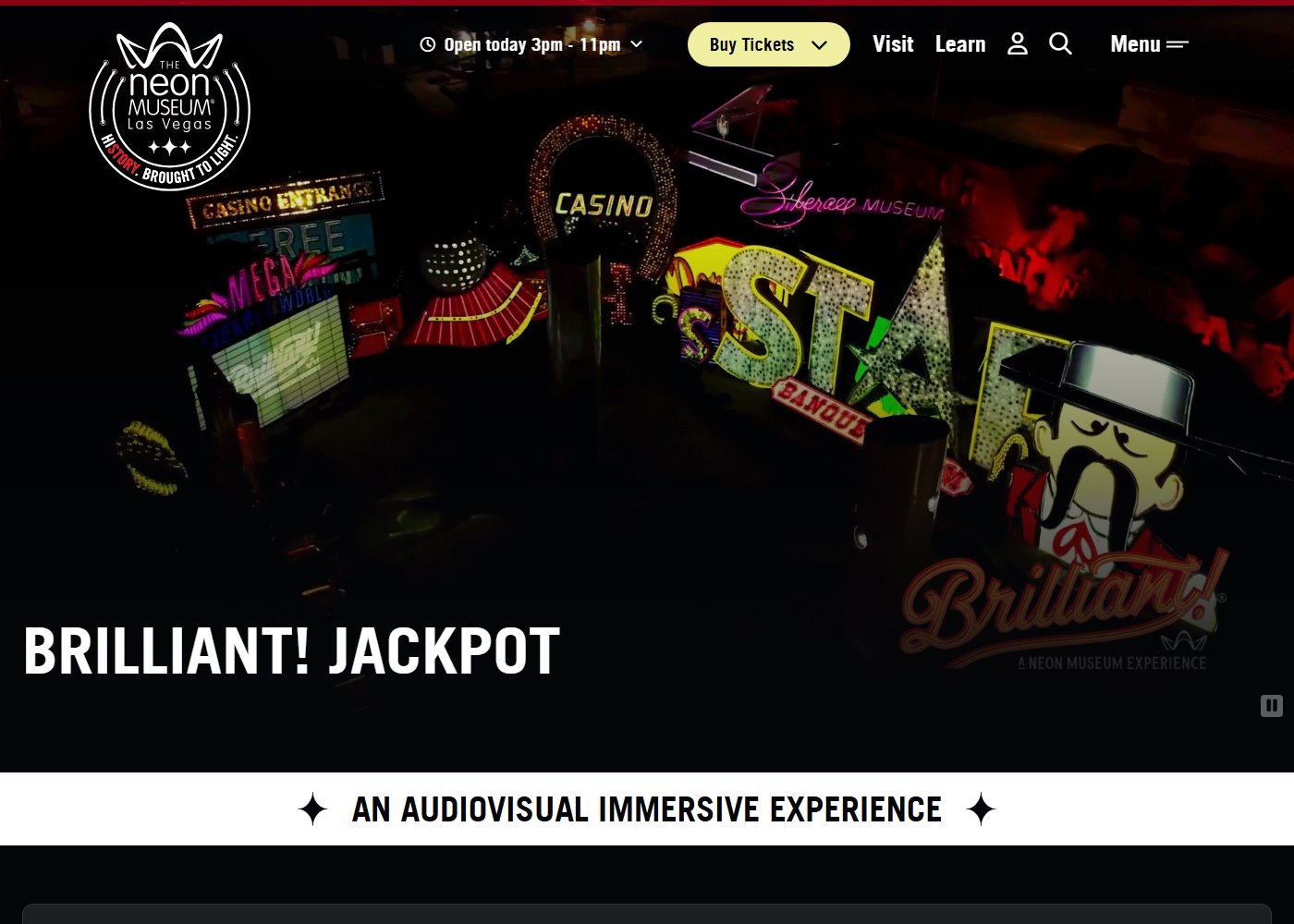
Created by artist Craig Winslow and originally debuted February 1, 2018 (upgraded and renamed Brilliant! Jackpot in a major December 2021 update), this is the museum’s after-dark centerpiece: a 45-minute, 360-degree audiovisual show that uses projection mapping to bring 40 of the collection’s most damaged, permanently dark signs back to life without actually re-wiring them. Per the museum’s own site, Winslow’s team traced each sign bulb by bulb and tube by tube using drone footage and 3D photogrammetry, then projects that artwork back onto the real, physical signs through eight projectors putting out 80,000 total lumens, surrounded by 24 3D-sound speakers housed in two towers modeled on the Flamingo’s champagne-bubble columns. The current version runs a rotating 54-song playlist, 56 percent of it performed by women, LGBTQ+ artists, and artists of color. It’s an add-on to Evening Admission (nightly 6-11pm) rather than included with a standard daytime visit. Source: neonmuseum.org, Brilliant! Jackpot; neonmuseum.org, About Us.
1. The Neon Boneyard — the 2.27-Acre Anchor That Started It All in 1996
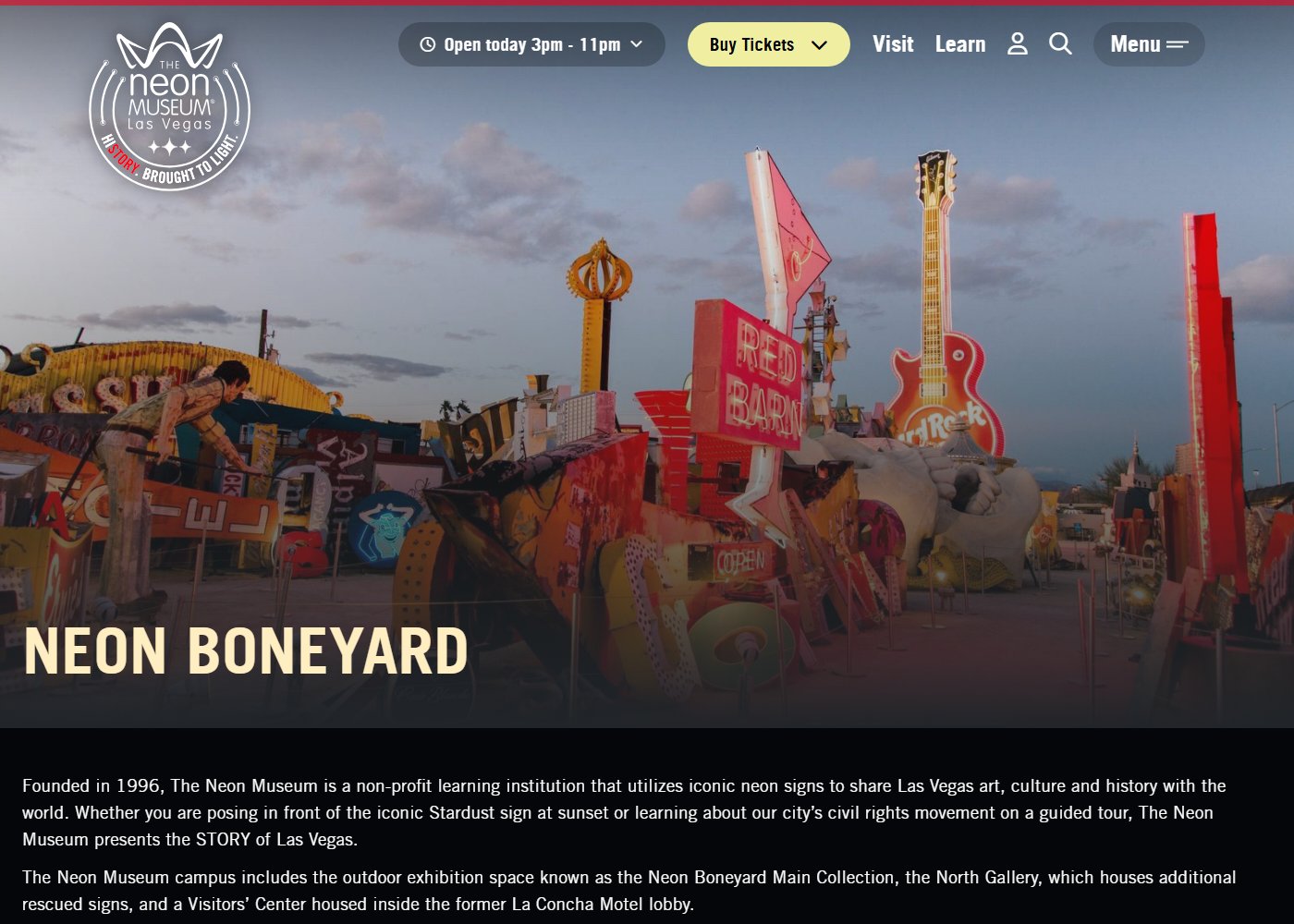
This is the reason the whole museum exists: founded in 1996 when the Las Vegas City Council approved $150,000 in redevelopment funds, and now a 2.27-acre outdoor exhibition space holding the bulk of the museum’s collection of more than 250 signs, about a quarter of them on loan from YESCO, the sign company that manufactured many of them in the first place. The oldest piece is a sign remnant from the 1930s Green Shack restaurant, and the collection spans hotel-casino signage from the Stardust, Riviera, Flamingo, Tropicana, El Cortez, New York-New York, the Plaza, and the Debbie Reynolds Hollywood Hotel, alongside non-casino pieces like a Hard Rock Cafe guitar and a fiberglass skull from Treasure Island. As of 2023 the museum drew 200,000 visitors a year, with another 30,000 turned away on sold-out nights, and it earned accreditation from the American Alliance of Museums in 2021 — the highest national honor available to a US museum. Source: Wikipedia, Neon Museum; neonmuseum.org, Neon Boneyard.
Nine stops, all checked directly against the museum’s own site and Wikipedia rather than a secondhand “best of Vegas” roundup — plus the honest relocation caveat up front. If you only have one evening, book Evening Admission, walk the Boneyard while there’s still light in the sky, and let Brilliant! Jackpot close things out in the North Gallery after dark.