Every big city in America is doing fireworks this week. That part’s not the story. The actual story is what small-town America has been quietly building toward for decades — in some cases centuries — and it all lands on the same day this year: America’s 250th. I was today days old when I learned there’s a Rhode Island parade older than the light bulb, a Nebraska town Congress officially named the country’s Fourth of July City, a California parade route longer than a 5K, and a Danish forest that throws a bigger July 4th party than most American cities.
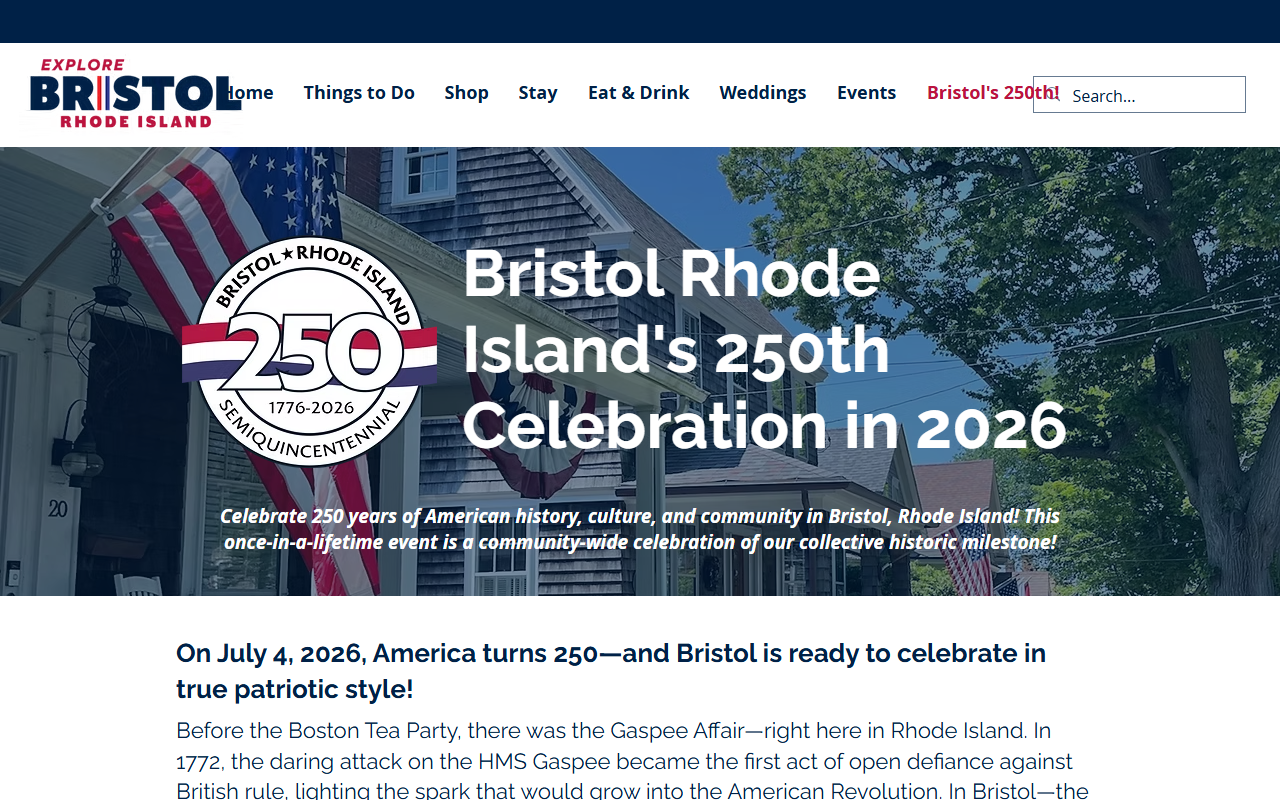
Bristol, Rhode Island — The Oldest Continuous Celebration in America
Bristol has held a Fourth of July celebration every single year since 1785 — nine years before the Bill of Rights was ratified, and only two years after the Revolutionary War officially ended. It is the oldest continuously running Independence Day celebration in the country. 2026’s parade is the 241st annual running, and it happens to land on the exact same year as America’s 250th — a coincidence Bristol has been planning around for years.
The parade steps off at 10:30am from Chestnut and Hope Streets and finishes on High Street, a 2.5-mile route that regularly draws 200,000+ spectators to a town of about 22,000 people. Hope Street has a permanent red-white-and-blue center stripe painted down the middle of the road — not a one-year stunt, a standing civic fixture. Full schedule and route maps: explorebristolri.com/bristol-250 and fourthofjulybristolri.com/parade.
Seward, Nebraska — Congress Made It Official
In 1979, Congress passed a resolution designating Seward, Nebraska as “America’s Official Fourth of July City — Small Town U.S.A.” Nebraska had already named it the state’s Official Fourth of July City back in 1973. It is, on paper, the most legally official Fourth of July town in the entire country.
For 2026, Seward is expecting nearly 50,000 visitors — more than 15 times the town’s own population — in what organizers are calling Nebraska’s largest-ever July 4th celebration, doubling as the state’s headline America 250 event. This year’s theme is “One Nation — Many Stories.” The July 3 pre-party includes free Chautauqua presentations by “Faces of Rushmore” — actors playing Washington, Jefferson, Lincoln, and Roosevelt — at the Nebraska National Guard Museum, a First Ladies Tea, and a concert by the 43rd National Guard Army Band. Details: 1011now.com and america250.org.
Alameda, California — The Longest Parade Route in the Country
Alameda runs the longest July 4th parade in the nation: a 3.3-mile route with 150+ entries, 2,500 participants, and roughly 60,000 spectators. 2026 is the 49th annual parade, starting at 10am at Park Street and Lincoln Avenue, and it doubles this year as the Alameda Fire Department’s 150th anniversary celebration. If you want to earn your spot on the curb, an 8:30am 5K “R.A.C.E.” run/walk precedes the parade along the same route, benefiting Midway Shelter. More: alamedaca.gov and alamedapost.com.
Rebild, Denmark — The Biggest Celebration Outside the US
You do not have to be in America to find the biggest July 4th party. The largest Independence Day celebration outside the United States happens every year in Rebild Hills, in Rebild National Park, Denmark — running continuously since 1912. It’s organized by the Rebild National Park Society, a Danish-American friendship organization, and the 2026 program includes speeches, live music, and cultural performances from both countries. More than a century of Danes gathering in a forest to celebrate an American holiday, with the actual amphitheater built specifically for it. More at rebildfesten.dk.
Four completely different reasons to love the Fourth: the oldest, the officially designated, the longest, and the one that isn’t even in this country. America turns 250 once. Pick one and go.
This is Post 2 of a three-part America 250 mini-series. Yesterday (Discovery #078): the big-city version — Sail4th 250, 32 nations of tall ships, and Macy’s fireworks over both rivers in NYC. Tomorrow (Discovery #080): how America celebrated the 50th, 100th, 150th, and 200th milestones — what each said about where the country was at the time.