
Ken’s question: “What are stablecoins, and why would they be interesting going forward? Why on earth would there be more than one in the end?” I went and read the primary sources, the law, and a few central-bank papers, then added a second round of research on how the issuers make money, what can go wrong and who actually uses them. Here is the plain-English version, with the parts I couldn’t confirm marked as such.
This is not investment advice. I am explaining how something works and what the sources say. I am not telling anyone to buy or sell anything. The market numbers in sections 1 and 2 are dated as of Nov. 5, 2026 and they will move. The newer sections (3 and 6 to 10) come from a second research pass on Nov. 6, mostly from search-result summaries, and I flag what I could not check.
The Short Answer
- A stablecoin is a digital token that a company promises you can swap back for $1. The company keeps cash and short-term U.S. government debt to back that promise.
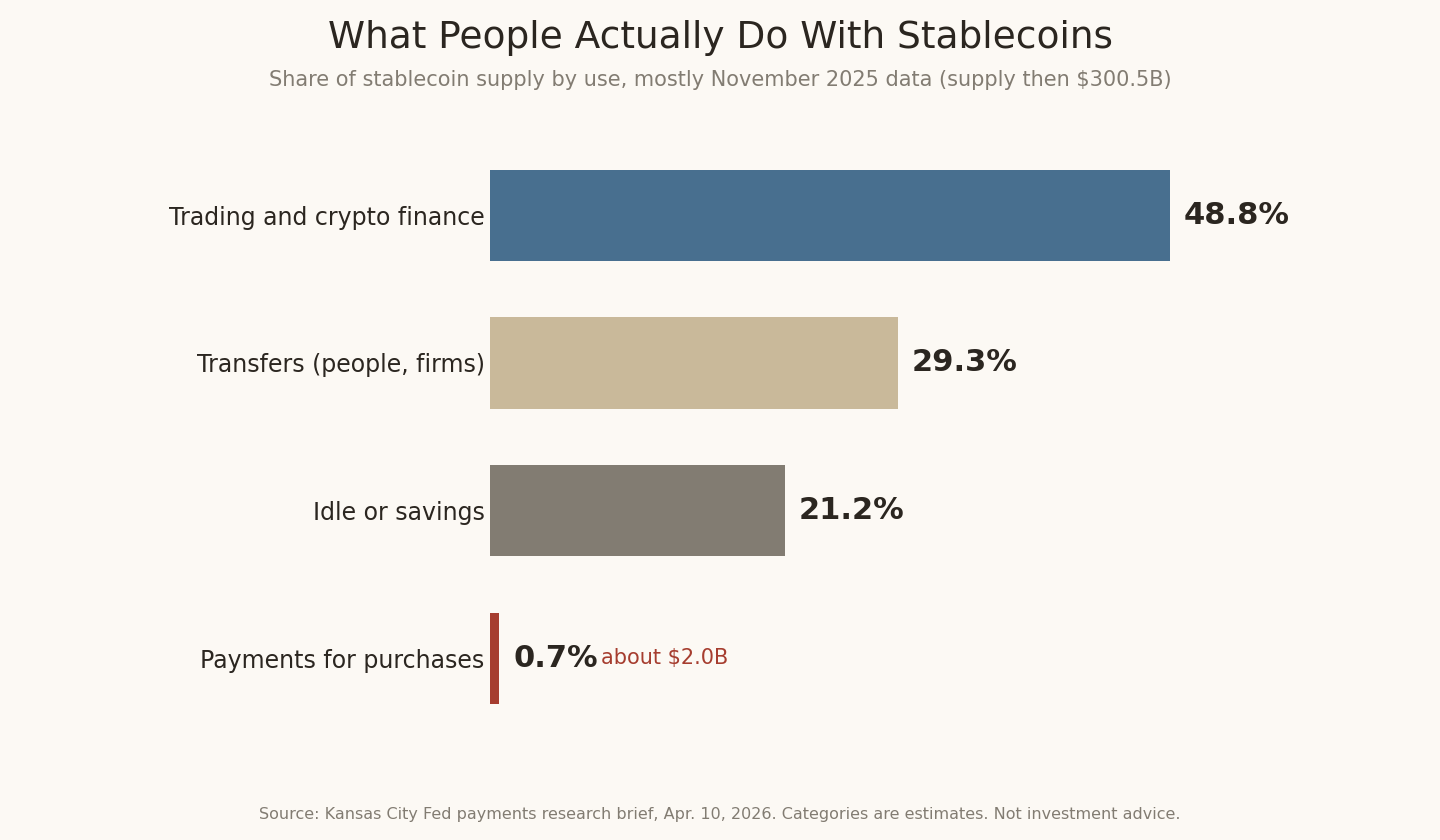
- Today almost all of it is used to trade other crypto, not to buy coffee. Payments are under 1% of use.
- Two coins, Tether’s USDT and Circle’s USDC, hold about 84% of the roughly $294 billion market.
- Will there be only one in the end? My read, which is a view and not a fact: probably not. Many issuers, a few dominant ones.
- Why more than one? Dollars already come from thousands of banks, all redeemable for the same dollar, with a couple of giants on top. Bank money is the closest comparison I found (section 5).
- How do issuers get paid? They keep the interest on the reserves. Circle reported $865 million of revenue and reserve income in Q3 2026, and Tether reportedly made about $1.5 billion of operating profit (secondhand, unverified).
- What can go wrong? A run. TerraUSD collapsed in 2022, and smaller coins have lost their peg as recently as 2026.
1. What a Stablecoin Actually Is
Three analogies that each get you most of the way:
- Casino chips or a gift card. You hand over a dollar, you get a chip worth a dollar. It only has value as long as you can cash it in with the house.
- Prepaid traveler’s checks. A company holds your money and issues a paper promise that others will accept. The check is only as good as the company behind it.
- A money-market fund that behaves like cash. The issuer parks reserves in very safe short-term assets and promises $1 per token. The difference is that it travels on a blockchain, any hour of any day.
The four main types:
- Fiat-backed (the big ones): each token is backed by cash, bank deposits and short-term Treasury bills. USDT and USDC are this type. The BIS reports 99.4% of fiat-backed stablecoins by value are pegged to the U.S. dollar.
- Crypto-collateralized: backed by other crypto, usually over-collateralized. DefiLlama tags Sky’s USDS and DAI and Ethena’s USDe this way.
- Algorithmic: held to $1 by code and incentives rather than by reserves. TerraUSD was the famous one, and it collapsed in May 2022, wiping out roughly $40 to $45 billion in market value (sources differ; Wikipedia’s summary says almost $45 billion within a week).
- Tokenized bank deposits: a bank’s own deposit, put on a blockchain. JPMorgan’s JPMD is the example I keep seeing. I could not open a primary source for it, so treat that as unverified.
What they are used for. The Kansas City Fed’s April 10, 2026 brief, written by Franklin Noll, estimates the split using data mostly from November 2025, when supply was $300.5 billion:
- Trading and crypto finance: 48.8%.
- Transfers: 29.3%.
- Idle or savings: 21.2%.
- Payments for goods and services: 0.7%, about $2.0 billion.
- Over 5% of the supply was sitting in bridges, the tools that move a coin between blockchains.
- One caution: I could not re-open this brief when I built the page, so I am relying on my notes from reading it earlier. Check the link.
Source: Kansas City Fed. Source: BIS Annual Economic Report 2026. Source: DefiLlama stablecoins data (JSON). Source: Wikipedia: TerraUSD.
2. The Market Today (as of Nov. 5, 2026)
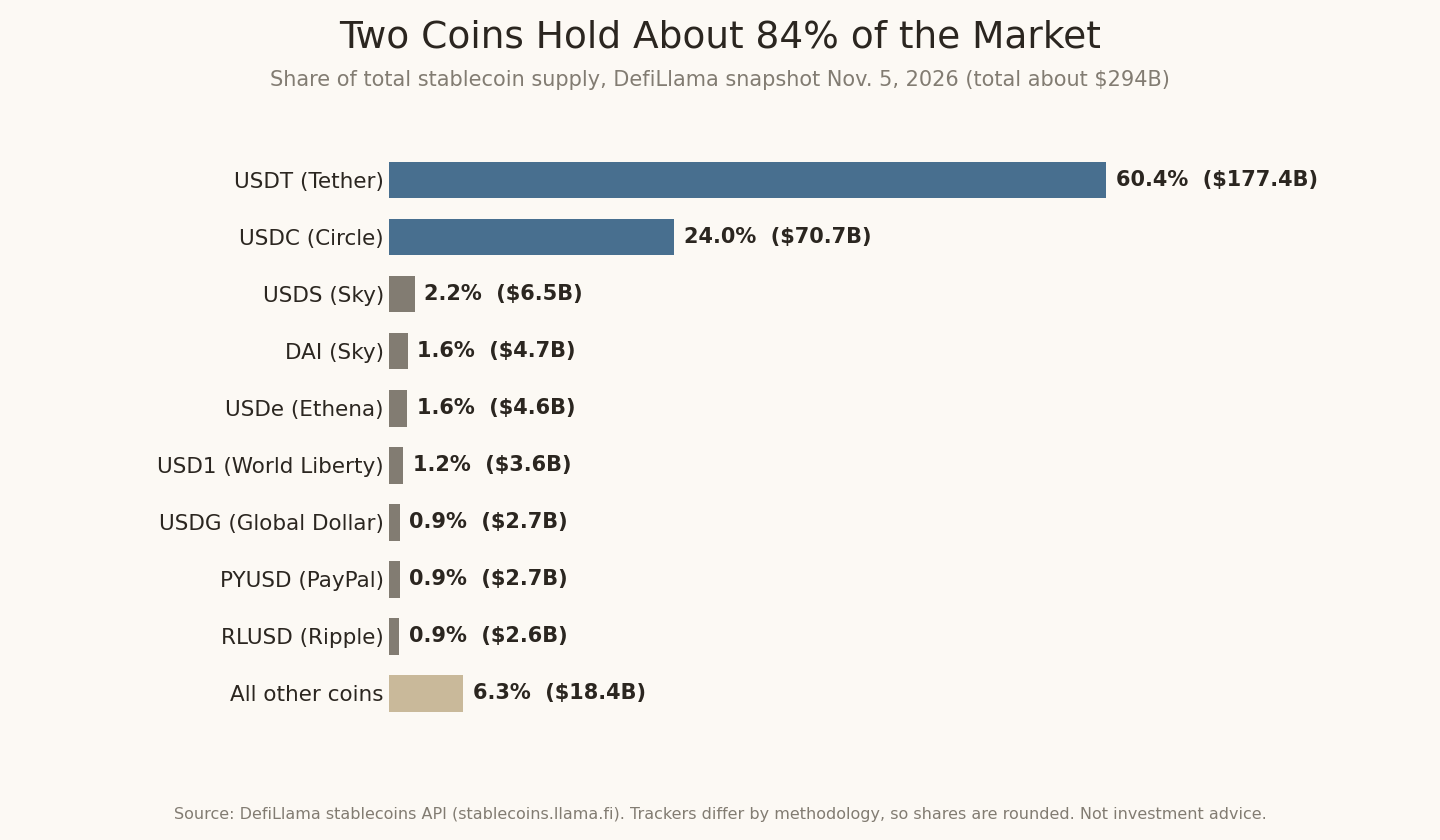
- Total supply: about $294.6 billion on DefiLlama’s daily series on Nov. 5. Other trackers show roughly $292 to $298 billion because they count differently, so treat any single number as approximate.
- Peak on the same series: $315.5 billion on May 17, 2026, so supply is about 6.6% below it. The BIS puts the end-of-May figure nearer $320 billion, a different count.
- USDT is about $177 billion and 60% of the market. USDC is about $71 billion and 24%. Together about 84%.
- Next tier, all roughly 1 to 2% each on DefiLlama: Sky’s USDS and DAI, Ethena’s USDe, World Liberty’s USD1, plus Global Dollar, PayPal’s PYUSD and Ripple’s RLUSD below 1%.
- Tether’s Q3 report (a BDO attestation, published Oct. 30): $191.45 billion in assets against $183.50 billion in liabilities, an excess buffer of about $7.95 billion. It reports about $132.4 billion in Treasury exposure and $4.5 billion of operating profit in the first nine months of 2026. Those are the company’s own numbers, reported by Crypto Briefing.
- Tether’s gold (about $19.1 billion) and bitcoin (about $8.4 billion) holdings: I only saw these in a search summary and did not find them on the page I opened. Unverified.
- BIS: 2025 stablecoin transaction volume was about $28 trillion, which it says is less than three business weeks of the largest U.S. wholesale payment systems. The BIS notes figures net of transfers between a party’s own wallets are far lower.
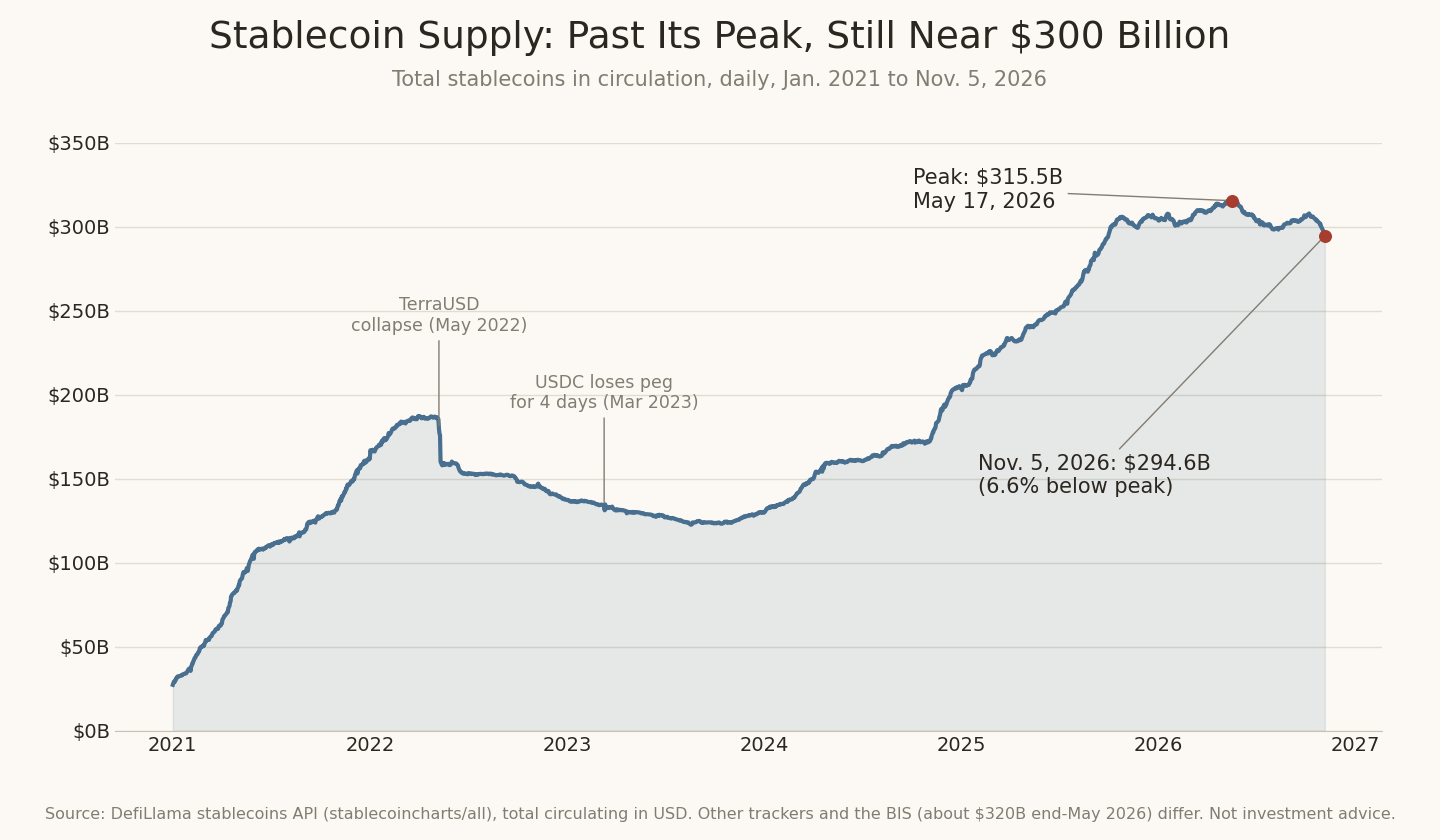
Source: DefiLlama stablecoin charts (JSON) (I pulled the daily series myself on Nov. 5). Source: Crypto Briefing on Tether’s Q3. Source: BIS.
Who else is moving in (all unverified, from search results and company announcements I could not open):
- Mastercard said in June 2026 it would support settlement in regulated stablecoins. Its press page blocked my request, so I only have the headline.
- Tether launched a U.S.-regulated product called USAT in January 2026 through Anchorage Digital Bank.
- Early Warning, the company behind Zelle, reportedly launched a coin called ZLUSD in June 2026.
- JPMorgan’s JPMD deposit token is reportedly live for institutional customers, and Western Union reportedly has a Solana-based coin, USDPT.
- I am leaving out claims I could not corroborate, including a reported consortium coin and any numbers on Visa’s pilot.
3. How the Issuers Make Money
The business is simple. You hand over a dollar, the issuer parks it in Treasury bills and cash, and the issuer keeps the interest. You get nothing for holding the coin, because the GENIUS Act bans issuer-paid interest (section 4). The figures here are from my Nov. 6 research. I did not open the filings myself, so check the links.
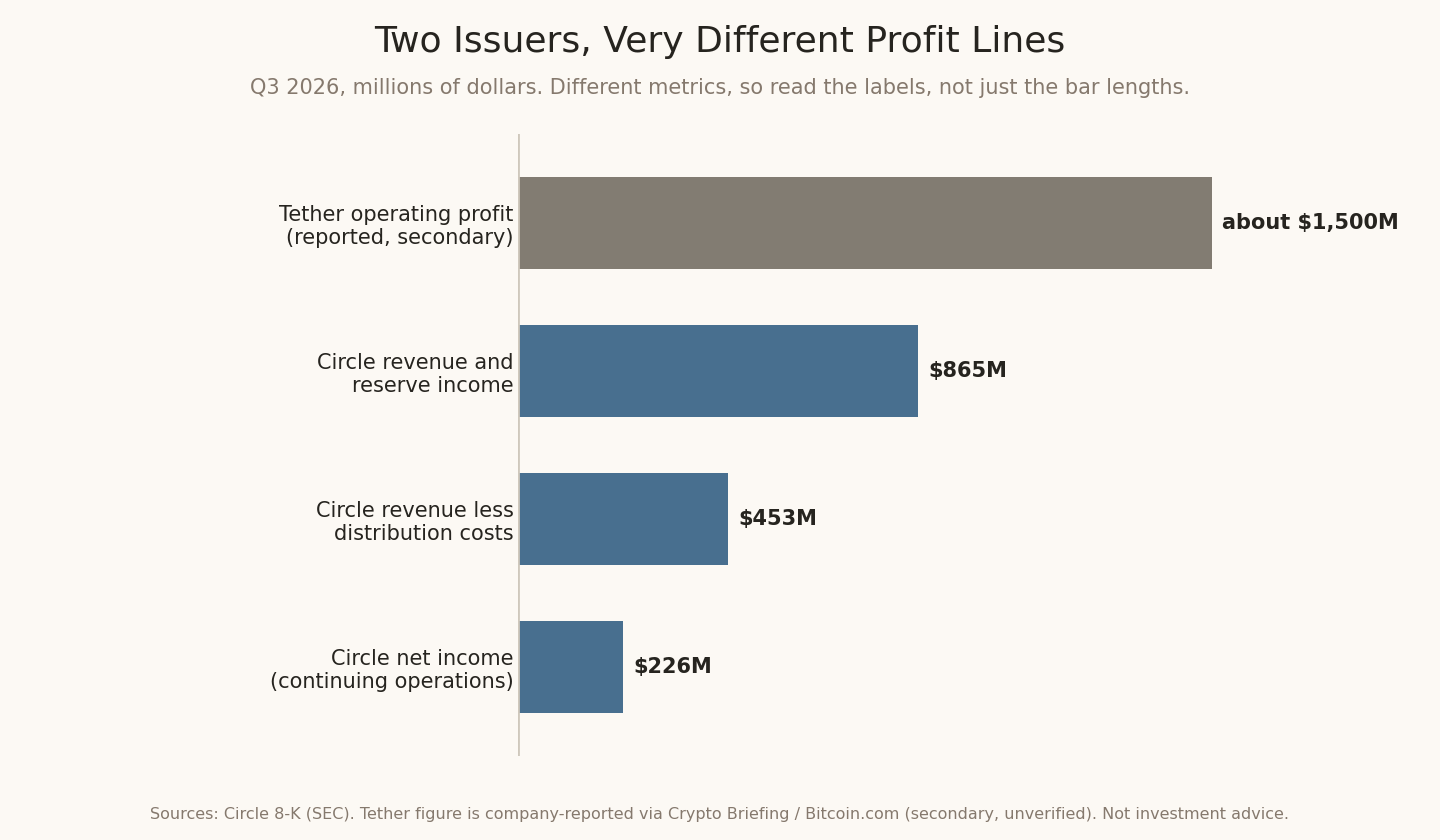
- Circle (USDC), Q3 2026, per its 8-K filed with the SEC: total revenue and reserve income of $865 million, up 17%. Revenue less distribution costs was $453 million. Net income from continuing operations was $226 million. USDC in circulation was $73.9 billion at period end, and Circle’s market share of 27% was down 183 basis points. (A Yahoo headline reported “$214M Q3 profit” and $73.7 billion, which conflicts with the 8-K, so I use the 8-K. The 27% share is at the quarter’s end and counted differently from the 24.0% DefiLlama figure above.)
- Distribution costs: Circle pays partners to distribute USDC. One secondary analysis puts FY2025 distribution costs at $1.664 billion, about 60.6% of revenue. Unverified, single source.
- The Coinbase split: Coinbase reportedly gets 100% of the reserve income on USDC held on its own platform and 50% of the residual reserve income elsewhere. One analysis puts Coinbase’s effective share in Q1 2026 at about 51%, or $330.6 million paid out of $652.5 million of reserve income, and says the agreement renews through 2029. Unverified: the percentages and the renewal come from a secondary analysis, not the contract.
- Tether (USDT), Q3 2026, reported Oct. 30: about $1.5 billion of operating profit and roughly $4.5 billion for nine months. Treasuries of about $132.4 billion (one outlet says $122.84 billion for bills only). Company-reported, via secondary coverage. Unverified.
- Tether a year earlier: year-to-date profit above $10 billion at Q3 2025, per The Block.
- Caution on the chart: operating profit (Tether) and net income (Circle) are different measures, and Circle shares a large part of its income with partners. The bars show scale, not a clean head-to-head.
Source: Circle Q3 2026 results (SEC 8-K exhibit). Source: Yahoo Finance headline (conflicts with the 8-K). Source: Insights4VC on Circle’s economics. Source: Coinbase 10-K exhibit (SEC). Source: Crypto Briefing on Tether’s Q3. Source: Bitcoin.com. Source: The Block (2025).
4. The Rules: the GENIUS Act and What Happens When
I read the text of the law itself on govinfo.gov (Public Law 119-27, signed July 18, 2025).
- Reserves: only approved kinds of backing, including cash, certain deposits and Treasury bills with 93 days or less to maturity.
- No interest from the issuer: an issuer may not pay a holder any interest or yield solely for holding the coin.
- Licensed issuers only: from three years after enactment, July 18, 2028, it is unlawful for a digital-asset service provider to offer or sell a payment stablecoin to a person in the U.S. unless a permitted issuer issued it.
- Start date: the earlier of 18 months after enactment (Jan. 18, 2027) or 120 days after the regulators issue final rules.
Where the rulemaking stands:
- The OCC issued its final rule on Oct. 21, 2026 (OCC Bulletin 2026-50). Its release says the rule and the Act both take effect Jan. 18, 2027, with standards for reserve backing, redemption and risk management. Jan. 18, 2027 is also the statutory 18-month date.
- Treasury’s proposal for how state regimes qualify was published Apr. 3, 2026. I could not confirm that Treasury’s or FinCEN/OFAC’s rules are final. Unverified.
- From my earlier reading, anti-money-laundering and sanctions rules are still to come in a separate rulemaking with Treasury, and the FDIC, Fed and credit-union regulators appear to still have rules pending. I could not re-confirm those two points from the page I reopened, so treat them as likely, not certain.
- The separate “market structure” bill, the CLARITY Act, failed a procedural vote 49 to 50 on Sept. 15, 2026, short of the 60 it needed. Senators Hawley, Collins and Moran voted no. The leading dispute for banks was stablecoin “yield,” because some fear it drains deposits, especially from small banks.
- After the Nov. 3 midterms, CryptoTicker reports Democrats leading both chambers from Jan. 3, 2027, with Sen. Elizabeth Warren likely to chair Senate Banking and Rep. Maxine Waters House Financial Services. It says CLARITY lapses on Jan. 3, 2027 unless the Senate acts. I am not quoting its seat counts, which looked odd.
- Abroad (search summaries only, unverified): Hong Kong issued its first two stablecoin licences in April 2026, the Bank of England finalized rules in June 2026 with a per-coin cap, and the EU’s MiCA transition period ended July 1, 2026.
Source: GENIUS Act text (govinfo). Source: OCC news release 2026-92. Source: OCC Bulletin 2026-50. Source: Chapman GENIUS rulemaking tracker. Source: American Banker. Source: CryptoTicker.
5. One or Many? The Bank-Money Comparison
Ken’s puzzle was why there would ever be more than one stablecoin. The best answer I found is that we already live with it: dollars are created by thousands of banks, all redeemable for the same dollar, and a few giants sit on top. (That framing is mine, from general background, not a quote from a source.)
How bank money works:
- Many issuers, one dollar. A dollar in one bank is worth a dollar in another, because of shared plumbing: check clearing, Fedwire and ACH, and access to central-bank settlement. Deposit insurance helps too (general background, unverified here).
- A few dominant, many small. A handful of banks hold a big share of deposits, and thousands of smaller ones survive anyway.
Where stablecoins look the same:
- Many issuers promising the same $1. USDT, USDC, PYUSD and the rest all promise a dollar back.
- A couple dominate. Two coins hold about 84% of supply.
- Bigger is more useful. A coin that more exchanges, apps and businesses accept is easier to trade without moving the price.
- The BIS leans this direction. It calls for a “unified ledger” that integrates tokenised central-bank reserves, tokenised commercial-bank money and other appropriately supervised private money.
Where they differ, and it matters:
- Par is not guaranteed across coins. You cannot send USDC into a USDT wallet and have it arrive as USDT. The BIS says, by construction, stablecoins cannot currently ensure exchange at par across issuers and blockchains under all conditions, and it describes fragmentation across blockchains as a drag on network benefits. The Kansas City Fed’s estimate that over 5% of supply sits in bridges shows how much plumbing it takes just to move between chains.
- Settlement. The BIS notes that stablecoin transfers settle neither directly nor indirectly on central-bank balance sheets. Ordinary bank payments do.
- The product is the risk. Two stablecoins both promise the same dollar. What differs is the quality of the reserves and the company holding them.
Why more than one may survive:
- Banks won’t hold a competitor’s coin. That is why JPMorgan and Early Warning (Zelle) built their own (both unverified here).
- Different currencies. Yen, euro, sterling and Hong Kong dollar coins serve different markets. The BIS says 99.4% of fiat-backed coins are dollar-pegged today, so non-dollar coins are a tiny slice, but regulators abroad are building rules for them.
- Rules differ by jurisdiction. The U.S., the EU, the U.K. and Hong Kong are each writing their own, and a coin that satisfies one may not satisfy another.
- Platforms want their own. Payment companies and crypto firms have launched coins (PayPal’s PYUSD and World Liberty’s USD1 are in the table above).
My hedged verdict: many issuers, a few dominant ones, probably more like Visa and Mastercard on shared rails, or like a few giant banks plus many small ones, than like a single winner. A couple of big, neutral coins, plus bank deposit tokens, with swap and settlement layers between them. Whether coins trade at par will depend more on clearing, redemption rights and central-bank access than on which brand wins. That is a view, not settled fact.
Source: BIS Annual Economic Report 2026. Source: Kansas City Fed.
6. What Can Go Wrong
A stablecoin is only as good as the promise and the reserves behind it. The record so far:
- TerraUSD, May 2022. About $40 billion was wiped out (one source says $45 billion). UST was an algorithmic coin held near $1 by minting and burning a sister token, LUNA. Withdrawals from the Anchor lending protocol (deposits fell from about $14 billion to $3 billion) set off a run, and the mint-and-burn loop collapsed LUNA. There were no dollar reserves to fall back on.
- USDC, March 2023. USDC briefly lost its $1 peg after Circle disclosed $3.3 billion of reserves held at Silicon Valley Bank when it failed, and it regained the peg days later (per Wikipedia’s USD Coin page, which I read earlier). The low of about $0.87 is from my memory. My second round of searching found nothing on it. Unverified.
- Tether’s history. A New York Attorney General settlement in Feb. 2021 ($18.5 million, no admission of wrongdoing, quarterly reserve reporting). A CFTC order in Oct. 2021 ($41 million against Tether over false or misleading statements about its backing; Blockworks’ headline gives a $42.5 million figure and I did not reconcile the two). Its reserves are attested by BDO Italia, not audited. The first breakdown it published showed only 3.87% in actual cash. That is old history, and today’s reported reserves (section 2) look different.
- Smaller recent depegs (crypto-news and exchange-blog sources): USDX fell to about $0.30 in Nov. 2025. xUSD lost about 77% in a day after a $93 million loss. USDe briefly hit about $0.65 on Binance in Oct. 2025. The only 2026 case I found is apxUSD, under $0.80 on June 25, 2026 (unverified). I found no 2026 depeg of USDT or USDC.
- What the law adds. The GENIUS Act text I read confirms the reserve types and the ban on issuer-paid interest (section 4); the OCC rule takes effect Jan. 18, 2027. Par redemption, monthly reserve disclosure and audited statements for large issuers are how I remember the Act. My searches did not confirm them. Unverified.
Source: CFI on Terra. Source: Cointelegraph on Terra. Source: Wikipedia: USD Coin. Source: Blockworks on Tether and the CFTC. Source: Forklog on USDX. Source: MEXC on xUSD. Source: Longport on USDe. Source: Blockchain.news on apxUSD.
7. Who Actually Uses Them?
- Size. The BIS puts the market at about $320 billion at the end of May 2026, with more than 99% of fiat-backed supply pegged to the dollar.
- Payments are small. McKinsey and Artemis estimate real payments at about $390 billion (Dec. 2025 data), of which business-to-business was about $226 billion. That is roughly 0.02% of global payments. Unverified, secondary (via CoinGeek). It does not match the Kansas City Fed’s $2.0 billion for payments in section 1, and I have not reconciled the two. The definitions of “payment” differ.
- Visa and Allium. A dashboard is cited second-hand at $75.7 billion gross volume against $12.9 billion adjusted. Unverified.
- Emerging markets (older data). Chainalysis, covering July 2023 to June 2024, put stablecoins at 61.8% of Argentina’s transaction volume, and Nigeria at nearly $22 billion in stablecoin transactions. I found no 2026 Chainalysis figure and no verified Turkey figure. Unverified.
- Dollarization. BIS Paper 170 (May 2026) warns of “digital dollarisation,” meaning dollar coins displacing local money.
- Remittances. The World Bank’s Q1 2025 data put the average cost of sending $200 at 6.49%: banks 14.55%, digital services 4.85%. I found no verified stablecoin-versus-bank cost comparison. Unverified as a stablecoin claim.
Source: The Block on the BIS report. Source: CoinGeek on the McKinsey/Artemis estimate. Source: Cointelegraph on Chainalysis data. Source: BIS Paper 170. Source: World Bank Remittance Prices Worldwide, Q1 2025.
8. Banks vs. Stablecoins
- Interest. The GENIUS Act bans issuer-paid interest. The CLARITY Act fight is over whether platforms such as exchanges can pay yield or rewards on coins you hold.
- The compromise. The Tillis-Alsobrooks proposal bars passive yield but allows activity-based rewards. Six bank trade groups say it can be avoided easily.
- Status is unclear. My earlier reading (section 4) found the CLARITY procedural vote failing 49 to 50 on Sept. 15. My second search found only reports that a markdown was set for May 14 and then of limbo by summer recess, and no November status. Treat where it stands as unverified.
- How many deposits could leave? The estimates I found are all secondhand and do not agree: up to $6.6 trillion attributed to Treasury and cited by the Bank Policy Institute (a stress scenario), $500 billion for Standard Chartered, and $531 billion for a worst-case lending impact. The White House published a report calling deposit-flight fears unwarranted. Unverified: I did not check the primary reports. A spread of more than 10 times tells you how little anyone knows.
Source: Cointelegraph on the bank groups’ objection. Source: S&P Global. Source: The Defiant.
9. Stablecoins and U.S. Debt
Issuers park reserves in Treasury bills, so the bigger the market, the more government debt it holds. How much is a matter of dispute:
- Reported holdings range from about $120 billion to about $220 billion. $120 billion (Mar. 2026). $182 billion, ranking 17th among holders (CryptoRank). About $220 billion for Tether and Circle combined (an American Banker opinion piece). The sources use different dates and definitions, and I could not reconcile them. Unverified.
- One anchor: Tether alone reports about $132.4 billion in its Q3 attestation (section 3, secondary coverage).
- Projections: a Treasury report (Apr. 2025) projects about $2 trillion in stablecoins by 2028. A Citizens white paper credits Secretary Bessent with $3 trillion by 2030 (secondary, unverified). These are forecasts, not facts.
- The skeptical side: the BIS finds the net output effect of $1 to $3 trillion in stablecoins would be minimal. I did not find a dedicated skeptic’s source beyond that.
Source: CryptoRank. Source: American Banker opinion. Source: Cointelegraph on the Treasury projection. Source: BIS Annual Economic Report 2026.
10. Stablecoins vs. Central Bank Digital Currencies
A central bank digital currency (CBDC) is digital cash issued by the central bank itself, not by a company. Three places, three different choices:
- United States. The Anti-CBDC Surveillance State Act passed the House 219 to 210 in July 2025 and was pending in the Senate as of June 2026. It has not been enacted, and an attempt to attach it to the defense bill (NDAA) failed. I could not confirm the executive order on CBDCs; from memory it is from January 2025. Unverified.
- Euro area. The European Parliament’s economic committee voted 43 to 14 on June 23, 2026 on the digital euro, and the plenary approved its negotiating mandate 416 to 169 in early July. Talks with member states followed. The ECB suggests issuance around 2029. Unverified (search summaries).
- China. From Jan. 1, 2026, banks can pay interest on e-CNY wallet balances at demand-deposit rates, with deposit insurance (per Caixin). I found no usage totals.
- The contrast (my reading): the U.S. is leaning on private coins and trying to bar its own, while Europe and China are building public ones, and China is making its version pay interest.
Source: CryptoSlate on the Anti-CBDC Act. Source: Sumsub on the digital euro. Source: Eunews on the ECB. Source: Caixin on e-CNY interest.
11. Why It Might Be Interesting Going Forward
The bull case:
- Cheap, fast, around-the-clock settlement and cross-border transfers.
- Dollar access for people in countries where local money is unstable. The BIS says they are used to a lesser extent as offshore stores of value in emerging economies with currency vulnerabilities, though cross-border performance is uneven once fees and spreads are counted.
- Demand for Treasury bills. Standard Chartered reportedly estimates $0.8 to $1 trillion of new bill demand if supply reached $2 trillion, and Treasury Secretary Bessent reportedly called $2 trillion reasonable in June 2025. Both are unverified, from search summaries.
- Big payments names entering the field (see the unverified list above), which would help if actual payments grow beyond 0.7% of use.
The bear case:
- Runs and reserve quality. A coin is only as good as its reserves. Tether’s excess buffer of about $7.95 billion is about 4% of its liabilities. Its non-cash holdings, if the unverified gold and bitcoin figures are right, would be larger than that buffer.
- Deposit flight. The bank lobby fears yield-like rewards would pull deposits from small banks. A White House study reportedly disagrees. Both unverified beyond American Banker’s description of the fear.
- Illicit finance. The BIS says stablecoins account for a significant share of illicit on-chain activity.
- Concentration. Two coins hold 84%.
- Real use is thin. Payments are 0.7% of use, and supply is about 6.6% below its May peak.
- The macro effect may be modest. BIS simulations of $1 to $3 trillion market sizes find the projected effect on output quantitatively modest.
12. What to Watch
- Jan. 3, 2027: the CLARITY Act lapse, and the new Banking and Financial Services committee chairs.
- Jan. 18, 2027: the GENIUS Act and OCC rule take effect, with application windows and the remaining federal rules to follow.
- The Treasury anti-money-laundering rule, and the fight over yield or “rewards.”
- July 18, 2028: the ban on unapproved coins at service providers kicks in.
- Whether the Senate takes up the Anti-CBDC bill, and how the digital euro talks between Parliament and member states end.
- Bank launches: whether more banks issue their own tokens.
- The share of coins other than USDT and USDC, and whether payments exceed 1% of use.
- Overseas: the U.K. regime (reportedly in force Oct. 2027) and more Hong Kong licences, both unverified.
13. What I Still Don’t Know
- Whether any coin outside the top two can gain real share before the 2028 deadline, or whether the law mostly cements them.
- Whether banks will really keep their coins separate, or end up sharing one.
- How the U.S. rules treat Tether’s offshore USDT versus its U.S. product.
- What really backs Tether beyond what it reports, and how fast it would meet a rush of redemptions.
- Whether payments ever become a big part of the story, or stay a footnote next to trading.
- What the real Treasury holdings of the issuers are. The reported range, about $120 billion to $220 billion, is too wide to trust.
- How big real payment use is. Estimates run from $2 billion to $390 billion depending on who is counting and what counts as a payment.
- Where the CLARITY Act and the yield fight stand today, and whether deposits would really leave banks. The estimates differ by more than 10 times.
- Which of the remaining GENIUS rules (Treasury, FinCEN, OFAC, FDIC, Fed) are final, and what the Act says on par redemption and audits. I am working from memory on the latter.
- Whether “bank money” is even the right frame. I think it is closer than any other comparison I tried, but that is my reading.
Related Reading
- Story #195: was the AI bubble just waiting for one pin?
- Story #185: who pays for credit card points, a close cousin of the “who gets the fee” question.
Sources I Opened, and the Ones I Couldn’t
- Opened and checked in the first pass: BIS Annual Economic Report 2026, the GENIUS Act text on govinfo.gov, the OCC news release, American Banker, CryptoTicker, Crypto Briefing, DefiLlama’s data feeds, and Wikipedia pages on TerraUSD and USD Coin.
- Could not open when building this page: the Kansas City Fed brief (relied on my earlier reading) and Mastercard’s press page (blocked).
- Second pass (Nov. 6): sections 3 and 6 to 10 come from search-result summaries. I did not open the primary filings or reports behind them, including Circle’s 8-K, the OCC bulletin, BIS Paper 170 and the World Bank report, so check the links before relying on a number.
- Unverified, from search summaries or memory: Tether gold and bitcoin holdings, the USDC low of about $0.87, the GENIUS par-redemption and audit terms from memory, the Coinbase revenue-share percentages and renewal, Circle’s distribution-cost percentage, the Treasury-holdings figures, the deposit-outflow estimates, CLARITY Act status, the Chainalysis and payments-volume figures, the CBDC executive order, Standard Chartered and Bessent figures, the payments partnerships listed above, non-U.S. regulation details, and the White House deposit study.
- Market numbers are as of Nov. 5, 2026 and different trackers disagree by a few billion dollars.
- Nothing here is investment advice.