I was today days old when I realized the internet has decided, collectively and on a coordinated timetable, that 2016 is culturally coming back. Snapchat dog filters. Pokémon Go. The Mannequin Challenge. Dabbing. The Chainsmokers. Zara Larsson’s “Lush Life” just charted again, ten years on. People are calling it the “Great Meme Reset.” #BringBack2016 has taken off across TikTok and Instagram and Threads. The official reset day, per the TikTok user who proposed it, was January 1, 2026.
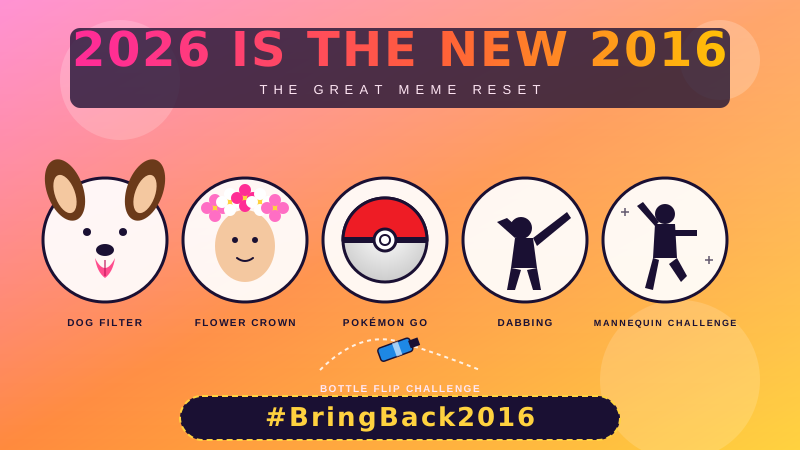
What it is:
“2026 is the new 2016” is a viral nostalgia movement that started circulating in late December 2025 and exploded across TikTok, Instagram, Facebook, YouTube, and Threads in early 2026. The idea is simple and a little on-the-nose: ten years on the dot, bring back 2016’s internet culture — the filters, the songs, the dances, the vibe. It rode on the back of a broader social-media phenomenon, the “Great Meme Reset,” which gained worldwide search momentum in December 2025. The scale is real. #2016 has more than a million posts on TikTok and 37 million on Instagram. #BringBack2016 is the rallying tag. The BBC documented sharp surges in “2016” searches on TikTok in early 2026.
Who started it (and how the reset got a date):
Two TikTok creators get the credit for catalyzing it. On December 31, 2025, @taybrafang posted a montage of 2016 moments — the kind of edit-with-music format the platform was built for. Around the same window, @joebro909 proposed January 1, 2026 as a “reset day” for reviving 2016 internet trends, and the date stuck. From there it spread the way these things spread now: out from TikTok into Instagram Reels, Threads, YouTube Shorts, and Facebook. The Great Meme Reset framing was already in the air — this trend slotted into it. Within weeks, millions of TikTok videos were running 2016-era filters and search interest in “2016” on the platform was climbing fast enough that the BBC wrote it up.
What people are actually reviving:
The catalog is broader than you’d expect, and it sorts neatly into four buckets.
Apps and aesthetics. The Snapchat puppy-dog face filter and the flower crown filter are back — not ironically, that’s the point, people are using them straight. Pokémon Go, Dubsmash, and even Vine get cited in the throwback edits. Photo style is reaching back too: oversaturated Instagram filters, low-res iPhone-camera-circa-2016 looks, glossy and over-bright.
Viral moments. The Mannequin Challenge, the Bottle Flip Challenge, dabbing, and the “catch me outside, how ’bout dat” meme have all been recirculated as participation prompts, not as historical references.
Music. Drake, Justin Bieber, and the Chainsmokers dominate the unofficial soundtrack. The killer detail: Zara Larsson’s “Lush Life,” originally a 2016 hit, resurged on international charts in early 2026, ten years after its first run, on the back of the trend. Billboard tied the move directly to the broader 2016 nostalgia wave. A song that finished its commercial life a decade ago is, in 2026, charting again because the internet collectively said it should.
Entertainment. The 2016 movies and shows people are pointing back at: Captain America: Civil War, Stranger Things season 1, Zootopia, Rogue One, Moana, La La Land, and Deadpool. Fashion is in there too — mirrored sunglasses, glossy makeup, the oversaturated photo aesthetic. Celebrities have publicly joined in; John Legend and Reese Witherspoon both posted ten-years-ago throwbacks.
The unspoken thing:
The nostalgia is selective, and it’s worth naming. People are reviving the 2016 of fashion, music, and memes. People are not reviving the 2016 of Brexit or the US presidential election. Critics — Taylor Delandro at Nexstar, Shane O’Neill in the Washington Post, Haben Kelati — have made that point in print, and it’s an honest one. The psychological frame everyone is dancing around is that 2016 is being reached for as “the year before” — before COVID, before generative AI became commonplace, before the feed started feeling synthetic. It’s escapism toward a remembered year, not the actual year. That doesn’t make the trend less interesting. It makes it more interesting, because it’s a fairly transparent case of the internet picking which version of a year it wants to remember and then coordinating, in public, to remember it.
How to participate (or just watch):
Search #BringBack2016 or #2016 on TikTok or Instagram and the trend is browsable as a feed — you don’t need an account to scroll on TikTok’s web view. Open a Spotify “2016” playlist, of which there are now many, and let the algorithm do the rest. Or just notice, the next time someone in your feed posts a Snapchat dog filter or sets a video to “Lush Life,” that it isn’t ironic — it’s a return. The closest thing to a canonical source is the Wikipedia article on the trend, which has been quietly tracking the citations as the coverage piles up.