I was today days old when I learned a Cambridge lab used machine learning on the genetic data from every known coronavirus in its family, computed a single shared “super-antigen” from the result, delivered it needle-free as a DNA vaccine to 39 volunteers, and got broad immune responses against SARS, COVID, and the bat viruses that could cause the next pandemic — the first time a vaccine designed entirely by computer simulation has been tested in humans.
What it is:
Most vaccines work by training your immune system to recognize a specific virus — one antigen targets one pathogen. This one is different. Professor Jonathan Heeney and his team at the Lab of Viral Zoonotics, in the University of Cambridge’s Department of Veterinary Medicine — along with the Cambridge spinout company DIOSynVax (DVX) Ltd. — designed a vaccine the opposite way. Instead of starting from one virus, they fed an artificial-intelligence / machine-learning system the genetic information of every known Sarbeco-family coronavirus collected through global surveillance programs. The AI’s job: find the structural features that are shared across the entire group, and combine them into a single computed antigen. They call it a “super-antigen” — a thing nature never made, that doesn’t exist on any individual virus, but contains the bits the immune system needs to recognize all of them.
The trial:
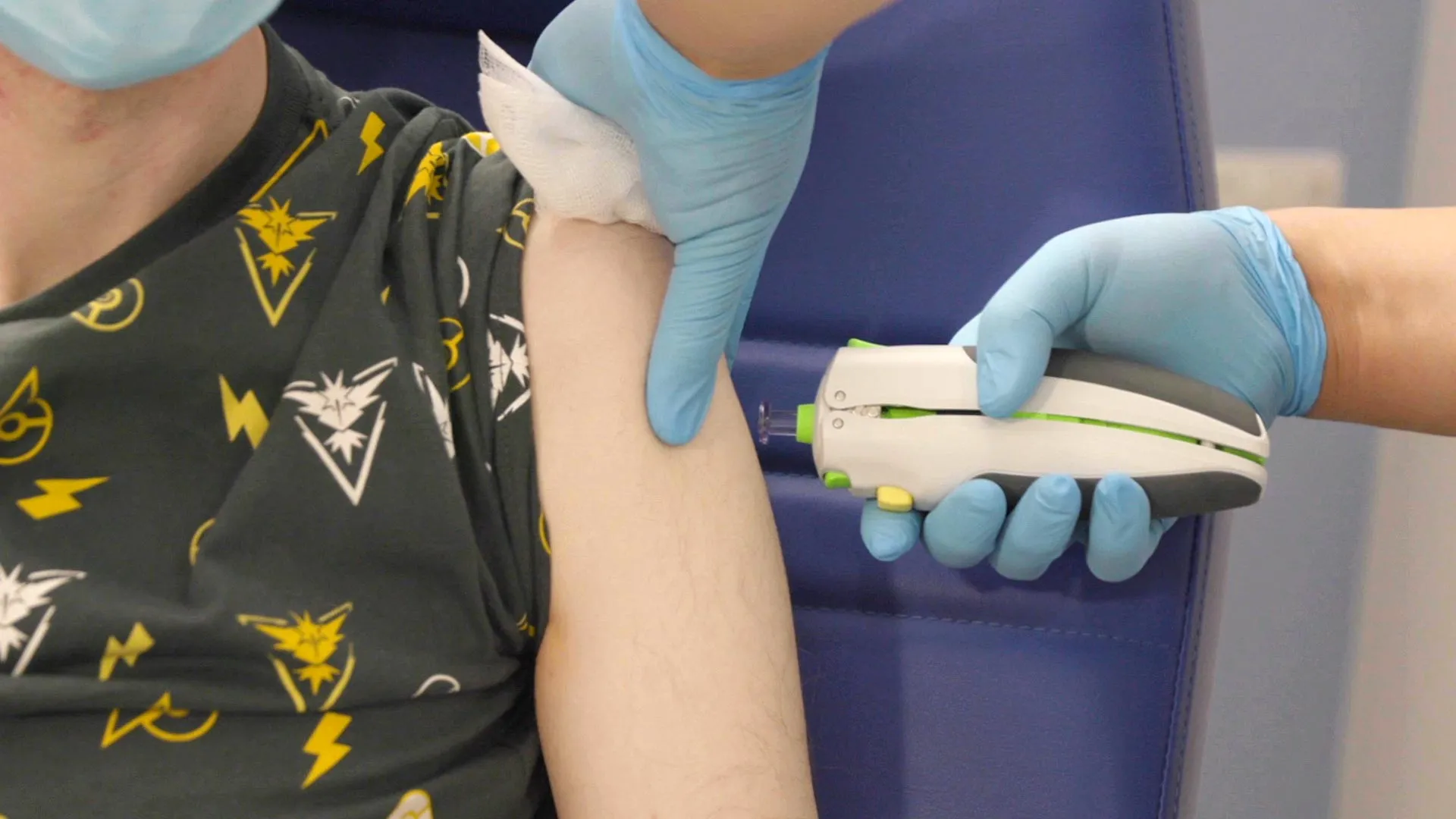
The first-in-human safety study enrolled 39 healthy volunteers, ages 18–50. The vaccine was administered as a DNA vaccine via a micro fluid jet — needle-free — one of the small set of viable alternatives for people with serious needle phobia. Result, published in the Journal of Infection (2026; volume 92, issue 6, article 106759, lead author Alasdair PS Munro): safe and well tolerated, with no adverse safety signals worth pulling the trial for, and broad immune responses in volunteers not just to SARS-CoV-2 (the COVID-19 virus) and the original 2003 SARS, but to related bat coronaviruses — the family of viruses that could potentially spill over from animals into humans and cause the next coronavirus pandemic.
Why this is a big deal:
Two reasons. First, the antigen was designed entirely by computer simulation — not optimized in a lab from a candidate sequence, not refined by directed evolution, but computed up-front from the math of viral genetics. This is the first time a fully computer-designed vaccine antigen has been tested in humans. Second, it’s structurally a universal coronavirus vaccine. The way vaccines have always been built, you’re reacting to a virus that has already arrived: SARS in 2003, MERS in 2012, COVID-19 in 2019, you build the vaccine after the fact, and the world spends a year catching up. A super-antigen computed from shared features works the other direction — it’s designed before the next variant exists, by design, because the features it targets are the ones every variant has to keep. If it works at scale, the next coronavirus that jumps from bats to humans walks into a vaccine that was already on the shelf.
The honest caveats:
This is a Phase 1 safety trial. Safety + immune response in 39 healthy volunteers is the beginning of the path, not the end. Phase 2 and Phase 3 (efficacy, larger populations, real-world coronavirus exposure) are still ahead. The vaccine could still fail to prevent actual infection in a broader population. None of that diminishes the milestone: the antigen design itself — the thing the AI did — works in human immune systems the way the model said it would.
Where to read it:
- Cambridge lab: Lab of Viral Zoonotics
- Company: DIOSynVax
- Journal paper: Munro et al., Journal of Infection, 92(6): 106759 (June 2026)
- News writeup: Science Daily summary