I was today days old when I learned Flag Day is June 14 because, on June 14, 1777, the Second Continental Congress passed a Flag Resolution that was two sentences long, didn’t specify how the stars should be arranged, didn’t set a star-point count, and didn’t name a designer — Betsy Ross’s story was invented by her grandson 93 years after the alleged event, the actual designer (Francis Hopkinson) tried to bill Congress in wine and got nothing, and the largest free-flying American flag in the country today is 140 ft by 70 ft, weighs 340 lb, and flies on a 400-foot pole in Sheboygan, Wisconsin.
The 1777 Flag Resolution — in full:
Here is the entire text of the resolution the Second Continental Congress passed on June 14, 1777, the act that established the United States flag:
Resolved, that the flag of the thirteen United States be thirteen stripes, alternate red and white; that the union be thirteen stars, white in a blue field, representing a new constellation.
That’s it. Two sentences. The resolution doesn’t say how the stars should be arranged. It doesn’t say how many points the stars should have. It doesn’t say which corner the blue field goes in. It doesn’t name a designer. It doesn’t specify the size or shape of the flag at all. That gap is why early American flags vary wildly: stars in a circle (the “Betsy Ross” pattern), stars in rows, stars in a single bigger star, six-pointed stars, five-pointed stars, stars in random arrangements drawn by whoever was sewing the flag that month. There wasn’t a wrong way to do it.
How June 14 became Flag Day:
The holiday itself was invented by one person. Bernard Cigrand was a small-town Wisconsin schoolteacher who, in 1885, organized the first formal Flag Day observance at his school and then spent the next 30 years campaigning for everyone else to do the same. President Woodrow Wilson proclaimed June 14 as Flag Day in 1916. President Truman finally signed it into law as a federally recognized observance in 1949. It is, technically, still not a federal holiday — just an officially recognized observance. The post office is open.
The Betsy Ross myth:
There is no historical evidence that Betsy Ross designed or made the first American flag. None. The story originates entirely with her grandson, William J. Canby, who told it to the Historical Society of Pennsylvania in 1870 — 93 years after the alleged event. Canby said his aunt had passed the story to him in 1857. So: third-hand, no contemporaneous documents, no order forms, no payment records, no congressional minutes mentioning her, no contemporary letters. A century after a six-year-old country was founded, a granddaughter remembered being told as a child that Grandma made the flag, and a grandson wrote it down. That is the entire chain of evidence. The story stuck because it’s a great story.
The Francis Hopkinson truth:
The actual designer of the Stars and Stripes is almost certainly Francis Hopkinson — a signer of the Declaration of Independence from New Jersey, a lawyer, poet, satirist, musician, artist, and the official designer of seals for the U.S. Treasury and the state of New Jersey. Hopkinson formally claimed credit for the flag in writing, while it was still a current event. He invoiced Congress for the work, requesting payment of “a quarter cask of the public wine” — about a quarter-barrel’s worth, several gallons. Congress reviewed his claim, decided he had been adequately compensated for other public-service work, and declined to pay. He never got the wine. But his claim is the one with the actual primary-source paper trail: contemporary documents, Congressional records, a real bill. Betsy Ross’s claim is a story told in 1857 by an aunt. Hopkinson’s claim is a receipt he sent to Congress in 1780.
The largest free-flying American flag in the country:
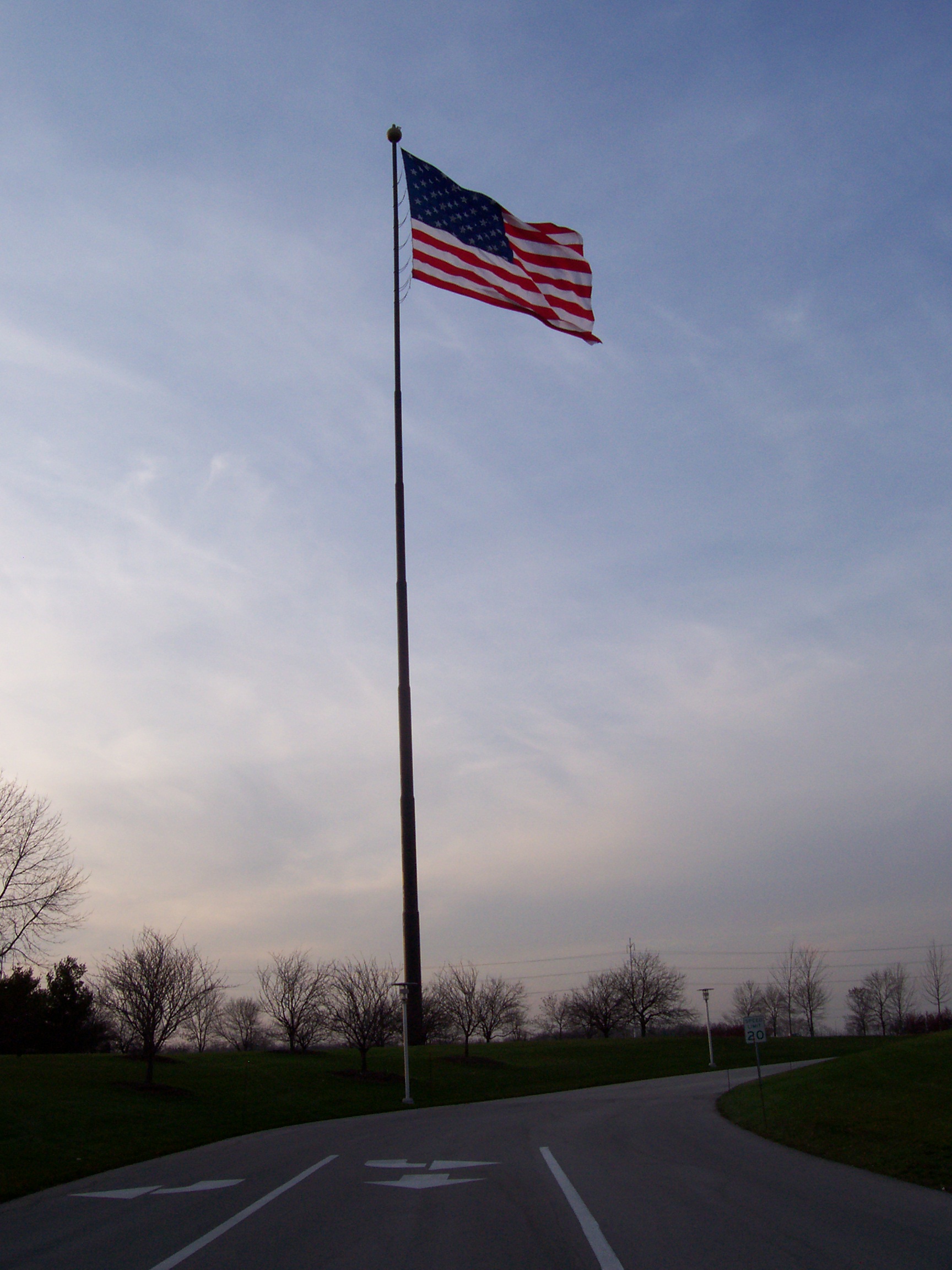
It’s in Sheboygan, Wisconsin, on the headquarters grounds of Acuity Insurance. The flag is 140 feet wide by 70 feet tall, weighs 340 pounds, has stripes that are over 5 feet tall and stars that span nearly 3 feet across. It flies on a 400-foot flagpole — the tallest in the country — built in 2014 as a Veterans Memorial. Acuity calls it “the World’s Tallest Symbol of Freedom.” “Free-flying” means the pole stands on its own, no guy wires — the flag flies the way a single flagpole and a flag are supposed to fly, just very large. (The flag has had to be replaced a handful of times after Lake Michigan thunderstorms tore previous versions to pieces. The current one is the third or fourth.)
Where to nerd out further:
- North American Vexillological Association (nava.org) — the formal society for the study of flags. Annual conferences, a journal (Raven), and a respected ranking of every US state flag from best- to worst-designed.
- r/vexillology on Reddit — the largest flag-nerd community on the internet, full of original flag designs, civic-flag redesign proposals, and flag-history threads.
- The Flag Institute (UK) — the British equivalent of NAVA, founded 1971. Best resource for flags of the rest of the world.
- Roman Mars’s TED talk on city flags (2015) — the canonical 18-minute crash course in why most American city flags are terrible and what a good flag looks like. If you watch one thing on this list, watch this.