I was today days old when I learned that every meme you’ve ever sent has a structured, Wikipedia-style entry — with its origin date, first-appearance citation, spread timeline, and notable variants — at a site called Know Your Meme. Founded in 2007 out of an early YouTube vlog. Currently archived by the Library of Congress alongside the Declaration of Independence. Free to read. No login. Thousands of staff-confirmed entries. The Encyclopedia Britannica of internet culture.
What it is:
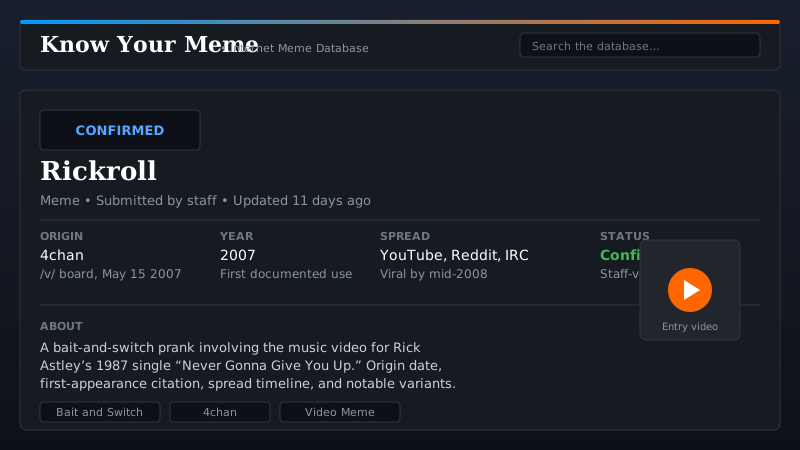
Know Your Meme is the canonical online encyclopedia of internet memes, viral content, slang, and internet subcultures. The format is structurally Wikipedia-like — every meme gets its own entry with an origin date, first-appearance citation, spread timeline, notable variants, and references — but the editorial model is different. Users submit; a research desk verifies. Entries move through a defined workflow (submitted → researching → confirmed, with deadpooled and popular as terminal states). Think of it less as Wikipedia and more as an encyclopedia with a real research staff sitting behind it. Free to browse. No account needed to read anything. An account is only required to submit memes, comment, or participate in research.
Who built it (and the Library of Congress detail):
Launched November 25, 2007 by Kenyatta Cheese, Elspeth Rountree, and Jamie Wilkinson as a spin-off of the Rocketboom vlog (CEO Andrew Baron contributed in his spare time). It became a standalone destination through 2008 and reached 9.5 million monthly visitors within three years. Acquired by Cheezburger Network in March 2011 for an undisclosed seven-figure sum. Cheezburger was acquired by Literally Media Ltd. in April 2016 — the current parent — headquartered in Seattle. And then the surprise: in June 2014, the Library of Congress formally inducted Know Your Meme into its Web Archiving Program. The same institution that preserves the Declaration of Independence and the Gettysburg Address decided that the catalog of LOLcats and Rickrolls was a piece of American cultural history worth keeping forever. Time named it one of the 50 Best Websites in 2009. It won a Streamy in 2010 and a Webby in 2012. But the Library of Congress is the line you don’t un-cross.
What you can actually look up:
Every meme you’ve sent in the last fifteen years is in there. LOLcats. Rickroll. Nyan Cat. Doge. Distracted Boyfriend. This Is Fine. Drakeposting. Hide the Pain Harold. Each entry carries the same structured metadata: origin (where it first appeared), date (when), spread (how it traveled across platforms), notable variants (the spinoffs that took off), references and citations (with links), and a status flag (confirmed, submitted, researching, deadpooled, or popular). Confirmed means staff has researched it and verified the origin story. Submitted means it’s in the queue. Deadpooled means it failed verification or fizzled. Researching means the staff is actively chasing down sources. The whole catalog is organized into five top-level categories — Cultures, Events, People, Sites, and Subcultures — and by 2017 there were already 2,700+ confirmed entries. The current count is much higher.
How to start (no account, just browse):
Go to knowyourmeme.com. Type any meme name into the search bar — the next meme you find yourself trying to explain to someone is almost certainly in there. Check the Trending and Latest tabs to see what’s rising and what’s newly confirmed. No login, no signup, no paywall, no popup. An account is only needed if you want to submit a meme, comment, or join the research community. For everything else, just read.