I was today days old when I learned about LibriVox — a 20-year-old volunteer project that has produced free MP3 audiobook recordings of more than 20,000 public-domain books. Every classic novel. Every public-domain non-fiction work. Recorded by volunteers around the world, hosted free by the Internet Archive. Both the source texts and the recordings are in the public domain. No account, no ads, no paywall. Just hit download.
What it is:
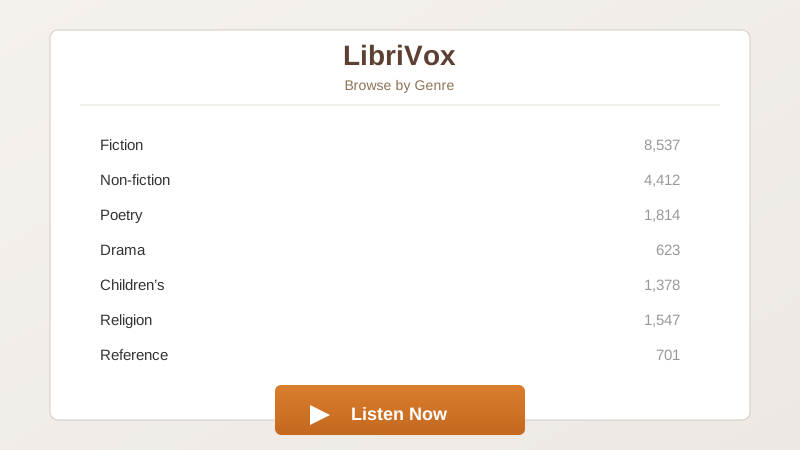
LibriVox is a free, ad-free archive of public-domain audiobooks read entirely by volunteers. Browse their catalog by title, author, language, or genre — fiction, drama, poetry, plays, religious texts, non-fiction. Pick a book, download the MP3s (or stream them, or grab via podcast feed), and listen. The project's stated quality standard is that recordings must be “understandable and faithful to the source text,” which means audio fidelity and narrator quality vary. Some recordings are studio-quality; others are clearly someone at their kitchen table with a USB microphone. That's not a bug — it's the reality. LibriVox publishes them anyway because the mission is breadth over polish. And the breadth is staggering.
Who started it, and the scale:
LibriVox was founded in August 2005 by Hugh McGuire, a Montreal-based writer, who posted a simple question: “Can the net harness a bunch of volunteers to help bring books in the public domain to life through podcasting?” Twenty years later, the answer is a resounding yes. As of December 17, 2024, LibriVox has crossed 20,000 completed projects — a milestone the project calls the “20K celebration.” Growth timeline: 10,000 projects (August 6, 2016), 15,000 (February 14, 2021), 20,000 (December 17, 2024). About 90% of the recordings are in English, though recordings exist in over 90 languages. Every volunteer. Every recording coordinated through an internet forum. Every recording proof-listened by community reviewers before publishing. Zero VC funding. Tiny annual budget (around $5,000 in the early years; a 2010 fundraising drive raised $20,000 in 13 days and kept the lights on).
What's actually on there (and what's popular):
The scope is encyclopedic: the King James Bible, Shakespeare, Jane Austen, Mark Twain, H.P. Lovecraft, scientific papers, historical documents, religious texts, drama. The most popular recordings (as of end of 2023) are Sun Tzu's The Art of War (22.7 million listens) and a collective reading of Alice's Adventures in Wonderland (22.4 million listens). You can listen to the complete works of Mark Twain, or just Adventures of Huckleberry Finn. You can grab the complete Jane Austen catalog, or Pride and Prejudice solo. Historical documents, public-domain movies (yes, audio of vintage films), children's stories, technical non-fiction — if it's in the public domain, someone has probably recorded it.
The variable-quality caveat (be honest):
Not every recording is polished. Some narrators have excellent microphone technique and clear diction. Others are home-recorded and lo-fi. Some books have collaborative recordings where different volunteers read different chapters, and the transition can be jarring. It's part of the charm and part of the limitation. LibriVox doesn't grade recordings on professionalism — they grade on understandability and faithfulness to the source. That means you might find a brilliant, intimate reading of Walden that someone recorded at home, or a dry but accurate recitation of a 19th-century naturalist's journal. Think of LibriVox less as “Audible for free” and more as “the most ambitious volunteer audio project on the internet, take the quality variance as part of the deal.” But that variance is also why it exists in the first place: a lone volunteer can record a book they love and share it with the world. No record label. No publisher approval. Just passion.
How to start (no account, just download):
Head to librivox.org, search for a title or author, and click. You can browse by genre, language, length, or narrator. Download the MP3s directly to your device, or subscribe to the project as a podcast in any podcast app. No signup required to download anything. If you want to volunteer as a reader, proof-listener, or BookCoordinator, you'll need a free account and forum access, but listening and downloading is completely anonymous. Both the source texts (sourced from Project Gutenberg) and the volunteer recordings themselves are dedicated to the public domain — you can rip them, remix them, redistribute them, without restriction. That public-domain double layer is the distinguishing feature.