I was today days old when I learned there’s a curated database of 11,082 out-of-copyright images you can browse three different ways: search the catalogue by artist or century or theme, scroll the Infinite View as a single endless 360° wall of art, or hit Shuffle and let it pick something for you. Medieval manuscripts. Early color photography. 16th-century illustrations of celestial phenomena. Victorian gym equipment. All free to browse, download, and reuse. It’s the Public Domain Image Archive, and it’s adding new works every week.
What it is:
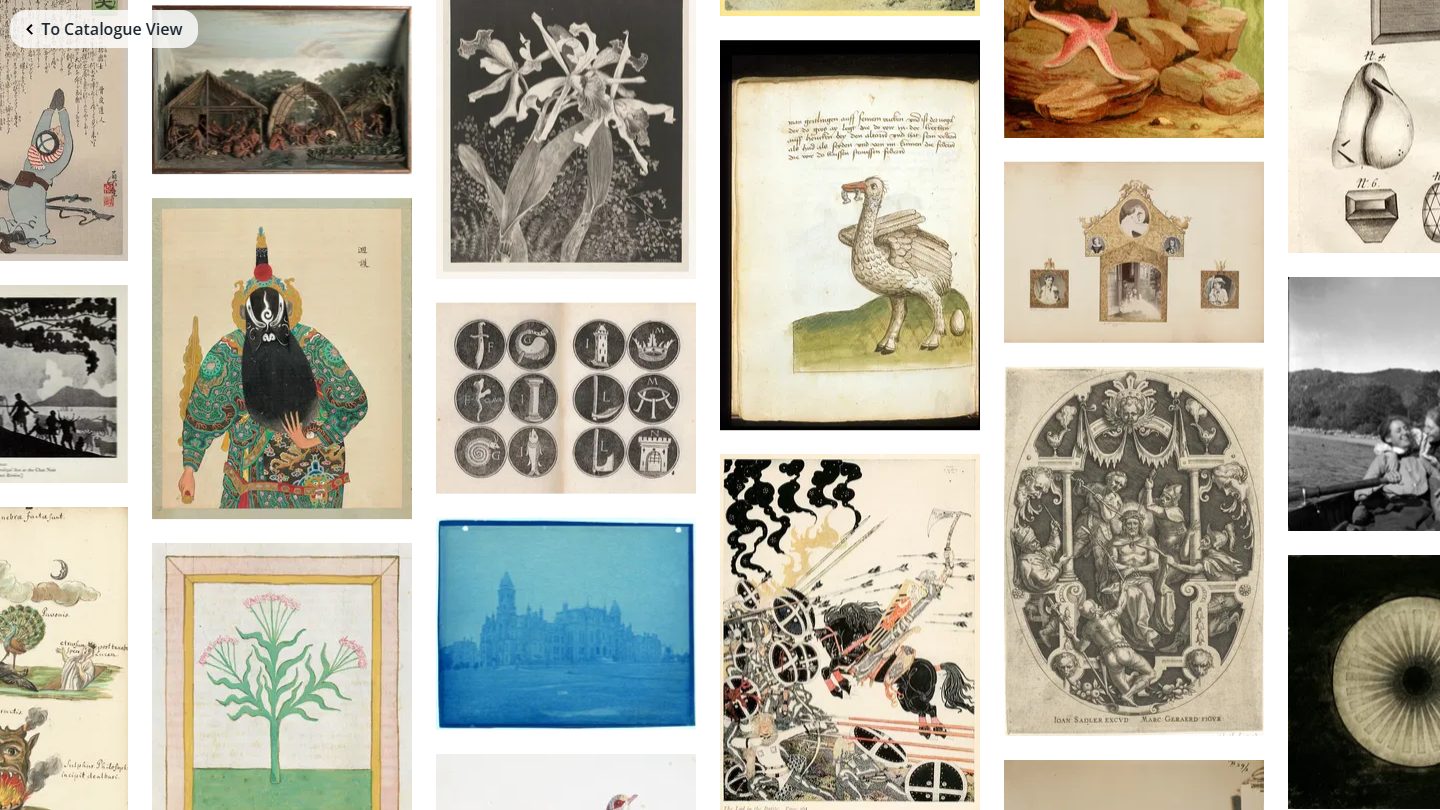
The Public Domain Image Archive (PDIA) is a curated database of 11,082 out-of-copyright works — as of this writing — all free to browse, download, and reuse. It’s a living catalogue, with new images added every week, and the structured search lets you slice the collection however you want to find your way in: by Artist, by Century, by Style, by Theme, by Tag, or through the curated All Galleries view. What’s actually in there is gloriously eclectic: medieval manuscripts, early color photography, 16th-century illustrations of celestial phenomena, and Victorian gym equipment all sit in the same database. The site offers three different ways to browse it: Catalogue View, which is the classic search-and-filter table; Infinite View, the 360° endlessly scrollable wall; and Shuffle View, which serves up something at random.
Who runs it (and the bigger project it’s part of):
PDIA is run by The Public Domain Review, the editorial and magazine project that publishes long-form essays drawing on public-domain artifacts. Think of it as a two-layer thing: PDIA is the bare-archive layer, the catalogue you go searching through when you need an image; PDR is the editorial layer that sits on top, writing curated essays that surface interesting things from PDIA and other archives. We’ll cover PDR itself in a future Discovery — they earn their own post. For now, what matters is that the archive has a serious editorial brain behind it, which is why the tagging and curation actually go somewhere.
The Infinite View (and why this isn’t just a search box):
This is the part that makes PDIA different. Most archives are a search bar and a grid of thumbnails, which means you only ever find what you already knew you were looking for. Type “botanical” and you get botanical. Type “portrait” and you get portraits. PDIA’s Infinite View turns the archive into something you can wander instead — an endless 360° wall of art that just keeps loading as you scroll. You drift into a Victorian gym ad sitting next to an illuminated 1450 manuscript page sitting next to a 1923 botanical lithograph, and within thirty seconds you’re looking at something you’d never have thought to search for. Shuffle View does the same thing with a single random pick — load, react, load again. That’s the editorial point: the difference between “here’s a database” and “here’s a way to discover things you didn’t know existed.” A stock-photo site optimizes for the first. PDIA optimizes for the second, and it’s the reason to send people there.
How to use it (free, no login, downloadable for real):
Go to pdimagearchive.org, or jump straight into the wall at the Infinite View. No account. No watermarks. No “free preview, full-resolution costs money” trick. Browse by Century if you want to time-travel one decade at a time. Browse by Theme if you want everything tagged “death” or “celestial” or “flora.” Browse by Artist if you came for a specific name. When you click into an image you can download the full-resolution file — the actual file, not a low-res preview — and use it on a blog, in a book, on a t-shirt, in a slide deck. They mean it about reuse. Free to browse, free to download, free to use. Open the Public Domain Image Archive and start wandering.