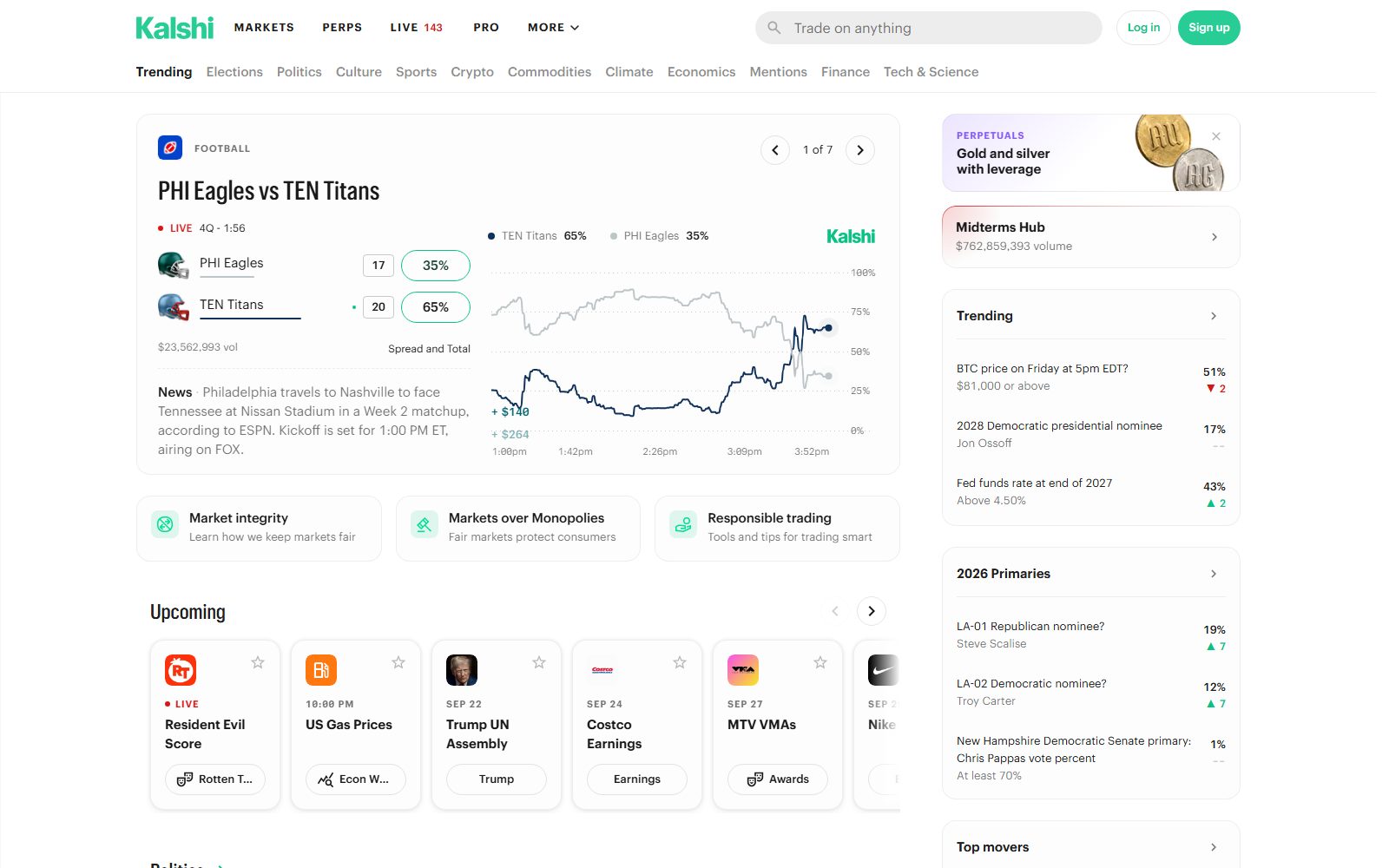
This isn’t a ranked list — there’s no natural “Top 10” for a legal and financial fight that’s still unfolding in real time. It’s a verified roundup of what’s actually new in two collisions happening at once: the older, state-licensed sports betting industry, and the newer “prediction market” platforms like Kalshi and Polymarket that let people trade on sports outcomes without a state gambling license. Every claim below was checked against a court ruling, a regulator’s own data, or direct reporting rather than taken from a general search summary, and a couple of widely repeated figures didn’t hold up — they’re corrected in place below rather than quietly dropped.
Prediction Markets: The Regulatory Fight
Kalshi has been registered with the Commodity Futures Trading Commission (CFTC) as a designated contract market since November 2020, and Polymarket relaunched a CFTC-regulated U.S. app in December 2025 after being blocked from the U.S. market since 2022. Both argue that federal registration makes their sports contracts legal nationwide, preempting state gambling law entirely — and states have spent 2026 aggressively testing that argument in court, with genuinely mixed results. Source: Wikipedia, Kalshi; Wikipedia, Polymarket.

The most significant single ruling so far: on August 28, 2026, the Ninth Circuit Court of Appeals sided with Nevada, holding that Kalshi’s sports-event contracts function as wagers rather than the “swaps” the CFTC was built to oversee — clearing the way for Nevada to enforce its own gaming laws against the company. Kalshi filed a petition for an en banc rehearing on September 9, 2026. That ruling directly conflicts with an April 2026 decision from the Third Circuit, which blocked New Jersey from enforcing its gambling regulations against those same kinds of sports contracts. Gaming attorney Joshua Kirschner of Holland & Knight called the resulting split “absolutely ripe” for the Supreme Court, though a Ninth Circuit rehearing could delay that timeline; the Court’s next term runs October 2026 through June 2027. Source: Covers.com, Ninth Circuit Rehearing Could Shape Prediction Market Supreme Court Timeline, September 16, 2026.
New York is the other headline case, and it’s a genuine correction to a widely repeated claim: it wasn’t decided by a state judge, and it wasn’t a win for Kalshi. New York Attorney General Letitia James sued Kalshi in July 2026, alleging illegal, unlicensed gambling and seeking roughly $36 billion in forfeited profits, taxes, and consumer compensation. Kalshi sought a preliminary injunction to block enforcement while the case proceeds, arguing the suit intruded on the CFTC’s exclusive federal authority. On July 7, 2026, U.S. District Judge Analisa Torres of the Southern District of New York rejected that argument, ruling that “Congress did not intend to preempt all state actions that may relate to DCMs” and that New York’s gambling laws “complement rather than conflict with federal law.” Kalshi is appealing to the Second Circuit, and the underlying $36 billion lawsuit is still ongoing — but for now, New York can keep enforcing its rules. Source: Ars Technica, Judge Rejects Kalshi Attempt to Override New York State Gambling Laws, July 8, 2026.
The split runs deeper than just two circuits. In Ohio, federal judge Sarah D. Morrison ruled in March 2026 that Kalshi’s products are gambling under Ohio Casino Control Commission jurisdiction. Massachusetts and Washington both won preliminary injunctions against Kalshi in 2026. Yet in Arizona, federal judge Michael T. Liburdi dismissed the state’s criminal charges against Kalshi in May 2026, ruling that federal law does preempt state law there — the opposite conclusion, from a different court, on essentially the same underlying legal question. Minnesota passed a law banning prediction markets outright in 2026, and a federal judge sided with Kalshi against that law in July. Meanwhile, the CFTC itself has sued several states — Wisconsin, New York, Arizona, Connecticut, Illinois, Massachusetts, and Minnesota — to defend what it calls its exclusive jurisdiction, and President Trump publicly called the governors and attorneys general opposing that position “SCUM” in a social media post. Nothing about this fight is settled. Source: Wikipedia, Kalshi.
Prediction Markets: The Growth Numbers
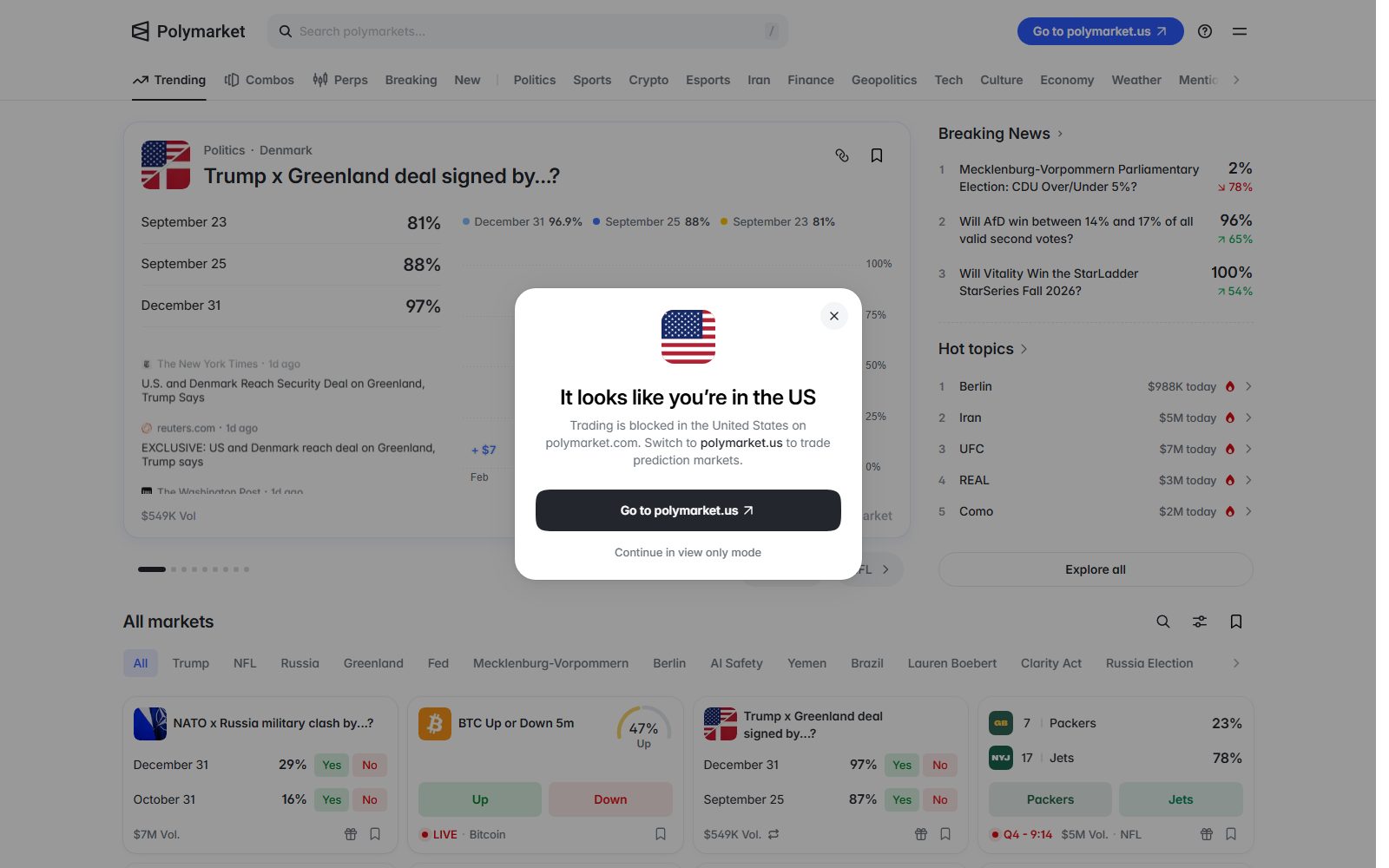
The growth figures cited around this industry are large, and worth being precise about what’s a reported fact versus a forecast. Prediction markets did roughly $51 billion in trading volume in 2025 — that part is a reported figure. Bernstein Research is projecting that could reach $240 billion by the end of 2026 and $1 trillion annually by 2030 (an implied ~80% compound annual growth rate) — those two numbers are analyst forecasts, not facts, and should be read that way. By early 2026, Kalshi and Polymarket had already combined for more than $60 billion in volume. Source: Markets Insider, citing Bernstein Research, September 1, 2026.
One figure worth correcting rather than repeating: reports of Kalshi’s federal lobbying spend at roughly $500,000 for a single quarter understate what’s actually on the record. Per lobbying disclosures reported by CNBC, Kalshi’s total federal lobbying spend hit about $1.8 million in the first half of 2026 alone — $990,000 spent directly plus the rest through outside firms — its highest six-month lobbying total on record, compared to $1 million spent across all of 2025. Source: Daily Caller News Foundation, citing CNBC lobbying disclosures, September 1, 2026.
On the insider-trading front, this needs to be handled carefully, because one matter is an active federal investigation and not a conviction. Per Kalshi’s own account of the matter, reported in July 2026, a teleprompter operator for President Trump, identified as Gabriel Perez, is alleged to have misused the platform by betting almost $100,000 on which specific words the President would say during the 2026 State of the Union address. That is an allegation under investigation, not an adjudicated finding of wrongdoing. A separate, already-resolved case offers a useful point of contrast: in August 2026, the CFTC fined former Congressman George Santos $35,000 (double his profit) after a federal investigation found he manipulated a Kalshi market tied to his own publicized State of the Union attendance — he had bet against himself attending on Kalshi’s rival Polymarket, then didn’t show up. Kalshi, which had already dropped Santos as a paid spokesman, separately clawed back $70,000 from him and banned him from the platform for life, the first time it has taken that step against anyone. Source: Wikipedia, Kalshi.
There’s also a real underage-use gap worth flagging: prediction markets frame themselves as financial exchanges rather than gambling sites, which several platforms have used to set their minimum age at 18 rather than the 21-plus minimum gambling age in most U.S. jurisdictions. Per CNN, citing the platform’s own data, users between 18 and 21 had traded an estimated $5.4 billion on Kalshi so far in 2026. Source: CNN, Young Adults Under 21 Traded $5 Billion on Kalshi This Year, August 28, 2026.
Traditional Sports Betting: Where It’s Legal Now
As of September 2026, 39 states plus Washington, D.C. allow some form of legal sports betting, with 30 of those offering it online or through an app — both the American Gaming Association and CBS Sports’ own state-by-state tracker independently confirm that count this month. Source: CBS Sports, U.S. Sports Betting: Where All 50 States Stand, September 16, 2026.
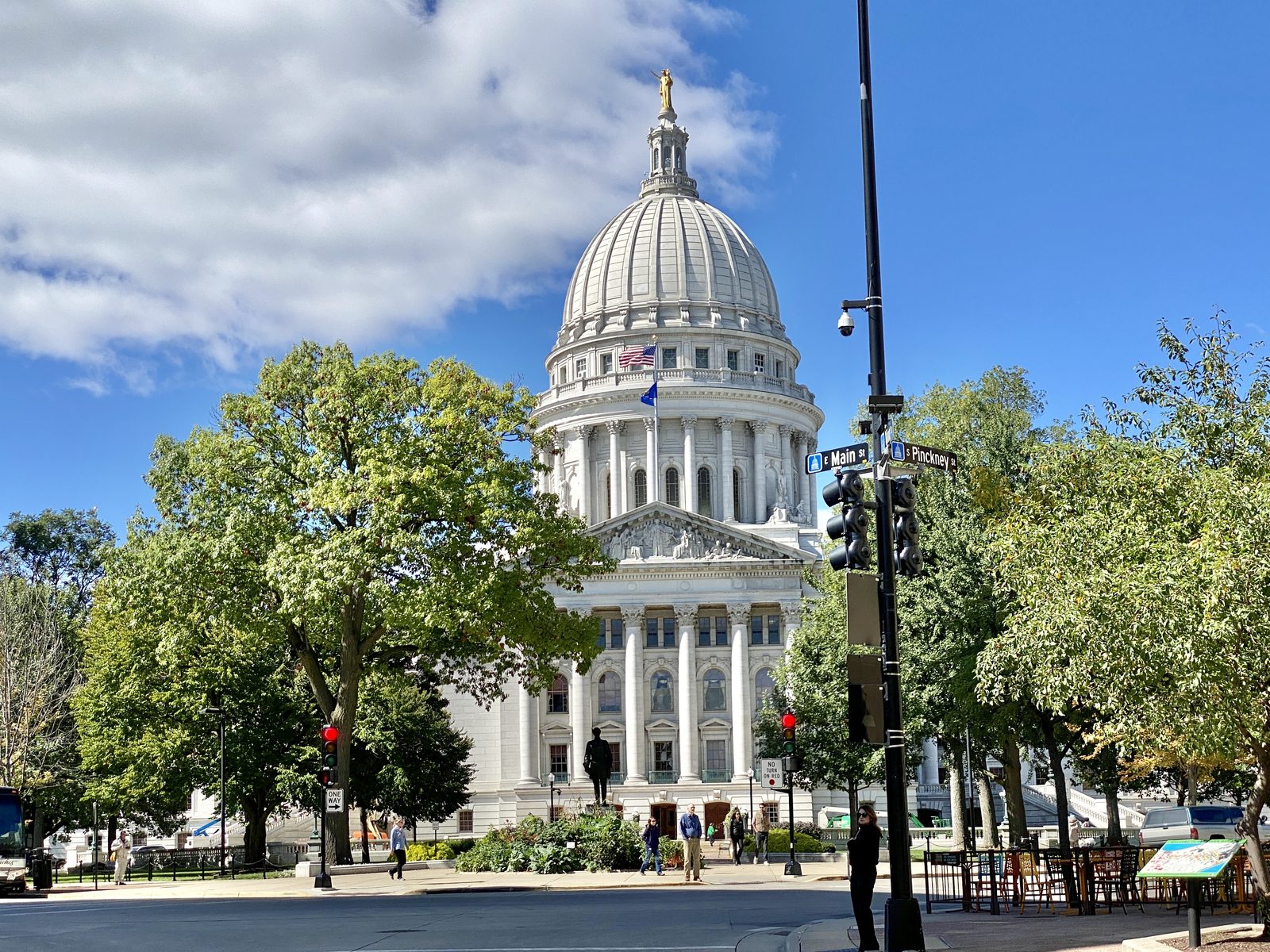
Wisconsin needs an honest correction here, not the headline it usually gets. Governor Tony Evers signed online sports betting into law on April 9, 2026, making Wisconsin the 33rd state to allow it — but that’s a legalization date, not a launch date. As of this post, mobile sports betting still hadn’t actually gone live in Wisconsin; the law gives the state’s federally recognized tribes exclusive rights to operate mobile sportsbooks, meaning commercial operators like DraftKings and FanDuel can’t launch there independently, and CBS Sports’ own September 2026 tracker still lists Wisconsin as “legal, launch pending.” Retail sportsbooks inside Wisconsin tribal casinos have been running for longer. Source: CBS Sports, U.S. Sports Betting: Where All 50 States Stand, September 16, 2026.
Arkansas checks out as reported: in March 2026, DraftKings and FanDuel entered the Arkansas market for the first time, but not through direct state licenses — both partnered as technology vendors with existing licensed casinos, DraftKings with Southland and FanDuel with Oaklawn, marking the first time either national operator had been available to Arkansas bettors. Source: CBS Sports, U.S. Sports Betting: Where All 50 States Stand, September 16, 2026.
One more honest gap: Puerto Rico is real, but it isn’t part of the “39 states” count above — it’s a U.S. territory that separately legalized sports betting back in 2019 and has been operating its own regulated market for several years already, running on its own timeline rather than the 2018 Supreme Court decision that opened the door for the 50 states.
Traditional Sports Betting: Who’s Winning
The clearest real story here isn’t “another record year” — it’s that growth has genuinely stalled. Per the American Gaming Association’s own Commercial Gaming Revenue Tracker, Q2 2026 sports betting handle was $38.84 billion (up 7.8% year-over-year), but sportsbook revenue was $3.91 billion, down 0.2%, with hold (the share of wagers operators keep) falling 81 basis points to 10.1% — more money flowing through the system, less of it staying with operators. Total U.S. commercial gaming revenue, which includes casinos and iGaming, was healthier: $20.39 billion in Q2 2026, up 5.1%, with iGaming specifically up 16.5%. Source: TheSpread.com, citing the AGA Commercial Gaming Revenue Tracker, September 7, 2026.
The AGA’s own NFL-specific projection makes the point even more directly: it estimates Americans will legally wager $29.5 billion on the 2026 NFL season through regulated sportsbooks, just 0.3% above 2025’s actual $29.4 billion — the smallest year-over-year increase since the Supreme Court struck down the federal sports betting ban in 2018, and by the AGA’s own account, the first flat NFL betting season since legalization began. AGA president and CEO Bill Miller said directly that “since the widespread launch of backdoor sports betting on so-called ‘prediction markets,’ the growth of legal handle has stalled,” and the AGA separately estimated that bettors aged 18–20 — below the legal sports betting age in most states — accounted for over $5 billion of that projected handle. Source: Covers.com, AGA Expects 1st NFL Season With Flat Growth Since Sports Betting Legalization, September 4, 2026.
That stall shows up state by state, too: Pennsylvania sportsbook revenue was down 20% year-over-year in August 2026, New York posted its lowest monthly handle since July 2025 (down 15.2% year-over-year) the same month, and Missouri hit a record-low monthly handle in July. On the older, full-year figures sometimes cited for this industry: the Tax Foundation reports that legal sports wagers totaled more than $157 billion in fiscal 2025, generating over $3.2 billion in state sports-wagering tax revenue — a genuine, sourced number, but a different one (and a different measurement period) than the unverified $165.6 billion figure that circulates elsewhere; it's used here instead. Source: Covers.com, Pennsylvania Sports Betting Revenue Drops 20% YoY, September 18, 2026; TheSpread.com, citing the Tax Foundation, September 7, 2026.
DraftKings and FanDuel remain the NFL’s two longest-running official sportsbook partners, and in August 2026 the league signed new multi-year deals with both, adding Fanatics Betting and Gaming as a third official partner — notably, no prediction-market platform was included. Even so, both companies are under real financial pressure: DraftKings’ stock was down roughly 50% over the trailing year as of August 2026, and FanDuel’s parent, Flutter Entertainment, was down close to 69% over the same span, even as both companies publicly downplay prediction-market “cannibalization.” Source: NFL.com, NFL Announces Official Partnerships With Three Leading Sports Betting Operators, August 26, 2026.
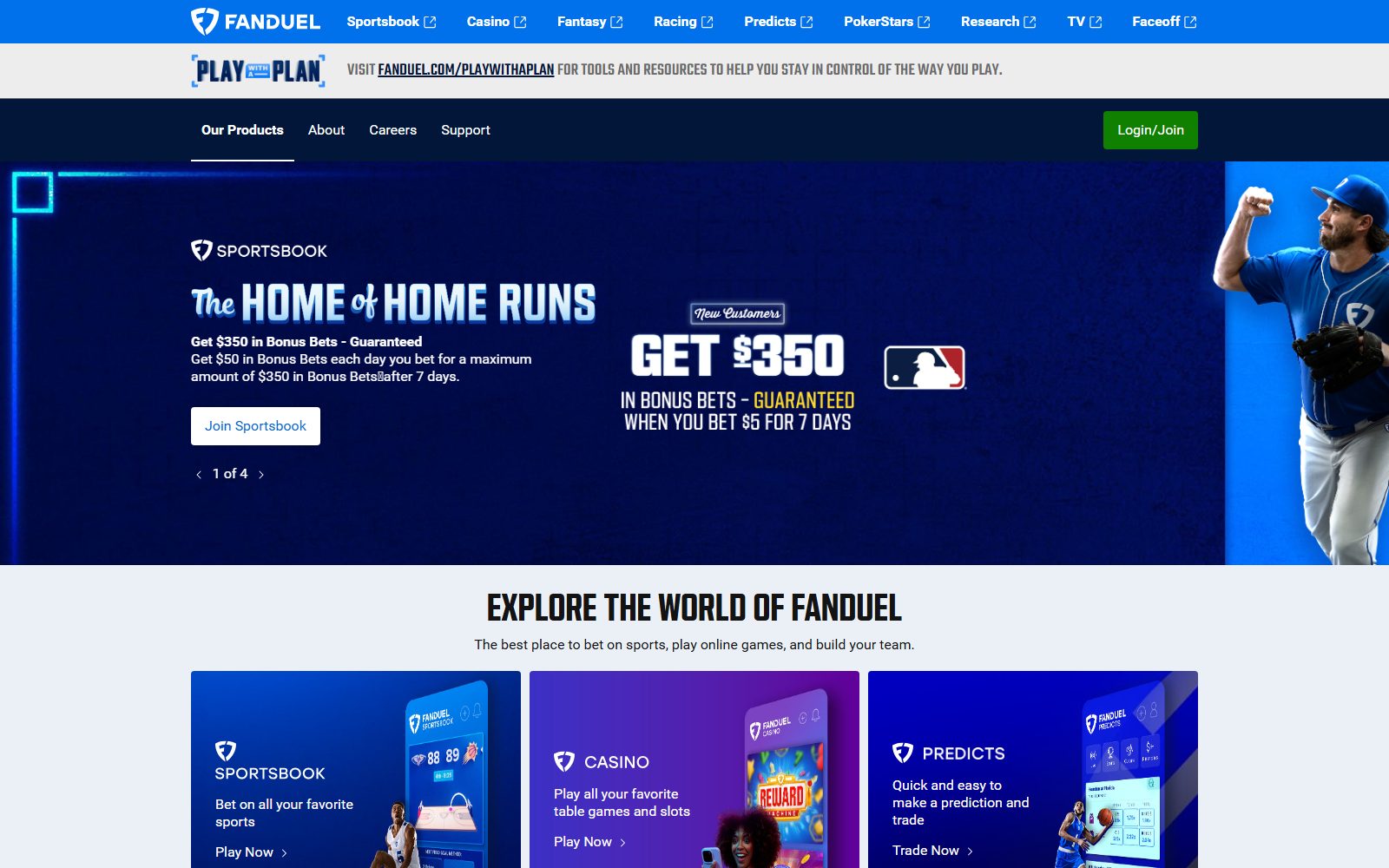
The irony: both companies are quietly building their own prediction-market products rather than just fighting the category. On DraftKings’ own August 2026 earnings call, CEO Jason Robins said the company’s predictions platform grew its annualized trading volume from $2.3 billion to $11 billion between April and July 2026 alone. And FanDuel’s own homepage today runs “Predicts” as a top-line product tab, right alongside Sportsbook and Casino, not hidden away. Both traditional operators and prediction-market platforms have also ramped up political spending ahead of the 2026 midterms: combined election-related spending by sports betting and prediction-market companies surpassed $72 million by late July 2026. Source: CNBC, Prediction Markets Take Center Stage in Latest Quarterly Earnings, August 7, 2026; Reuters, Sports Betting Industry Spending on US Midterm Elections Surpasses $72 Million, July 28, 2026.
The legal fight isn’t close to settled — a real circuit split, a New York case still headed toward trial, and a Ninth Circuit rehearing decision that could shape whether the Supreme Court steps in this term or waits. The growth numbers are real but should be read as what they are: a strong reported 2025, and analyst forecasts — not facts — for 2026 and beyond. And the traditional sportsbook industry's own data tells a story most people haven't heard yet: 2026 is on pace to be the first flat betting season since legalization began in 2018, with DraftKings and FanDuel responding not by fighting prediction markets outright, but by quietly becoming prediction markets themselves.