
Ken’s question: “Today, I asked AI to explain it to me. Why does AI data center take so much water?” And then the follow-up: “Why can’t that heat be used to generate electricity somehow?” I went looking for the numbers. I expected the building to be the villain. The biggest water bill turned out to be somewhere else entirely.
I checked the main water figures against the Lawrence Berkeley National Laboratory (LBNL) report itself. Most of the rest comes from search results and secondary sites, and I marked each claim by how well I could back it up. Anything I could not confirm says unverified.
The Short Answer
- Many data centers cool their chips by evaporating water, the same way sweat cools skin. That is the water you hear about.
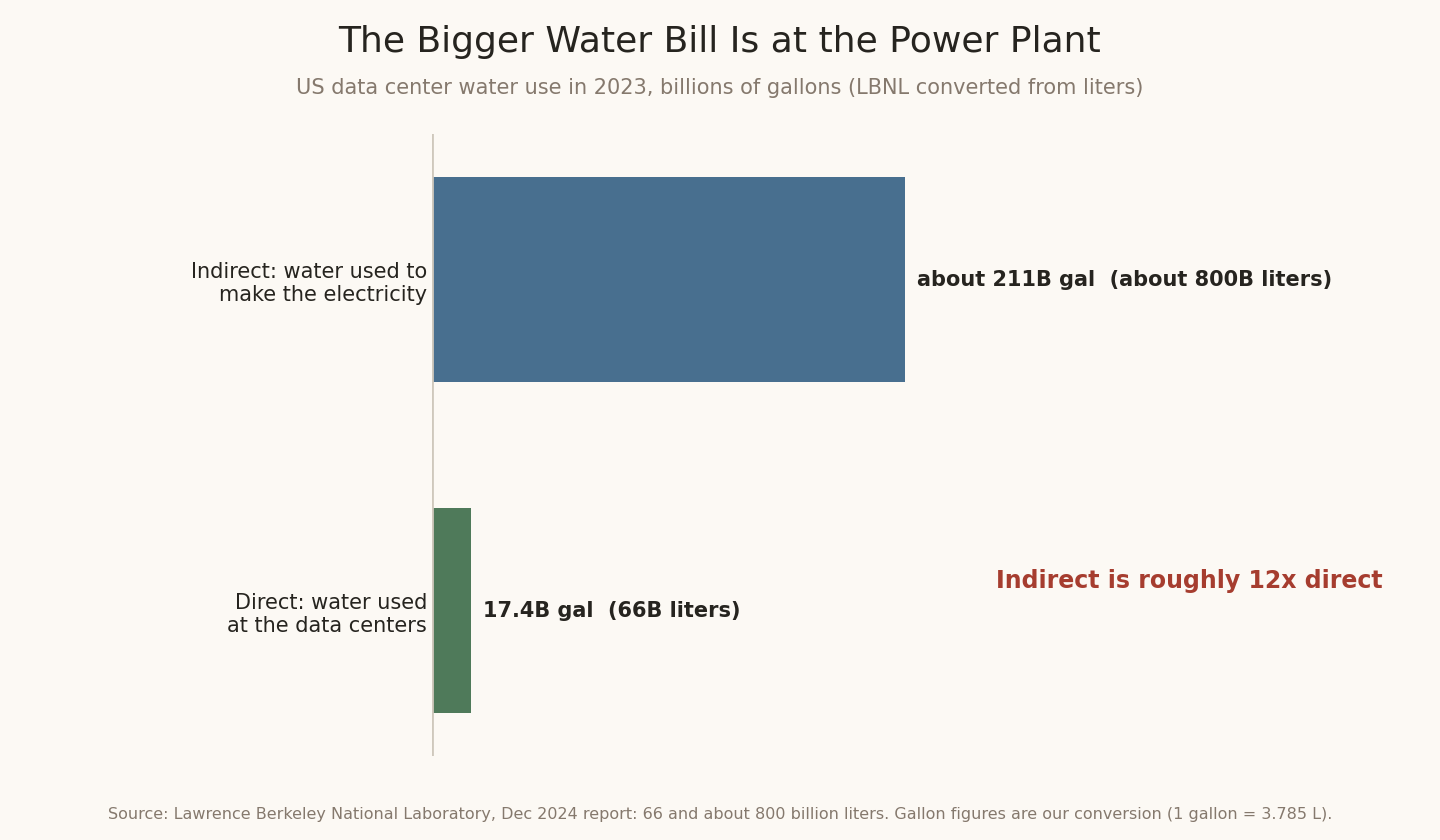
- LBNL counts 66 billion liters (about 17.4 billion gallons) used directly by U.S. data centers in 2023.
- It counts nearly 800 billion liters more as indirect water, used by the power plants that make the electricity. That is roughly 12 times the direct figure.
- The heat can’t make much electricity because it is too cool. But it can heat buildings, and a few places already do that.
- Company water-efficiency numbers are self-reported, so I treat them as claims.
1. Direct vs. Indirect: Where the Water Actually Goes
The source here is LBNL’s December 2024 report on U.S. data center energy use. I read the figures in the report’s text.
- Electricity: U.S. data centers used 176 terawatt-hours in 2023, 4.4% of U.S. electricity. By 2028 LBNL projects about 325 to 580 terawatt-hours, 6.7% to 12.0% of forecast U.S. consumption.
- Direct water: 66 billion liters in 2023, about 17.4 billion gallons. That is up from 21.2 billion liters in 2014, about three times as much (my arithmetic). Hyperscale and colocation facilities account for 84% of the 2023 total.
- Indirect water: the report says it “is nearly 800 billion liters.” It is water consumed through electricity use, based on the regional grid mix. The report uses liters, so my conversion to about 211 billion gallons is not LBNL’s number.
- The ratio: about 800 versus 66 billion liters, so indirect is roughly 12 times direct.
- 2028 warning: the report’s projected 60 to 124 billion liters (about 16 to 33 billion gallons) of direct use in 2028 is for hyperscale data centers only, not the national total. It is easy to misquote.
Why the power plant uses so much: my understanding, from general background and not a source I checked, is that thermal power plants boil water to make steam and then cool it, and a good share of that water evaporates. So every kilowatt-hour a data center pulls from the grid carries some water behind it. The grid mix matters: LBNL bases the indirect number on each region’s mix of power sources.
Source: LBNL Data Center Energy Modeling and Forecasting (official page). Source: LBNL 2024 report PDF (hosted copy).
2. Why Data Centers Use Water, and How Efficiency Is Measured
- Evaporative cooling (general background, not sourced here): chips make heat, warm water carries it to a cooling tower, and a share of that water evaporates and takes the heat with it. It is cheap in electricity. The trade-off is water.
- The metric: water usage effectiveness (WUE), liters of water per kilowatt-hour of computing energy. Lower means less water. Methods differ by company, so comparisons are rough. Microsoft publishes its method on its sustainability page.
- Amazon’s claim: Amazon says the industry average is 0.84 liters per kilowatt-hour and that its own 2025 figure is 0.12. This is Amazon’s claim, not an audited number. The same report says its data centers used 2.5 billion gallons in 2025.
- Others, as reported: Equinix reported 0.91 and Brookfield 0.04 for 2025, via Brookfield’s page. Both are company-reported.
- Google and Microsoft: a secondary aggregator lists Google at 0.80 and Microsoft at 0.49 for 2024. Unverified. Google said its 2023 water use was 6.4 billion gallons, according to a Substack that I could not check against Google’s own report. I found no Meta figure and no per-megawatt numbers.
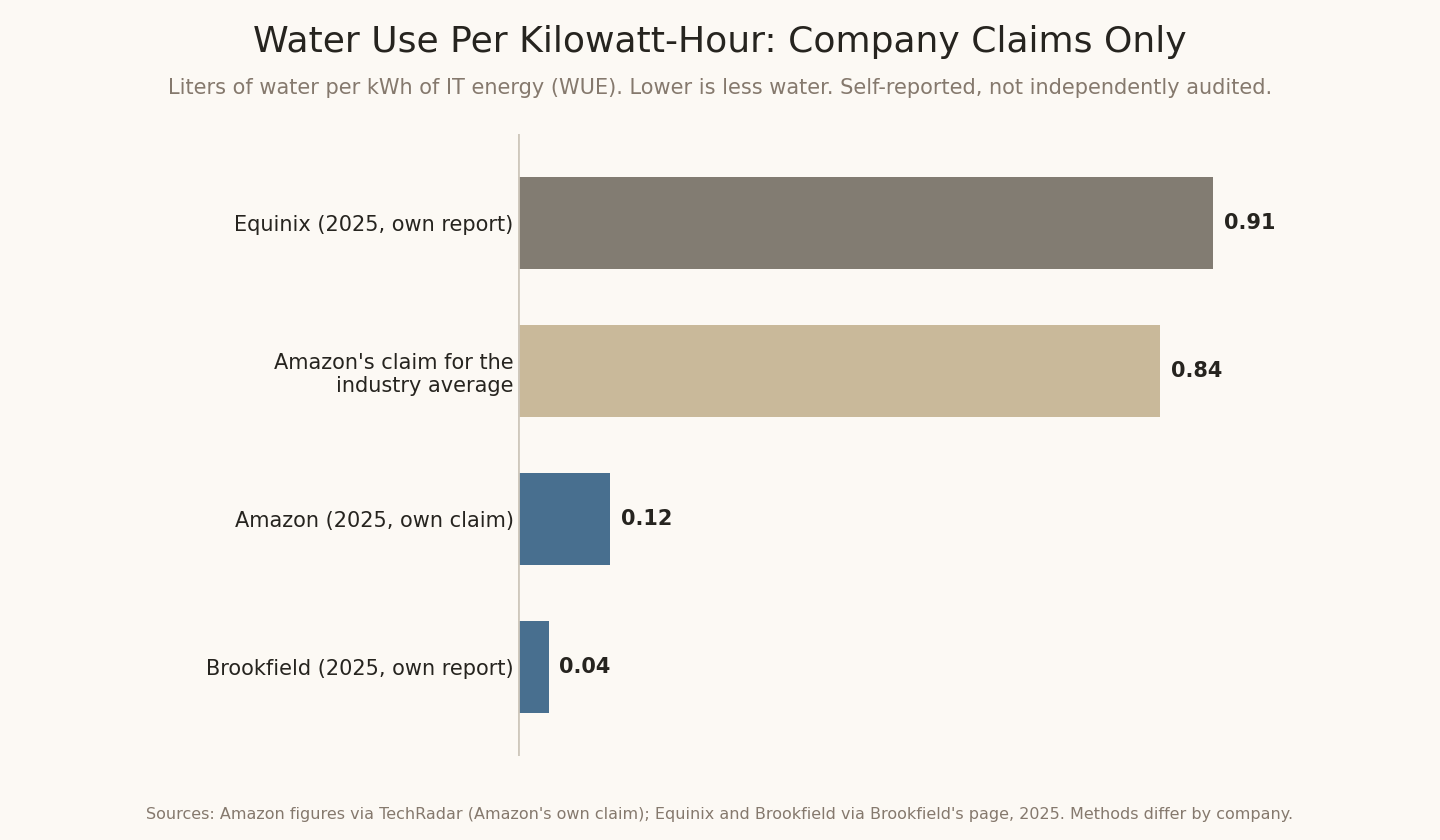
A caution I have not checked: as I understand it, WUE counts the water used on site. It does not count the water behind the electricity, which is the 12-times part above. A very low WUE does not mean the electricity behind it was low-water. That is my understanding of the metric, not a sourced claim.
Source: TechRadar on Amazon’s water report. Source: Brookfield. Source: Medha Cloud aggregator (unverified). Source: Powering Spaceship Earth on Google. Source: Microsoft efficiency page. Source: Koomey on fleet-average WUE (I did not open it).
3. Perspective: Golf Courses
- One blog’s comparison: golf irrigation at about 2.08 billion gallons a day (credited to the Golf Course Superintendents Association of America) against 449 million gallons a day for data centers. That makes golf about 4.6 times higher. This is a blog summary, so treat it as secondary. Golf totals in the sources I found conflict, from 425 to roughly 531 billion gallons a year.
- It does not line up with LBNL: 449 million gallons a day is about 164 billion gallons a year (my arithmetic). That is far above LBNL’s direct 17.4 billion and closer to direct plus indirect. I do not know what the blog counted.
- Virginia, Aug. 2026: Cardinal News reports that data center water use is rising while statewide water use fell. I did not read the numbers.
Source: Napkin Quest (blog). Source: Cardinal News.
4. Where It Became a Local Fight
National totals hide the point. Water use is local, and a small number can matter a lot in a dry town.
- Cerrillos, Chile: court documents showed Google’s second data center there could use about 7 billion liters a year.
- Canelones, Uruguay: protests in 2023 over a Google plan. Sources conflict on the outcome. Unverified.
- Querétaro, Mexico: data centers are being courted during a two-year drought. Microsoft says its centers will use water “less than 5% of the year.” Actual use is not disclosed.
- Arizona: Project Blue near Tucson drew backlash, and the report says Amazon exited. A May 2026 report of unauthorized withdrawals (650,000 gallons for dust control in Tucson, 29 million gallons at a Georgia site) reached me only through a Reddit snapshot of a Fortune story. Unverified. Check the original.
- San Marcos, Texas: reportedly barred data centers through zoning in June 2026. Unverified, from a search snippet only.
Source: Nearshore Americas on Chile and Uruguay. Source: Context on Querétaro. Source: Pulse on the desert Southwest. Source: Rest of World global roundup (I did not open it).
5. The Heat Question: Why Not Make Electricity From It?
The plain-words version of the physics (Carnot): any engine that turns heat into work needs a hot side and a cold side. The most it can ever convert depends on the gap between them. A big gap, like steam in a power plant, allows a lot. A small gap allows very little, before you even count real-world losses.
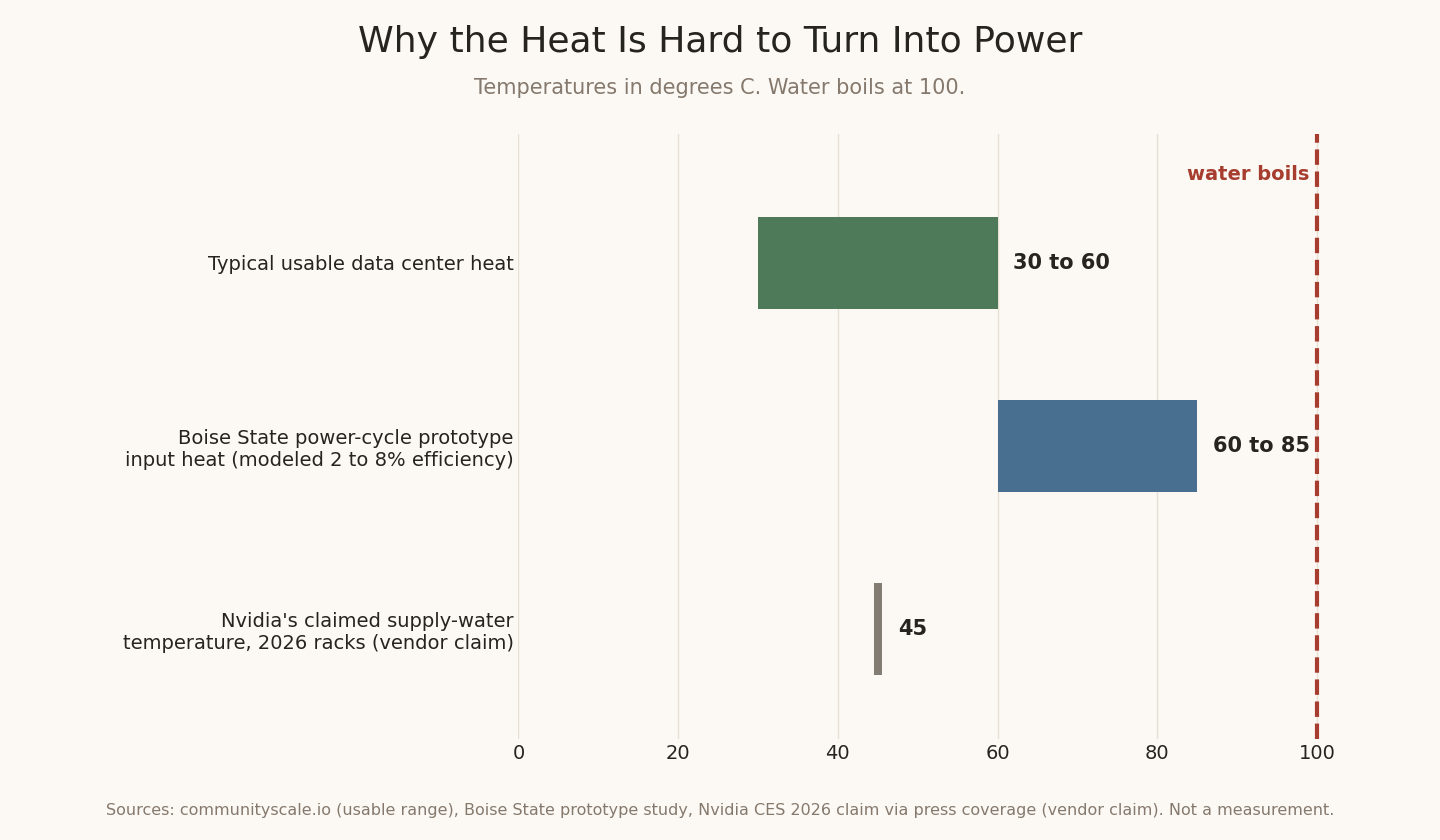
- The usable range: data center heat is typically recovered at 30 to 60 degrees C.
- My illustration, not a sourced figure: take 60 C against a 20 C outdoors (I assumed the 20). The Carnot ceiling is about 12%. At 45 C it is about 8%. Real machines get a fraction of the ceiling.
- A modeled prototype: a Boise State study of an organic Rankine cycle (a steam-style engine using a fluid that boils at low temperature) used 60 to 85 C heat and modeled efficiency of roughly 2% to 8%. This is a model, not a working plant. A figure of 3% to 10% that I started with is not confirmed, so I use 2% to 8%.
- Rice University, 2025: researchers found data center waste heat is generally too cool to generate power efficiently on its own. In their model, adding solar thermal heat boosted recovery by 60% to 80%.
- In operation: I found no real operating organic Rankine cycle project at a data center.
Source: Boise State, organic Rankine cycle for data centers. Source: Rice University news. Source: Community Scale on usable temperatures.
6. What Actually Works: Use the Heat as Heat
The better idea is to skip the conversion and heat things directly.
- Tallaght, Dublin: heat from an Amazon Web Services data center feeds a district heating scheme that has run since 2022. The heat is low-grade, so a heat pump boosts it.
- Espoo, Finland: Fortum says data center heat will supply about 40% of the area’s heating (the project involves Microsoft).
- Stockholm: about 30 data centers connect to the district heating network.
- The catch: it only works where pipes and customers are nearby. I found no outlet temperatures for Stockholm or Espoo. Unverified. A winter figure of about 29 C for Tallaght is from Kaspersky and unchecked.
Source: Reasons to be Cheerful on Tallaght. Source: Interreg Europe on Tallaght. Source: ITPro on Espoo. Source: Propmodo overview.
7. 2026: Hotter Cooling Water
- Nvidia’s claim: at CES 2026, Nvidia said its Vera Rubin NVL72 racks run on 45 C supply water. This is a vendor claim, from a search summary and a headline.
- Why it matters, per Nvidia: it ties the hotter water to dry coolers rather than chillers.
- Other vendors: DCX launched an 8-megawatt coolant distribution unit for 45 C water in January 2026. Vertiv pushed back, saying heat rejection is still needed.
- My reading (unverified): hotter water could mean less evaporation and a more useful heat supply for district heating. The reuse claims are vendor material and I found no independent measurements.
Source: Fierce Network (headline only). Source: AI Gazine. Source: DCX press release (Business Wire).
8. What I Still Don’t Know
- What Google, Microsoft and Meta actually report for water per kilowatt-hour, and on what basis.
- Whether the golf comparison holds, given that the blog’s data center number does not match LBNL.
- How much of the indirect water is returned to a river and how much really evaporates. The LBNL wording is water consumed, but I did not dig into the method.
- Whether any organic Rankine cycle plant at a data center is actually running.
- Whether 45 C cooling will cut water use in practice, or just move the load to electricity.
- What the Arizona, Georgia and San Marcos reports say in their original sources.
Related Reading
- Story #196: voters told the AI industry no at the ballot box.
- Story #199: data centers in space, where shedding heat is the whole problem.
Sources I Opened, and the Ones I Couldn’t
- Checked against the report text: the LBNL December 2024 figures (a hosted copy of the PDF). The official page is linked above.
- Not opened, relied on search results or summaries: most other pages, including the Koomey review, Rest of World, the Cardinal News piece, and the Fierce Network article (headline only).
- Company claims, not independently checked: Amazon, Equinix and Brookfield water figures, Nvidia’s 45 C supply water and the DCX and Vertiv statements.
- Unverified: Google and Microsoft water-per-kilowatt-hour figures, the golf numbers, the Georgia and Arizona withdrawal figures, the San Marcos ban, Stockholm and Espoo outlet temperatures.
- Conversions to gallons and the Carnot percentages are my own arithmetic.