
Every few weeks someone important says the future of AI computing is in orbit. After the election I watched Elon Musk post that “data centers in space” were “looking pretty appealing right now.” My gut reaction was: that is like 25 years away, if ever. This post is me trying to make that argument properly, and then checking where my gut is weakest.
This is not investment advice. I am weighing what has been built and what analysts have modeled. I am not telling anyone what to buy or sell.
The Short Answer
- My thesis: the burden of proof is on the people pitching orbital AI data centers. The best evidence so far is a roughly 1 kilowatt prototype, and every dated target I found through October 2026 has slipped. Gigawatt-scale orbital AI compute looks like a 2040s story at best.
- Where I have to be honest: “25 years if ever” is my own guess, not a finding. The most detailed independent cost model I found (SemiAnalysis) puts cost parity around 2040, about 14 years out, in its base case. An optimistic model (Forethought) says 3 to 5 years, but only if Starship ship reuse works.
- So “if ever” is the weakest part of my gut feeling. “Not soon, and not without a lot of unproven steps” is the part the evidence supports.
- The objection that sounds scariest, radiation, is actually the one the evidence answers best. Cost, heat and repair are the hard ones.
1. Who Is Pitching, and What Has Actually Flown
Here is the hardware I could find that has really been launched. Everything on it is edge-scale: watts to a few kilowatts, not megawatts.
| Project | What flew | Launched | Scale |
|---|---|---|---|
| Starcloud-1 | 60 kg bus with one Nvidia H100; company says it ran Gemma inference and nanoGPT training | 2025-11-02, Falcon 9 | 700 W chip |
| Google Suncatcher M1 | Refrigerator-sized, four Trillium TPUs; reported cooling holds about 15 minutes before the TPUs shut down | 2026-10-01, Transporter-18 | about 1 kW solar |
| Kepler | 10 optical relay satellites (~300 kg each) with 40 Jetson Orin modules and 2.5 Gbps crosslinks; sells edge compute | 2026-01-11 | edge modules |
| China pathfinders | ADA Space/Three-Body: 12 satellites in 2025 at 744 TOPS each; 8 test satellites on 2026-10-14 with 10 kW liquid-cooling loops | 2025 and 2026-10-14 | TOPS-class, 10 kW loops |
- A space-compute tracker counts 53 programs, of which 21 have flown some compute or storage. All of it is edge-scale. I use that tracker for counts and dates only, because it has internal inconsistencies.
- Suncatcher: Sundar Pichai said the first Gemini prompt answer came back on 2026-10-30 (secondary reporting). Google has not published in-orbit radiation or cooling data, per GCN. I covered the odder side of this satellite in Story #182.
- HPE reportedly lost 9 of 20 SSDs on its space-station computer (tracker, unverified by me).
- No Western startup launched a new compute satellite between April and September 2026.
- Every dated target through October 2026 slipped by 5 to 24 months. Starcloud-2 (two 8 kW satellites) moved into 2027. Starcloud-3 is listed at 200 kW on Starship.
- Paper plans are much bigger than hardware. FCC filings total about 1.26 million satellites: SpaceX/xAI 1,000,000, Starcloud 88,000, Blue Origin 51,600, others. None granted.
- SpaceX’s design for its AI1 satellite is 150 kW, and it has an aspirational 100 GW per year by 2030 (company claim). Its April 2026 IPO filing reportedly says orbital compute “may not achieve commercial viability” (Reuters-derived; I could not open the filing, so unverified).
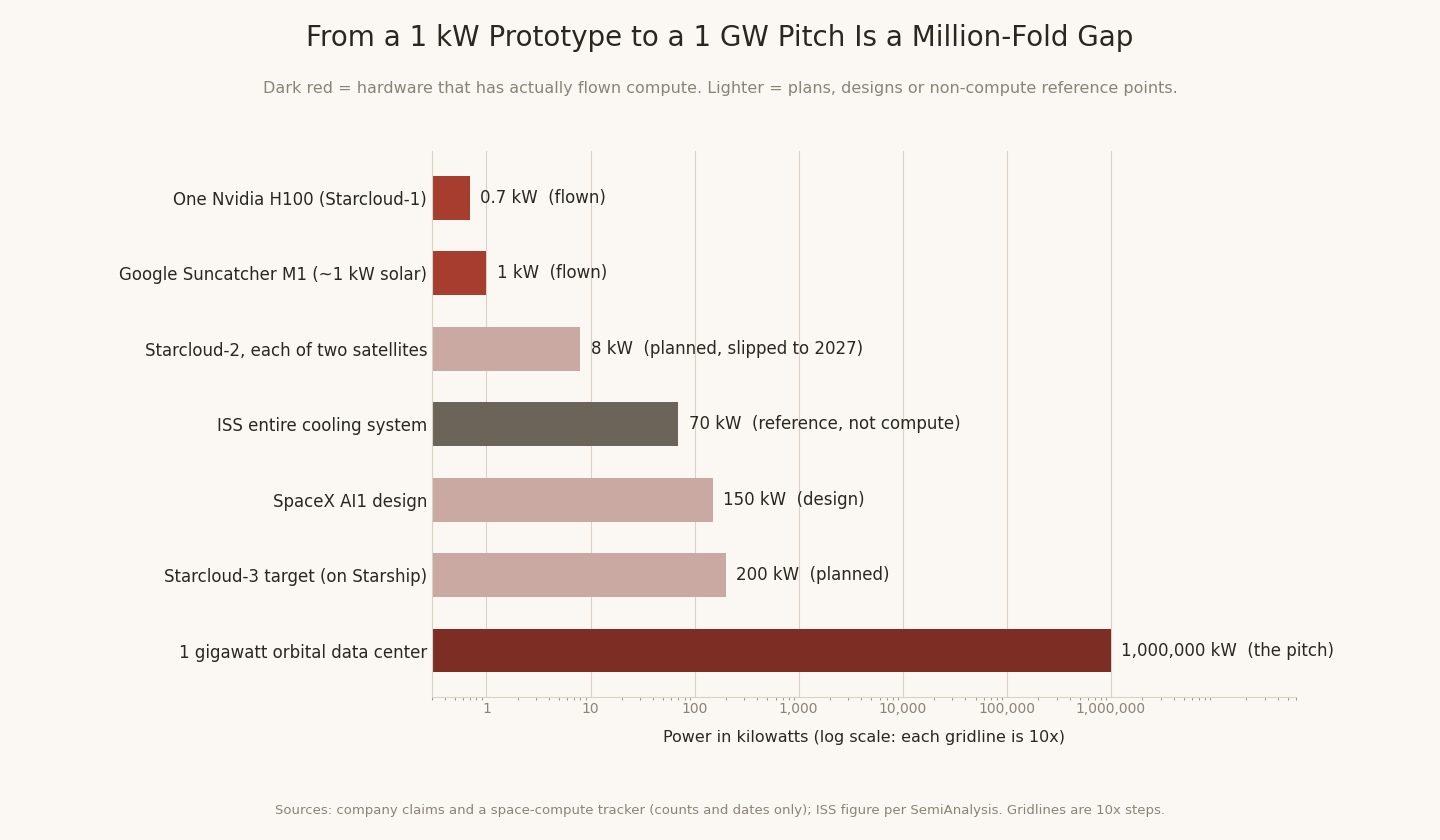
Source: Starcloud, Google, Kepler, ADA Space and SpaceX claims as compiled in a space-compute tracker (newspaceeconomy.ca; counts and dates only). Source: Google Project Suncatcher facts. Source: NPR. Source: GCN (Google has not published in-orbit data). Source: SemiAnalysis for the ISS reference point.
2. The Skeptic’s Case, Ranked by Strength
I ranked these from the strongest objection to the weakest. Several of the numbers are company claims or analyst models, and I label them as I go.
Strongest: Cost
- SemiAnalysis (June 3, 2026, “To Boldly Go”): about $10.91 per GPU-hour in orbit versus $2.49 on the ground.
- Capex per cluster unit is about $3.1 million in orbit versus about $382,000 on the ground, with $1.6 million of the orbital figure being launch.
- It assumes a 5-year orbital life versus 15 years on the ground.
- The gap is more than 4x in 2026, shrinks to about 30% in the early 2030s and reaches parity around 2040 in the base case. Early-2030s parity appears only in what it calls the “Musk case.”
- Other estimates, per GW: McCalip puts it at $31.2 billion in orbit versus $14.8 billion on the ground at $1,000 per kg of launch. His headline uses a stronger word, but his own page shows a gap of about 110%, so I am quoting numbers, not adjectives. IEEE Spectrum puts it at about $51 billion versus about $16 billion per GW over 5 years, using 4,300 satellites and 30 million kg. Wood Mackenzie reportedly says about $170 billion per GW (snippet only, unverified).
- One thing that cuts against the cost objection: electricity is only about 5 to 7% of an AI data center’s revenue and chips are the largest cost (tracker), so free solar power alone does not fix the economics.
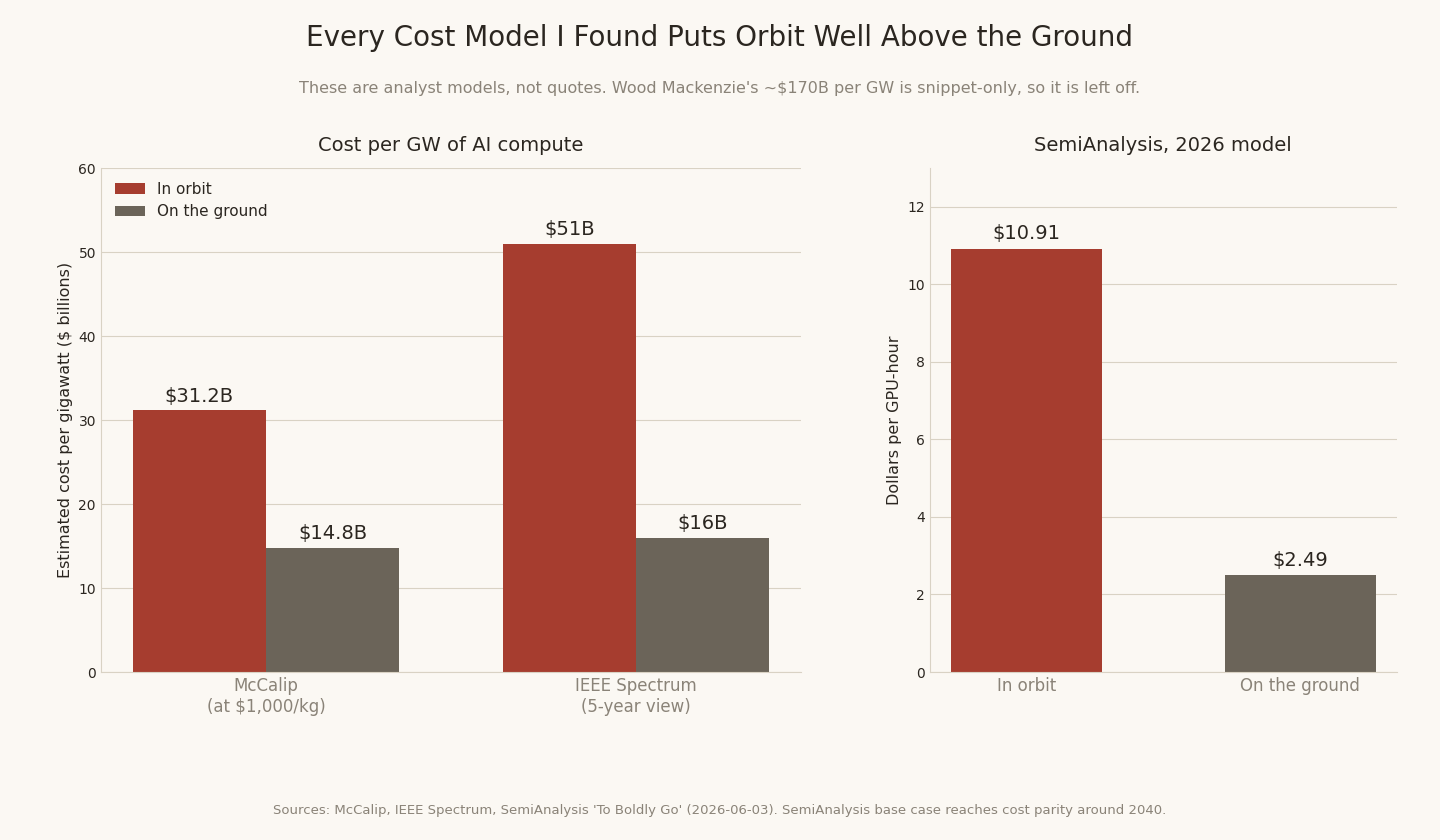
Source: SemiAnalysis, “To Boldly Go” (2026-06-03). Source: McCalip’s space data center cost analysis. Source: IEEE Spectrum. Source: Wood Mackenzie (snippet only, not opened). I could not re-open these pages myself for this draft, so the numbers are as reported by my research pass.
Second: Launch Cost Has to Fall by 6x to 30x
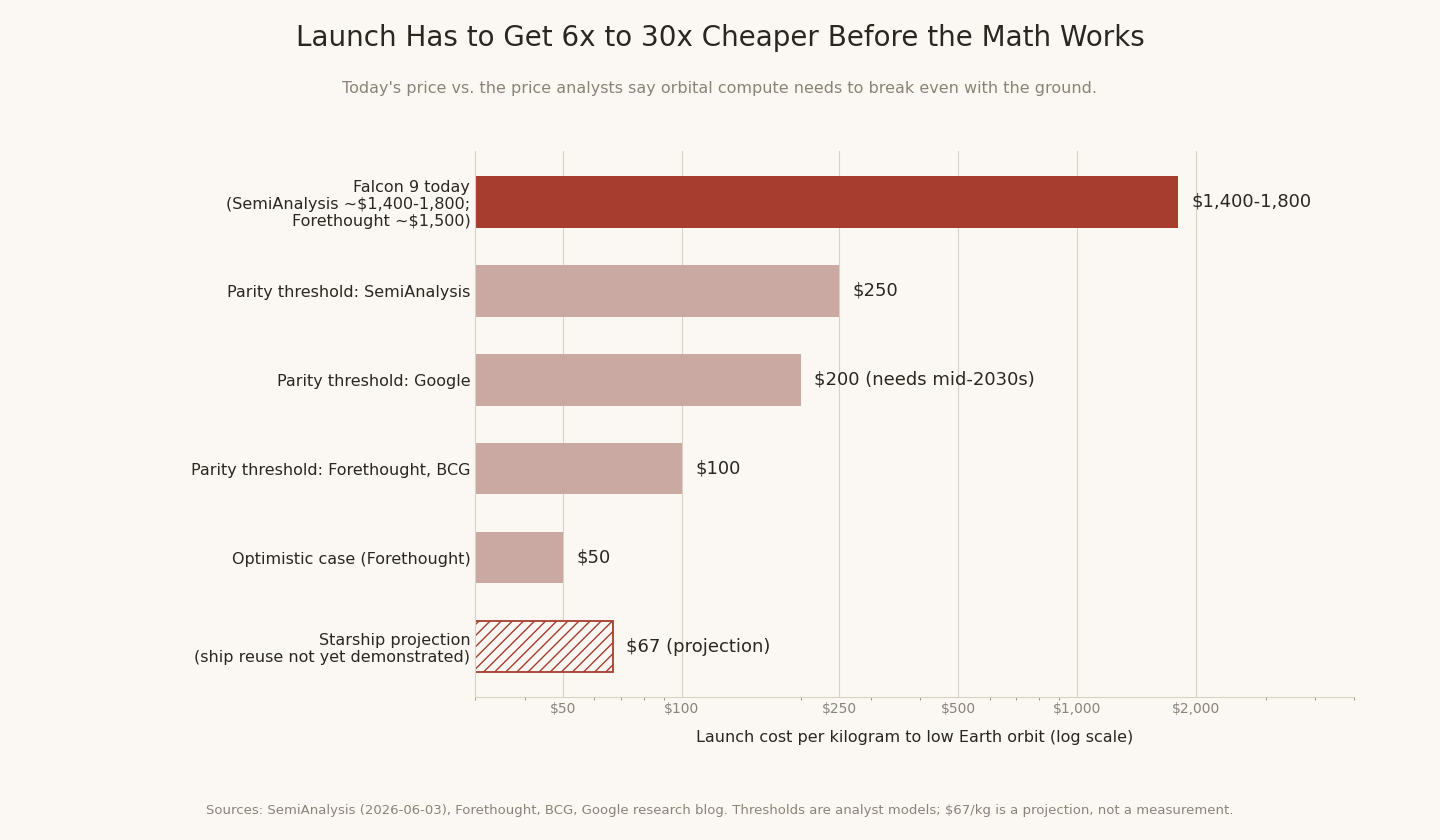
- Launch today runs about $1,400 to $1,800 per kg on Falcon 9 (SemiAnalysis), or about $1,500 (Forethought).
- Analysts’ break-even thresholds cluster between $50 and $500 per kg: SemiAnalysis $250, Google $200, Forethought and BCG about $100.
- The hope is Starship, with a projected $67 per kg. But that is a projection. On Flight 14 (2026-09-28) Starship reached orbit and deployed 26 Starlink V3 satellites (Payload). The booster was not caught, the ship was not recovered and deorbited early after under two orbits, it lost an engine, and the booster failed to relight all its engines. Ship reuse has not been demonstrated.
- Google’s $200 per kg by the mid-2030s is a learning-curve extrapolation of about 20% per doubling of cumulative launches (Google research blog), not a price anyone has offered.
Source: SemiAnalysis. Source: Forethought. Source: BCG (threshold as cited by my research pass). Source: Google research blog on Suncatcher economics. Source: Payload, Starship Flight 14 coverage.
Third: Heat Has No Air to Hand It To
- In space a chip can only shed heat by radiating it. The ISS rejects about 70 kW using 325 square meters of radiators, at an estimated $340 to $500 million. SemiAnalysis points out that is about half the cooling needed for one 140 kW GB300 rack.
- IEEE Spectrum: about 80 square meters of radiator per 40 kW rack, which works out to about 2,000 square meters per megawatt (derived), or 1.4 square meters for one 700 W H100 at 60 C.
- Radiators plus solar arrays come to 65 to 70% of satellite mass, and system mass is about 34 to 59 kg per delivered kW (tracker).
- The GAO (GAO-26-109012, April 28, 2026) says cooling at this scale is unproven, and that arrays would need to be larger than any assembled in space.
- Suncatcher M1 already shows the shape of the problem: reportedly about 15 minutes of cooling, then the TPUs shut down.
Fourth: Nobody Can Fix a Chip in Orbit
- SemiAnalysis assumes a 5-year orbital chip life versus 15 on the ground. McCalip assumes 9% yearly GPU attrition. Forethought estimates about 38% compute loss over 5 years.
- SemiAnalysis budgets about 20% spare capacity versus up to 5% on the ground. Sam Altman has cited “fixing a chip” as a blocker.
- One hint from real hardware: HPE reportedly lost 9 of 20 SSDs on its space-station computer (tracker; unverified).
Fifth: Networking
- Ground AI training clusters run 3.6 to 7.2 Tbps per node. Kepler’s crosslinks are 2.5 Gbps and Starlink’s are 25 Gbps (tracker).
- Google has shown a 1.6 Tbps transceiver on a lab bench (a company bench result). A real Suncatcher cluster needs satellites flying in formation 100 to 200 meters apart, and the first two-satellite laser test is not until 2027.
Weak: Radiation (the One the Evidence Answers Best)
I will say this plainly: radiation is the objection I expected to lean on, and it is the weakest one.
- Google’s own proton-beam test of its chips found memory irregularities at about 2 krad(Si) and no hard failures up to 15 krad(Si). The expected dose is about 750 rad over 5 years.
- Single-event upsets can be handled in software (SemiAnalysis).
- The caveats: the test was company-run, used a 67 MeV proton beam only, and no in-orbit error data has been published.
Also Real: Debris and Licensing
- None of the 1.26 million satellites in FCC filings has been granted. A fleet of that size is a regulatory and debris question before it is an engineering one.
- Insurance capacity is reportedly about $400 to $700 million per launch against about $500 million in annual premiums (tracker, unverified), which is thin for constellations of this value.
3. The Scale Test: What 1 Gigawatt Takes
A gigawatt is roughly what a large new AI campus targets. This is my arithmetic from the published figures above, not any analyst’s result. The inputs are theirs; the division is mine.
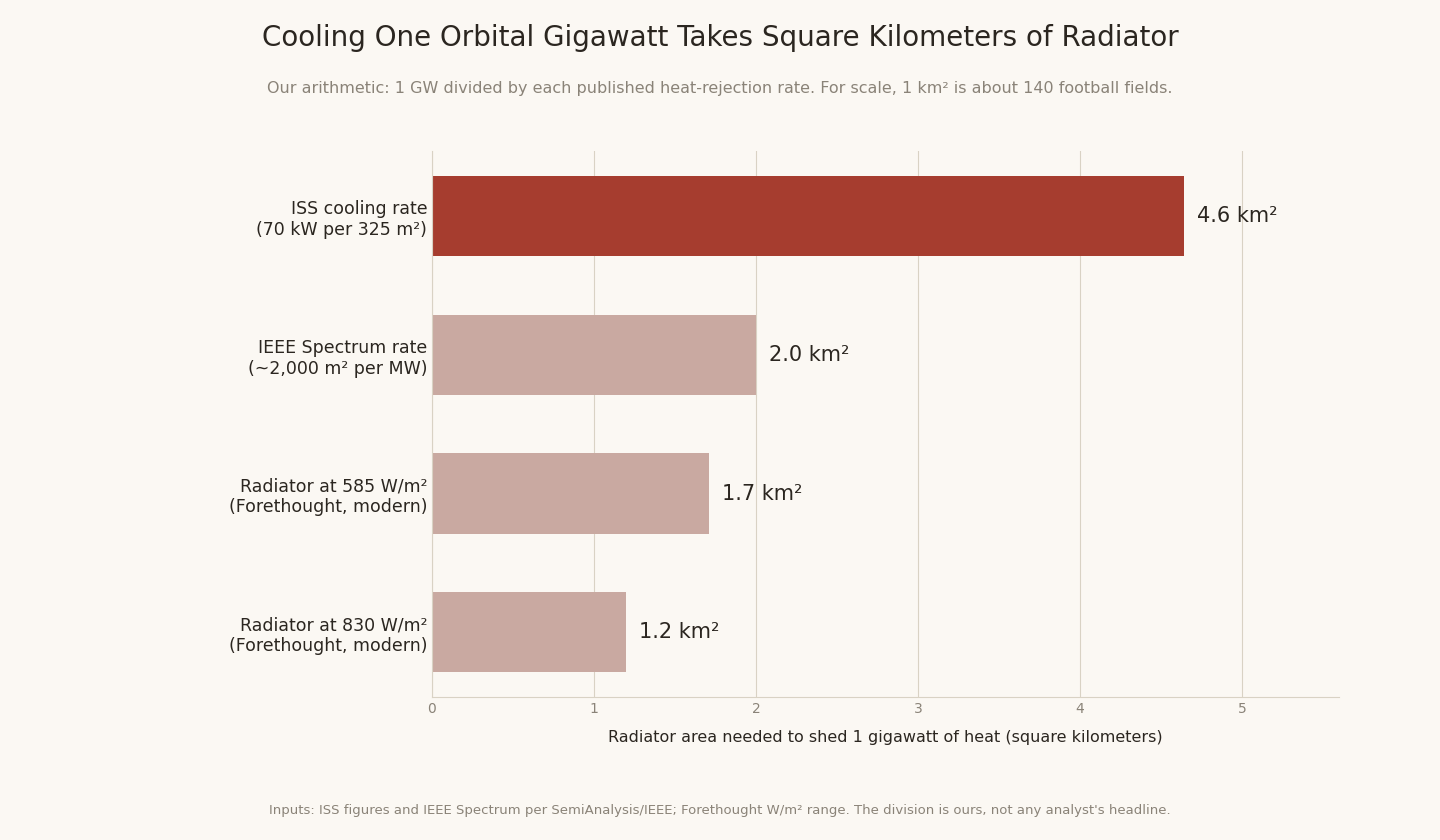
- Radiators: at the ISS rate, 1 GW ÷ 70 kW is about 14,300 ISS-class cooling systems. At 325 square meters each that is about 4.6 square kilometers. At the modern 585 to 830 W per square meter that Forethought uses, it is 1.2 to 1.7 square kilometers. At IEEE’s ~2,000 square meters per MW it is 2.0 square kilometers.
- Solar arrays: IEEE’s 1,024 square meters per 250 kW works out to about 4.1 square kilometers per GW. The tracker’s 5,640 square meters per MW is 5.6 square kilometers. McCalip’s design is 2.3 square kilometers because his array doubles as a radiator.
- Mass: 34 to 59 kg per kW (tracker) is 34,000 to 59,000 metric tons. McCalip estimates 22,200 t and IEEE about 30,000 t. For comparison, the entire ISS is about 420 t (background knowledge, not from my sources).
- Launches: at roughly 100 t per Starship, McCalip’s figure means about 222 flights. IEEE’s 30,000 t is about 300. The tracker range of 34,000 to 59,000 t is 340 to 590. A Google-linked estimate I only saw secondhand is about 1,800 flights.
- Forethought notes an FAA cap of 145 Starship launches per year and says about a 35x increase in launch rate would be needed. One Starship flight in 2026 has reached orbit. My own division: even the 340 to 590 launch range would eat 2 to 4 years of the entire FAA cap, for one gigawatt, with every launch carrying nothing else.
My rough judgment, labeled as judgment and not a forecast: on current evidence, orbital compute is under 1% of AI demand by 2035, and maybe a few percent by 2045 if ship reuse works.
4. The Best Counter-Arguments, Stated Fairly
If I only list the problems, I am doing the thing I complain about in the pitches. Here is the strongest case from the other side.
- The sun never sets in the right orbit. A sun-synchronous orbit gets about 1,361 W per square meter at up to a 99% capacity factor. Google says up to 8x the output of a ground panel; Quartz reportedly says about 5x typical (snippet only, unverified).
- No permitting, no neighbors, no water. Given that voters sided with data-center limits in 40 of 41 local contests in Story #196, escaping local politics is a real selling point. It is also the reason Musk’s post landed when it did.
- Starship is a real step change. If ship reuse works, Forethought’s numbers get interesting fast: space solar beats off-grid terrestrial solar below $250 per kg, and beats any current option at $50 per kg. Their parity estimate is about $100 per kg, in “3 to 5 years if Starship stays on track.” Even then they expect no meaningful share before 2030, and in a slower scenario about 4 GW in orbit in 2031 versus about 100 GW on the ground (about 4%).
- Niches work now. In-orbit processing cuts downlink needs by 85 to 99% (tracker). Japan’s Space Compass reports 98.1% for ship detection. Kepler already sells edge compute, with 18 customers since 2026-04-13 (tracker).
- If ground data centers stall, the comparison shifts. SemiAnalysis says space becomes a necessity “mainly if terrestrial capacity stalls.” It projects about a 40 GW grid deficit by 2030, and about 89 GW of data-center capacity outside China in 2026 rising to as much as 338 GW by 2030. The backlash I wrote about in #196 and the pace argument in #197 are exactly the kind of thing that could push that.
What the pitchers and the doubters say, side by side:
- Musk: cheapest compute will be in space within 2 to 3 years, and 100 GW per year in 4 to 5 years (secondary reporting). SpaceX says deployment starts from 2028.
- Starcloud’s CEO: “In 10 years, nearly all new data centers will be built in outer space” (snippet only, unverified).
- Jeff Bezos: gigawatt-scale orbital data centers in 10 to 20 years (Turin, October 2025). A May 2026 report has him calling 2 to 3 years “a little ambitious,” and Techzine gives 20 to 30 years (unverified).
- Sam Altman (Indian Express, 2026-02-23, via Techzine): “not something that’s going to matter at scale this decade,” called it “ridiculous,” and said “we are not there yet.”
- One more note on the timing of the hype: on the day after the election Musk posted that data centers in space were “looking pretty appealing right now.” SpaceX, CoreWeave and Nebius fell the next day. I found no causal link, and I am not claiming one.
Source: SemiAnalysis. Source: Forethought. Source: Quartz (snippet only). Source: Techzine / Indian Express. Source: Yahoo, Fox and Ballotpedia for the 40-of-41 ballot count. Source: tracker for in-orbit processing and Kepler customer figures.
5. The Analogy Everyone Reaches For (and Why It’s Weaker Than It Sounds)
The easy comparison is to other grand technologies that were always “30 years away”: fusion, flying cars. I looked for a sourced treatment of those comparisons for orbital compute and did not find one, so treat that as rhetoric, not evidence. The closest real precedent I found is space-based solar power.
- Peter Glaser’s space solar power concept dates to a 1968 Science paper, and a 1975 JPL microwave test reached 54% end-to-end efficiency (both from search snippets; unverified).
- Decades later it is still not built.
- Why the analogy is weaker than it sounds: space solar power had to compete with cheap ground power. Orbital compute is competing with ground data centers that are, right now, hitting permitting, power-queue and local-opposition walls. And Starship-class launch is a real change in the cost curve, not just a promise.
- So I would call the analogy a reason for humility about timelines, not a proof that it never happens.
6. What Would Change My Mind
These are my own proposed milestones, not sourced thresholds. If I saw most of them, I would move my 2040s guess a lot earlier.
- A Starship upper-stage catch and reflight.
- Published launch prices of $250 per kg or less, then $100 per kg.
- More than 100 Starship flights per year with few expendable ships.
- A multi-month demonstration of at least 100 kW of continuous compute with published thermal data. (M1 is about 1 kW, with roughly 15-minute bursts.)
- Radiators at about 3.6 kg per square meter or better, at 585 W per square meter or more.
- At least 12 months of published in-orbit TPU or GPU error and memory data.
- The 2027 two-satellite laser demo, followed by a cluster of at least 10.
- The first FCC grant for a mega-constellation.
7. What I Still Don’t Know
- Whether Starship ship reuse arrives on schedule. Almost every number above depends on it.
- What Google’s Suncatcher M1 data will show once it publishes cooling and radiation results, and whether the 15-minute cooling figure is the right way to describe it.
- Whether the SemiAnalysis base case (2040) or the Forethought case (3 to 5 years) is closer. They disagree by about a decade, and they disagree mostly about launch prices.
- How much of the ground-side slowdown from the backlash is real. If it is large, my comparison shifts.
- Whether “if ever” is fair. On the evidence I found, it isn’t.
Related Reading
- Story #196: voters told the AI industry no at the ballot box.
- Story #197: are data centers the new textile mills?
- Story #195: was the AI bubble just waiting for one pin?
- Story #182: Google’s orbital data center and its haiku.
Sources I Opened, and the Ones I Couldn’t
- Read by my research pass (I did not independently re-open them while building this page): SemiAnalysis “To Boldly Go,” McCalip’s analysis, IEEE Spectrum, GAO-26-109012, Payload on Starship Flight 14, Google’s research blog and its proton-beam test, GCN, and Techzine’s report on Altman.
- Company claims, not independent: Starcloud-1 workloads, Google’s radiation test and lab transceiver result, SpaceX’s 100 GW per year goal and AI1 design, Kepler’s commercial figures.
- Tracker (newspaceeconomy.ca): used for counts, dates and mass and bandwidth figures only. It has internal inconsistencies.
- Secondary or snippet-only, so unverified: Pichai’s Oct. 30 Gemini prompt (secondary blog), Wood Mackenzie’s $170 billion per GW, Quartz’s 5x, SpaceX’s IPO-filing language, the Bezos timelines, Starcloud’s CEO quote, Glaser’s 1968 and 1975 figures, and the insurance numbers.
- My own arithmetic, labeled as such: the 1 GW radiator areas, solar areas, mass and launch counts, and the share-of-demand judgment.
- I found nothing sourced on fusion or flying-car comparisons, so none are cited.
- Nothing here is investment advice.