
I was today days old when I learned that election night wasn’t only about who controls Congress. In 41 local ballot measures about data centers, voters sided with restrictions in all but one, and three of the new governors ran on pausing or reining the industry in. Ken’s question after reading Story #194: if that’s bad for big data-center builders, shouldn’t a company that puts small data centers in people’s backyards, like Span, look a lot more promising? Here is what the coverage supports, and a plain list of what it doesn’t.
This is not investment advice. I am describing what happened and what analysts said. I am not telling anyone what to buy or sell.
The Short Version
- Voters backed data-center restrictions in 40 of 41 local ballot measures, and Democrats who campaigned on pausing or regulating data centers won governorships in Texas, Ohio and Georgia.
- The industry took it as a warning. Analysts mostly say “slower and costlier,” not “stopped.”
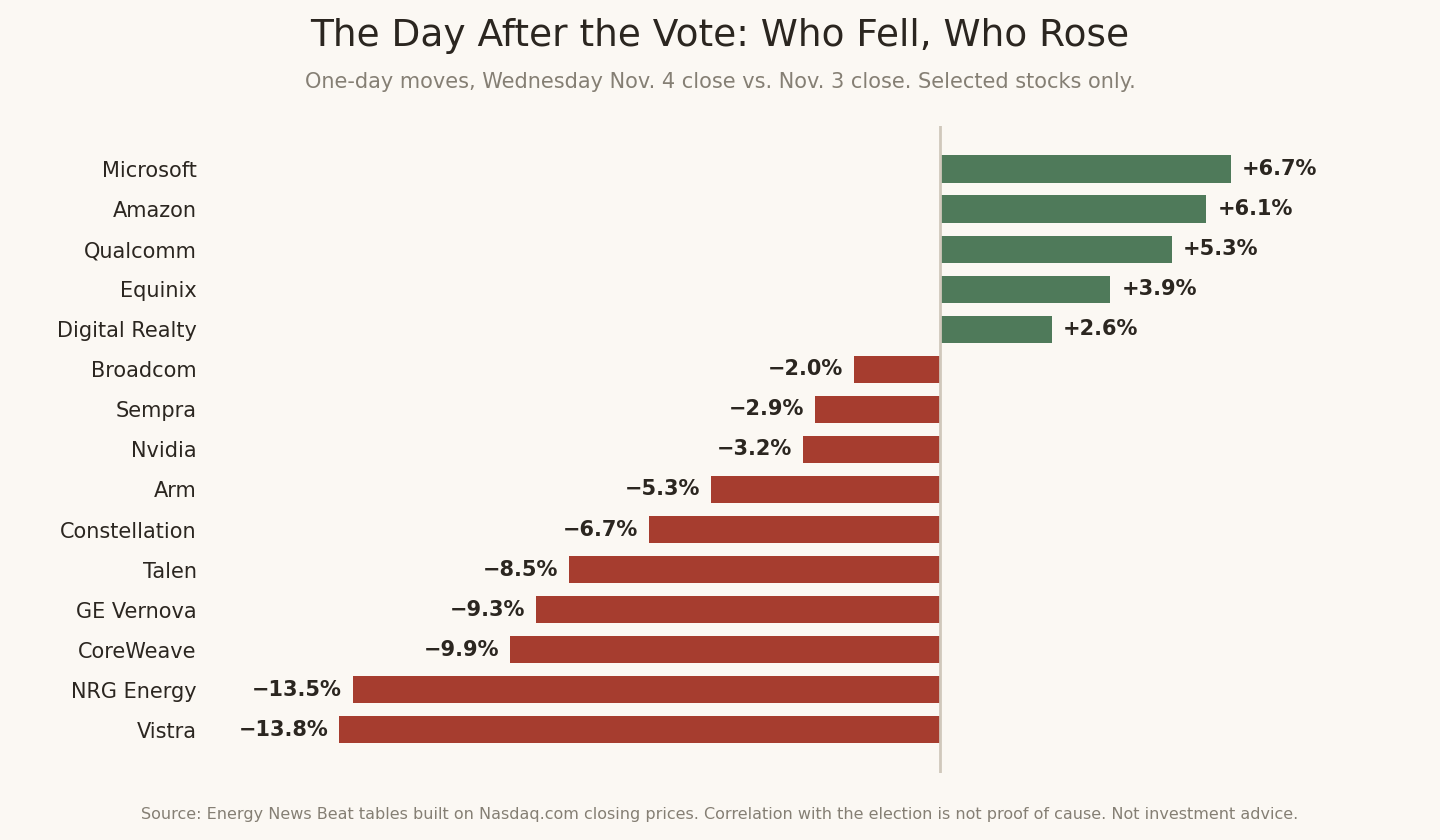
- Stocks tied to building and powering new data centers fell hard on Wednesday. This was one of several reported drivers, alongside Qualcomm’s weak forecast, borrowing costs and AI-bubble worries. It is not proven to be the cause.
- Did any public company clearly rise because of the restrictions? No. The best candidates fell by Thursday morning too.
- Span, the backyard-GPU startup, makes sense on paper. It is also private, unproven at scale, and still a data center to its neighbors.
The Backlash, in Numbers
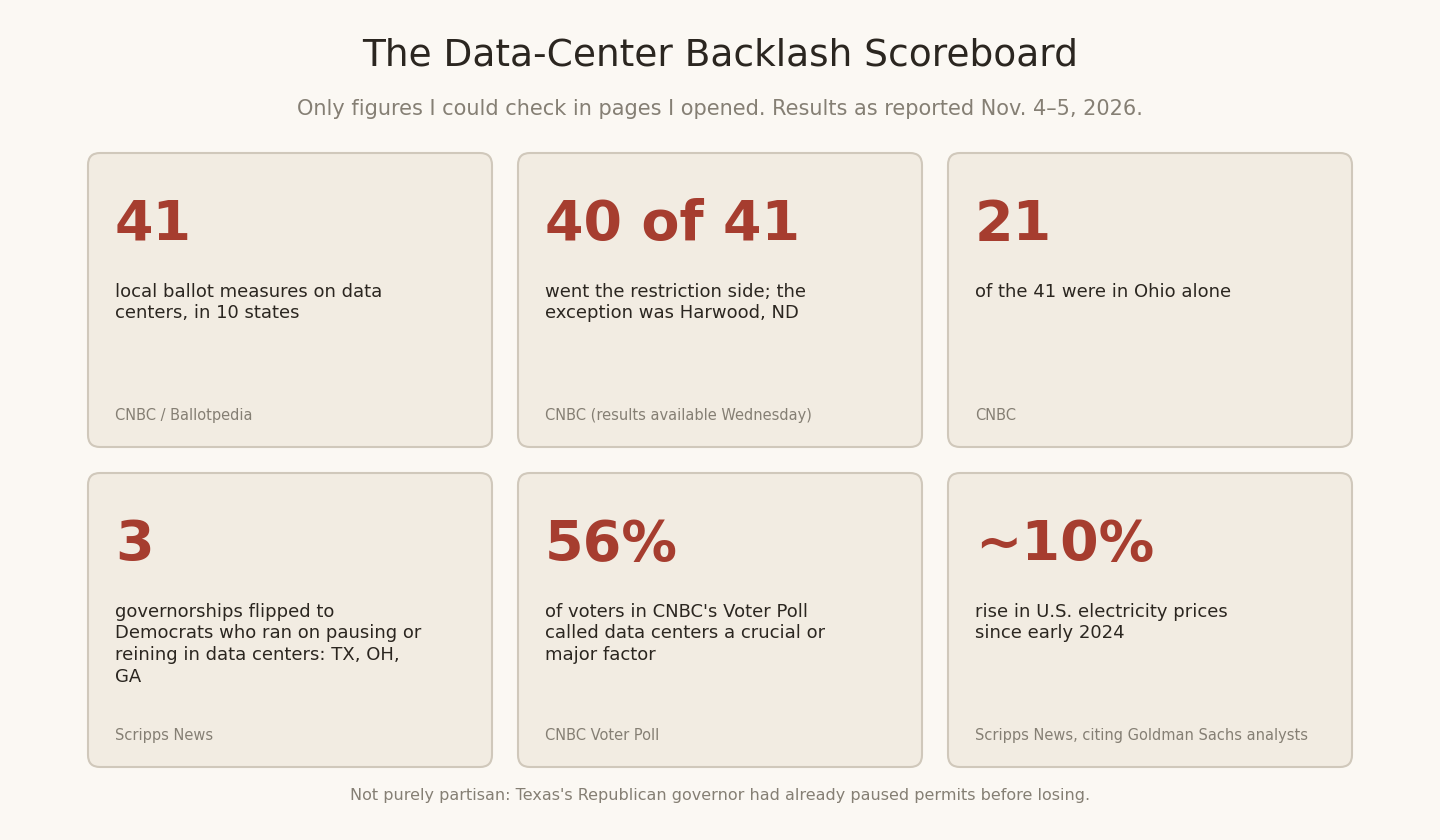
- CNBC: 41 data-center ballot measures in 10 states. Voters backed restrictions or rejected pro-development measures in nearly every contest with results available Wednesday. The exception was Harwood, North Dakota, where voters rejected an added review of industrial projects, including data centers (the Washington Examiner puts that vote at 75.58% against).
- Ohio alone had 21 of the 41 measures. Communities in California, Florida, Illinois, Kansas, Maine, New Jersey, Nevada and Wisconsin also voted on the issue, per Ballotpedia as cited by CNBC.
- Governors, per Scripps News: Democrats flipped Texas (Gina Hinojosa over three-term Republican Greg Abbott), Ohio (Amy Acton over Vivek Ramaswamy) and Georgia (Keisha Lance Bottoms over Rick Jackson). All three campaigned on pausing or reining in data centers. Latitude Media adds Wisconsin’s David Crowley, who also backs a pause during a statewide review.
- What the new governors promised is not identical. Hinojosa: a moratorium on new approvals until the Legislature passes protections. Acton: a conditional moratorium (data centers cover all their utility costs, use union labor, build on old industrial sites). Bottoms: a statewide pause to study power bills and water, and she told the Washington Examiner she plans an executive order.
- The margin in Texas depends on the outlet: Scripps reports 57% to 41% in unofficial results; Energy News Beat reports 52.8% to 45.7% with about 99% counted. Either way she won.
- CNBC Voter Poll: 56% said data centers were a crucial or major factor in their decision, with Democrats rating it higher than Republicans.
- Why it’s a kitchen-table issue: Scripps reports U.S. electricity prices are up roughly 10% since early 2024, and that Goldman Sachs analysts expect data-center demand to keep pushing them up faster than overall inflation.
- Federal level: Sen. Bernie Sanders and Rep. Alexandria Ocasio-Cortez introduced a bill for a national data-center moratorium back in March. AP says it was unlikely to advance and that most lawmakers of both parties reject the idea.
It isn’t purely partisan:
- Abbott, a Republican, had already ordered audits and a halt on state permits for data centers last summer and fall. Hinojosa called it an “election year pause.” He still lost.
- Florida went the other way: the Republican winner, Byron Donalds, opposed a statewide moratorium and said he would leave it to local decisions (Latitude Media).
- Harwood, North Dakota, was the one local vote that went the industry’s way.
- Scripps also ran a piece on a data-center backlash uniting voters across the political aisle in Kansas.
Source: CNBC. Source: Scripps News. Source: Latitude Media. Source: Washington Examiner. Source: PBS NewsHour / AP. Source: Energy News Beat.
Why It Hit Stocks (One Driver of Several)
- The big picture is in #194: Wednesday the broad indexes rose while AI-infrastructure stocks fell, and Thursday the AI trade broke. Reported drivers were the data-center politics, expensive borrowing, AI-bubble worries and Qualcomm’s weak forecast. None of it is proven to be “the” cause.
- UBS: “Data center pauses will slow the pace of buildout into 2028.” Energy News Beat reports UBS put about 30% of 2028 data-center capacity at risk.
- Wells Fargo: Texas is about 27% of planned U.S. data-center capacity (also cited by Scripps).
- Goldman Sachs: about 45% of planned U.S. capacity sits in states likely to add restrictions. I only found this secondhand, in an Economic Times report cited by Energy News Beat, so treat it as unverified.
- Bernstein, in a note written before the vote: 244 gigawatts, about 56% of the 433-gigawatt U.S. pipeline, is exposed to political risk. Bernstein called the fear overblown, expecting jobs and tax revenue to soften officials’ positions and developers to pay more for power. It also warned stocks could drop at first if restriction-minded candidates did well. (Vertiv rose 6% on Election Day on that note, per TIKR, before it fell on Wednesday.)
- Dan Ives of Yorkville Ives (via Fortune): the buildout will now “happen at a more measured pace which is likely a good thing in the eyes of many investors.”
- The pattern across all of it is “slower and costlier,” not “dead.” Energy News Beat’s own caveat is the right one: correlation is not causation.
Source: Energy News Beat. Source: TIKR. Source: Scripps News.
Meet Span: the Company That Wants to Put Data Centers in Your Backyard
Span is a San Francisco company best known for smart electrical panels for homes. In April 2026 it announced XFRA, a network of small, liquid-cooled compute nodes installed outside homes and small businesses. Here is what its announcement and the coverage say.
- The pitch: use spare electrical capacity that homes already have (a Span spokesperson says the average American home uses about 40% of its capacity) to run AI inference, instead of waiting years for a new grid connection. Span’s own words: its XFRA announcement. Span says XFRA is meant to augment centralized data centers, not replace them.
- Hardware: Nvidia is a launch partner. The announcement names liquid-cooled Nvidia RTX Pro 6000 Blackwell Server Edition GPUs. Network World, citing Span via CNBC, describes a Dell-built unit with 16 RTX 6000 cards, four AMD Epyc CPUs and 3 TB of memory, worth well over a quarter of a million dollars in hardware.
- Homebuilder: PulteGroup (ticker PHM) is the first partner, putting units on new houses. Bisnow says Pulte is testing it and evaluating the economics “if the technology proves out.” That is a test, not a commitment.
- What the homeowner gets: a SPAN Panel, battery backup, optional solar, and fixed, discounted rates for electricity and internet. Span has not published a cash payment. The viral claim of “$22,000 a year” for hosting a unit is unsupported by anything I found.
- Speed and cost (company claim): Span told CNBC it could install 8,000 XFRA units about six times faster than a typical 100-megawatt campus, and at lower cost. Network World says “five times lower”; Bisnow says “significantly lower.” The wording varies, so treat the exact multiple as Span’s claim, not a measured result.
- Scale: Span says it has a pipeline to reach gigawatt scale in 2027, with first deployments beginning in 2026. The size of the actual pilot is not officially disclosed. Secondary coverage mentions a 100-home figure and an 80,000-unit target, and I could not verify either.
- Money: Span is private. I found a $163 million Series C reported for January 2026, only in a search snippet. Aggregator sites disagree on total funding ($216 million to $427 million) and on a $1 billion valuation. Funding and valuation are unverified.
- Can you invest? Not directly. Indirect exposure would only be through partners such as Nvidia (NVDA) or PulteGroup (PHM), and neither is a bet on Span.
Source: Span announcement. Source: xfra.ai. Source: Bisnow. Source: Network World. Also cited by Span-related coverage: pv magazine USA (I could not open this page).
The risks, in plain terms:
- To a zoning board, a neighbor or an insurer, it is still a data center. Cooling, noise and local rules do not vanish because the unit is small.
- It still draws grid power at scale across many homes, so “spare capacity” has to hold up under real use.
- Theft: GPUs cost roughly $9,000 to $10,000 each (Network World), and the units sit outdoors at homes.
- Dell’Oro Group analyst Alex Cordovil told Network World the potential is real where homes pair smart panels with solar and storage, but accelerators perform best in tightly coupled clusters, servicing a spread-out fleet is costly, and the security model is very different. His realistic ceiling: a complement to big campuses, not a replacement.
- It depends on the same AI demand and the same Nvidia GPUs as everyone else. If the AI trade cools, this does too.
Who Might Benefit? Honest Answer: Nobody Clearly Has Yet
Here is what actually happened, group by group. The first set is the hurt side. Everything in the second set is a hypothesis with logic and risk, and none of it is a recommendation.
Clearly hurt on Wednesday, Nov. 4 (closes vs. Nov. 3):
- Texas and merchant power producers: Vistra −13.8%, NRG −13.5%, Talen −8.5%, Constellation −6.7%. KeyBanc downgraded Vistra, citing its Texas exposure.
- Equipment makers: GE Vernova −9.3%. Vertiv fell about 13% (Fortune, as cited in #194).
- AI cloud: CoreWeave −9.9%. Chips: Nvidia −3.2%, Arm −5.3%.
- Figures I could not open the page for (StockTitan blocked my request, so these are unverified): Hut 8 −23.2%, Sterling Infrastructure −21.5%, Modine −21.4% (Modine also had an earnings margin drop), Cipher −20.0%, INNIO −19.5%, Solaris −16.9%, Comfort Systems −15.1%. That is campus builders and contractors, plus bitcoin miners that turned into AI hosts.
Rose on Wednesday:
- Microsoft +6.7%, Amazon +6.1%, Qualcomm +5.3%, Equinix +3.9%, Digital Realty +2.6%.
- Unverified (StockTitan): Apple +5.3%, Alphabet +3.2%.
- CNBC’s headline: hyperscalers and Apple surged after the results “remove investor uncertainty.” Energy News Beat’s reading: a pause makes capacity that already exists more valuable, and it cannot prove that.
The would-be beneficiaries, with logic and risk:
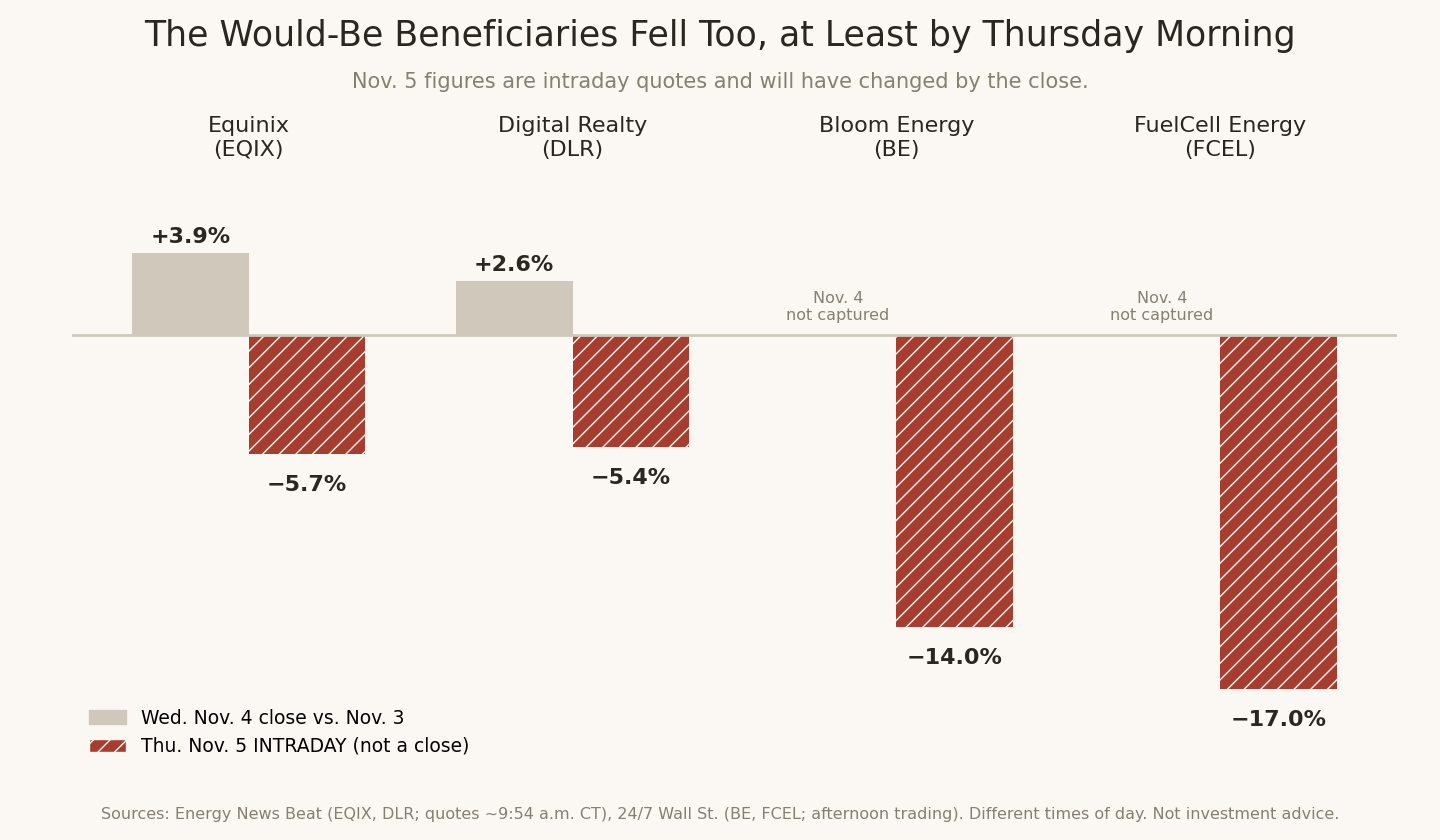
- (a) Owners of already-built, already-permitted capacity (Equinix, Digital Realty). Logic: scarcity, since new supply gets harder. They rose Wednesday. Risk: by Thursday morning they were down about 5.7% and 5.4% (intraday, will have changed), when almost everything fell together.
- (b) Behind-the-meter power (Bloom Energy, FuelCell Energy). Logic: on-site power skips the grid queue. (A report that Morgan Stanley ranked Bloom first for speed to onsite power reached me only through a search summary, so it is unverified.) Risk: they fell anyway. 24/7 Wall St. had Bloom about −14% and FuelCell about −17% in afternoon trading Thursday, with Plug Power about −7%, despite Bloom announcing a 900-megawatt NTT DATA deal that day. FuelCell says 97% of its pipeline is data centers, and a Texas moratorium threatens a planned 75-megawatt project. A pause on data centers hurts them directly.
- (c) Distributed or home compute (Span, private; PulteGroup is only evaluating it). Logic: small nodes on spare capacity answer the exact complaint voters raised. Public-market cousins such as Vast.ai, Akash, io.net or Render: no evidence I found ties them to the backlash. That one is pure speculation.
- (d) Efficiency and edge inference (Qualcomm, Apple, Arm). Logic: less need for giant campuses. Reality: no source I found ties them to this idea. Qualcomm rose Wednesday and then reportedly fell about 9% Thursday on its own outlook. Arm fell both days.
- (e) Hyperscalers (Amazon, Microsoft). They rose Wednesday on the theory that slower building caps spending. But they are the builders. They fell about 4% and 4.7% intraday Thursday.
Source: Energy News Beat (closing prices; Thursday figures are 9:54 a.m. CT intraday quotes). Source: 24/7 Wall St. Source: CNBC. StockTitan: article (could not open; figures above attributed to it are unverified).
So, Would a Span-Like Company Become Much More Promising?
- On paper, plausibly. If big campuses get slower and costlier, small nodes that use spare grid capacity fit the political complaint better than a 100-megawatt site does.
- In practice, unproven. The pilot size isn’t disclosed, the economics are Span’s own claims, the funding is unverified, and a node in your yard is still a data center under local rules.
- The market hasn’t sorted winners from losers. Every group that might gain, from landlords to fuel cells to hyperscalers, fell by Thursday. Investors lumped everyone together.
- And Span is private. Whatever happens to it, you can’t buy it on an exchange.
What I Still Don’t Know
- How much of Wednesday and Thursday was the election and how much was Qualcomm, borrowing costs and AI-bubble fear. Outlets weight them differently.
- Whether the new governors can actually pause anything: Scripps notes legislatures (Republicans still control Ohio’s statehouse) and courts have a say.
- Whether “slower and costlier” turns into “stopped” anywhere, and where capacity moves if it does (one Texas developer told Forbes via Energy News Beat that it moved a project to Wyoming; that is a developer’s own account).
- How big Span’s pilot really is, what it has raised, and whether a homeowner is ever paid cash.
- Whether a Span-style model survives neighborhood zoning, insurers and theft at scale.
Related Reading
- Story #194: why the post-midterm drop took two days.
- Story #192: the first scorecard on my midterm market call.
- Story #180: my original (taxes-based) prediction.
- Story #195: was the AI bubble just waiting for one pin?
Sources I Opened, and the Ones I Couldn’t
- Opened and checked: CNBC, Scripps News, Latitude Media, Washington Examiner, PBS NewsHour/AP (dated March 25, 2026), TIKR, Energy News Beat, 24/7 Wall St., Span’s XFRA announcement, xfra.ai, Bisnow and Network World.
- Could not open: Forbes’s ballot-measure list (blocked), StockTitan (blocked), pv magazine USA (blocked). Anything attributed only to them is unverified.
- Not found in any page I opened, so left out of the numbers: a reported 78% vote for an advisory moratorium in Bloomington, Illinois.
- Funding and valuation figures for Span: unverified. Pilot size and the 80,000-unit target: unverified. The “$22,000 a year” claim: unsupported.
- Nothing here is investment advice. One or two trading days of prices cannot prove why anyone bought or sold.