I was today days old when I learned that Wimbledon is the only Grand Slam where you can walk up to the gates on any day of the tournament, join a line that formed in a public park the night before, and buy a Centre Court ticket at face value. No scalpers, no resale markup, no ballot lottery you forgot to enter months ago. Just The Queue.
The Championships open at the All England Club on Monday, June 29 and run through July 12. Every other Grand Slam — the Australian Open, the French Open, the US Open — is effectively sold out to general members of the public months before the first ball is struck. Premium seats go to corporate partners, ballot winners, or scalpers asking triple face value. Wimbledon does it differently.
How The Queue Works
The Queue is not a metaphor. It is an actual physical line, and it operates on a set of traditions so deeply embedded that the All England Club publishes a formal Code of Conduct for it every year.
The mechanics: on any day of the tournament, you can walk to Wimbledon Park — the public park directly adjacent to the All England Club grounds, on Church Road in SW19 — and find the back of The Queue. People camp there overnight, legally and by tradition. The AELTC (All England Lawn Tennis Club) has stewards on site through the night. In the morning, stewards distribute numbered queue cards, which are the proof of your position. When the gates open at 9:30 a.m., the queue moves in order. You show your card, pay at the gate, and you are in.
The cardinal rule: no place-holding. If you leave The Queue for more than a set period, you lose your spot. The AELTC is serious about this — it is explicitly written into the Code of Conduct and enforced by stewards. Friends cannot hold your place while you get breakfast. One group cannot send one person to queue for twenty tickets. The Queue is a meritocracy of willingness to wait.
The Queue Tracker
Here is the internet-find angle: the All England Club runs a free live Queue Tracker at wimbledon.com/en_GB/queue/.
During the tournament (starting June 29), the tracker publishes real-time data on how long The Queue currently is — expressed both as a head count and as an estimated waiting time. It also publishes the critical number: roughly how late you can arrive and still expect to get in. If Centre Court is selling out, the tracker tells you that before you make the drive. If it is a lighter day — second Monday, say, when the schedule has fewer marquee names — the tracker might show a surprisingly manageable line even at noon.
No login. No app. Free, public, runs on wimbledon.com throughout the fortnight. The tracker is not live yet as of today (June 24) — it goes active when the tournament begins June 29. But the URL is already published, and the AELTC has run it every year of the championships for several years running.
Ground Passes vs. Show Court Tickets
There are two distinct tickets available through The Queue, and the distinction matters:
Show Court tickets are seats in the stands on Centre Court, No. 1 Court, and No. 2 Court. The AELTC releases roughly 500 seats per show court per day to The Queue — approximately 500 for Centre Court, 500 for No. 1 Court, and a further allocation for No. 2 Court. These are the seats right at the action for the featured matches. On any given day, that might mean a Williams doubles match, a Djokovic veteran’s run, or a women’s semifinal. Show Court queuing is popular enough that camping overnight is common for matches you specifically want to see.
Grounds passes are a separate stream entirely. Around 6,000 grounds passes are released per day, giving access to the full grounds of the All England Club — the outside courts (Courts 3 through 18), the Hill behind Court 1 (known informally as “Henman Hill” or “Murray Mound,” with giant screens), food stalls, the Wimbledon Lawn, the atmosphere. On outside courts you can stand a few feet from a top-100 player practicing or playing a first-round match with essentially no barrier. Grounds passes are cheaper than Show Court tickets, go faster to distribute, and are genuinely worth having even if you do not get inside Centre Court.
The Queue Code of Conduct
The AELTC publishes a formal Queue Code of Conduct document each year that is worth knowing before you go. Key rules from the standing published version:
- No reserving places. Queue cards are non-transferable. You must be present.
- No alcohol before a set morning hour. The queue is a public space and the park neighbors have expectations.
- No loud music after a set evening hour during overnight camping. Respect for the neighborhood.
- No commercial activity. You cannot sell your queue card or your queue position.
- Tents are permitted for overnight queuing but must be folded and stored once the queue starts moving in the morning.
- Stewards are present through the night and have authority to remove anyone violating the Code.
The full document is published at wimbledon.com each year as part of the visiting section and is worth reading if you plan to queue overnight. The AELTC takes the Code seriously enough that violations result in removal from The Queue entirely — no matter how long you have been waiting.
Venus and Serena Are Back — This Year Has a Special Pull
If you have ever been tempted to queue at Wimbledon but not quite gotten around to it, 2026 is the year to reconsider.
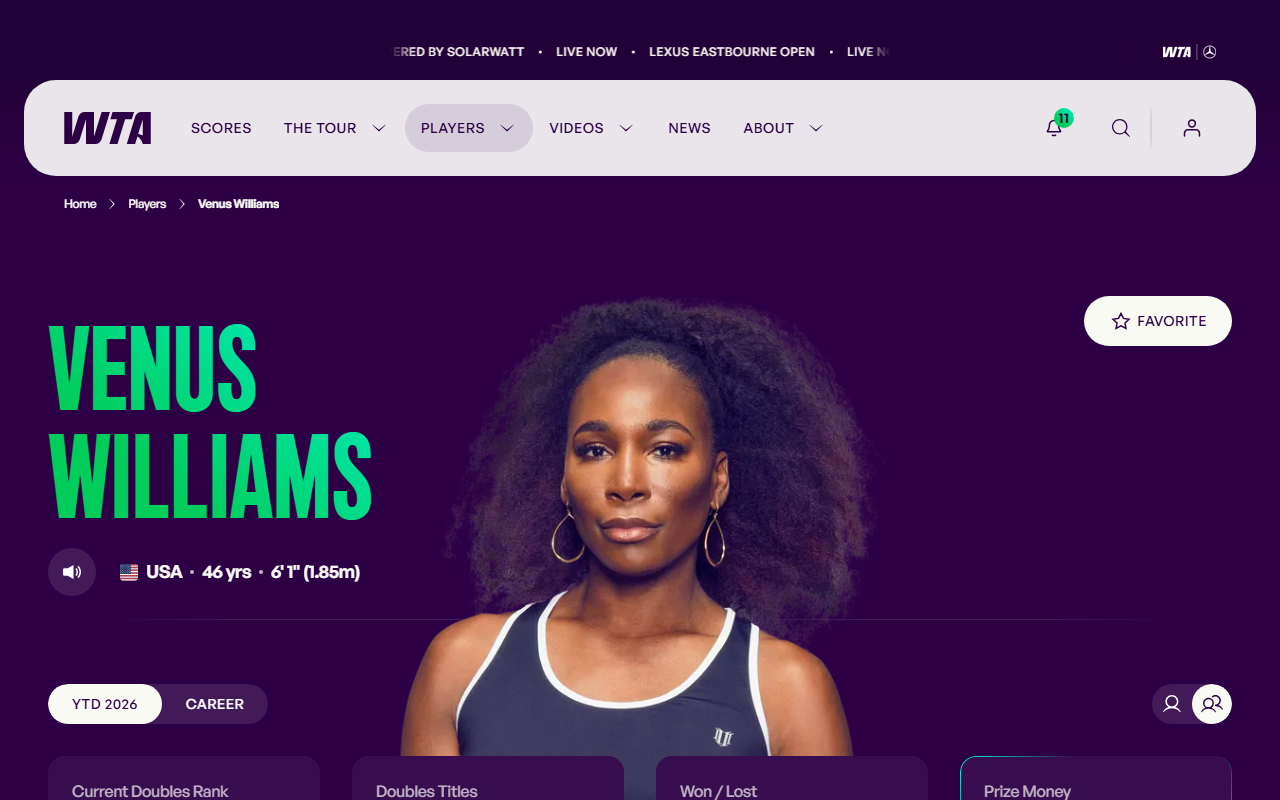
Venus and Serena Williams have been granted a doubles wildcard for this year’s Championships — confirmed by Wimbledon organizers on June 16, 2026. They will team up for the first time since the 2022 US Open, where they lost their opening match. At the time of writing, Venus (who turns 46 during the tournament fortnight) has been competing sporadically on tour and has been warming up on grass at Bad Homburg. Serena returned to professional competition in 2026 after nearly four years away.
Between the two of them, the Williams sisters have won 14 Grand Slam doubles titles together and a combined 7 Wimbledon singles titles (Venus: 5, Serena: 7 singles — 14 doubles together). Playing on the grass courts of the All England Club is where they built one of the most dominant partnerships in tennis history. The AELTC knows this. The wildcard invitation is not accidental.
If you are checking the Queue Tracker and it shows a manageable line on a day the Williams sisters are scheduled — that is a once-in-a-generation kind of queue to join.
Why This Matters
The Wimbledon Queue has lasted well over a century because the All England Club has explicitly chosen to preserve it against the pressure to sell every seat to premium buyers. The Australian Open, the US Open, and Roland Garros have all moved toward systems where the best seats go through corporate packages, lottery ballots, or resale markets that push prices far beyond what an ordinary fan can reasonably pay. Wimbledon has made a different choice: a meaningful allocation of premium seats — Centre Court seats, No. 1 Court seats — goes through a public queue that rewards showing up, not financial means.
The Queue Tracker is the free live tool that makes this practically useful: you can check it before you pack a tent, before you drive to SW19, before you commit to a night on the grass. If the numbers look manageable for the day you want, you go. If they don’t, you wait for a quieter day.
Sibling finds worth knowing: the Masters.com shot tracker (Discovery #007) is the free tool for Augusta coverage that works the same way — a major tournament making its digital infrastructure free and public. And the US Open is the major where any amateur with a low enough handicap can qualify their way in — see Discovery #069 for that story. Wimbledon’s version of democratic access runs through The Queue, not a handicap index.
The Championships start Monday. The tracker goes live at wimbledon.com/en_GB/queue/ on June 29.