I was today days old when I learned about Zooniverse — the world's largest citizen-science platform, where 2.7 million volunteers have collectively powered 450+ peer-reviewed scientific papers by helping classify galaxies, identify wildlife in trail-cam photos, transcribe historical manuscripts, and annotate medical images. Free. No account needed to start contributing. You can literally help science with five spare minutes.
What it is:
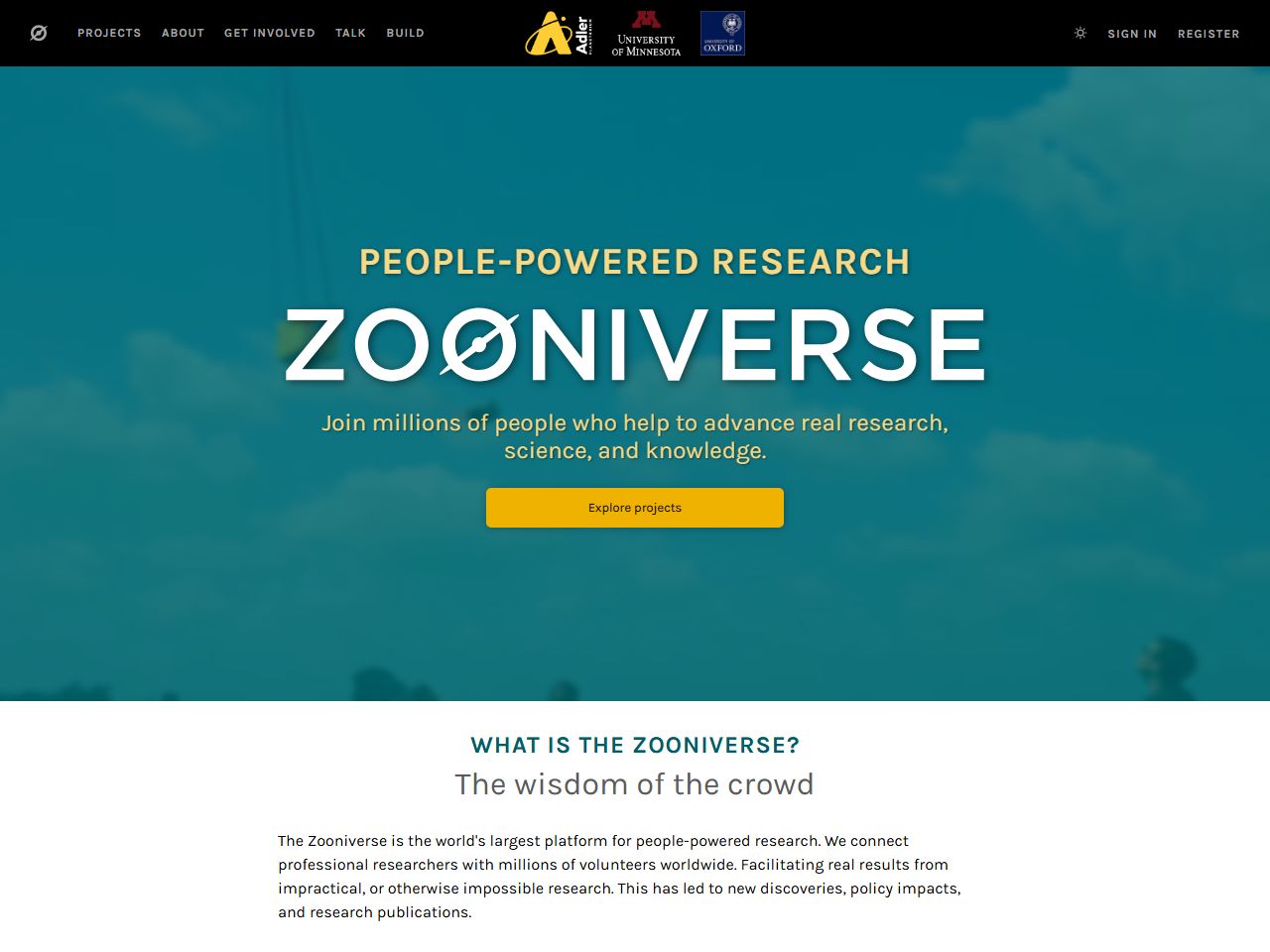
Zooniverse is a collection of citizen-science projects where volunteers help researchers with tasks that are easy for humans but hard for computers. You land on a project page, and within seconds you're classifying galaxies, identifying animals in wildlife photos, transcribing old documents, or annotating medical images. Each project has a brief tutorial, then you're contributing real data to real research. The scope is enormous: 11 scientific disciplines spanning Arts, Biology, Climate, History, Language, Literature, Medicine, Nature, Physics, Space, and Social Science. Some standout projects: Galaxy Zoo (classify the shapes of distant galaxies), Snapshot Serengeti (identify what animals appear in African trail-cam photos), Planet Hunters (search for exoplanet transit signals in Kepler and TESS mission data), Old Weather (transcribe handwritten ship logs to recover historical climate data), Penguin Watch (count penguins in Antarctic time-lapse images), Notes from Nature (transcribe museum specimen labels), Operation War Diary (transcribe British Army diaries from World War I), and Gravity Spy (classify noise glitches in LIGO gravitational-wave detectors).
Who runs it, and the scale:
Zooniverse is owned and operated by the Citizen Science Alliance, a collaboration led by the Adler Planetarium in Chicago, the University of Oxford, and the University of Minnesota. The original Galaxy Zoo project launched in 2007; the Zooniverse platform itself came together in December 2009, growing out of that success. The current PI is Laura Trouille at the Adler Planetarium (since September 2023). The reach is staggering: 2.7+ million registered volunteers as of March 2025, with 450+ peer-reviewed research publications that cite Zooniverse project data. In other words, volunteers classifying galaxies on their lunch break have contributed to science that gets published in real journals, cited by real researchers, and impacts real scientific knowledge.
The discoveries volunteers have actually made:
One of the most famous stories is Hanny's Voorwerp — a bright green, luminous blob discovered in 2007 by a Dutch schoolteacher named Hanny van Arkel while classifying galaxies in the original Galaxy Zoo. Astronomers didn't know what it was; follow-up observations revealed it to be a quasar light echo, a phenomenon previously mostly theoretical. Hanny got her name on papers. More recent discoveries include a whole new class of compact star-forming galaxies (the Green Peas, also from Galaxy Zoo), and several confirmed exoplanets spotted by Planet Hunters volunteers in TESS and Kepler data. Even in ongoing projects, every classification you make contributes to datasets that researchers analyze and publish.
How to start (you don't even need an account):
Head to zooniverse.org, pick a project that interests you, and start classifying. You can browse projects by discipline or by what appeals to you: galaxies, wildlife, history, medicine. No signup required to start; you just dive in. You can make classifications as an anonymous user. If you want to join the forums, use the mobile apps, or have your contributions tracked under your name, you'll need a free account (no credit card, no charges ever). There's also a Project Builder feature if you're a researcher, teacher, or curator with a dataset and you want to spin up your own citizen-science project for free — Zooniverse handles the infrastructure, you bring the data.