
I was today days old when I found out that “why did it take two days?” might be the wrong question. After Story #192, Ken asked it three ways: shouldn’t the drop have come on election day, did big, old, young or retiree money act differently, or did old men simply take a day to call their brokers? Here is what the coverage supports, and a plain list of what it doesn’t.
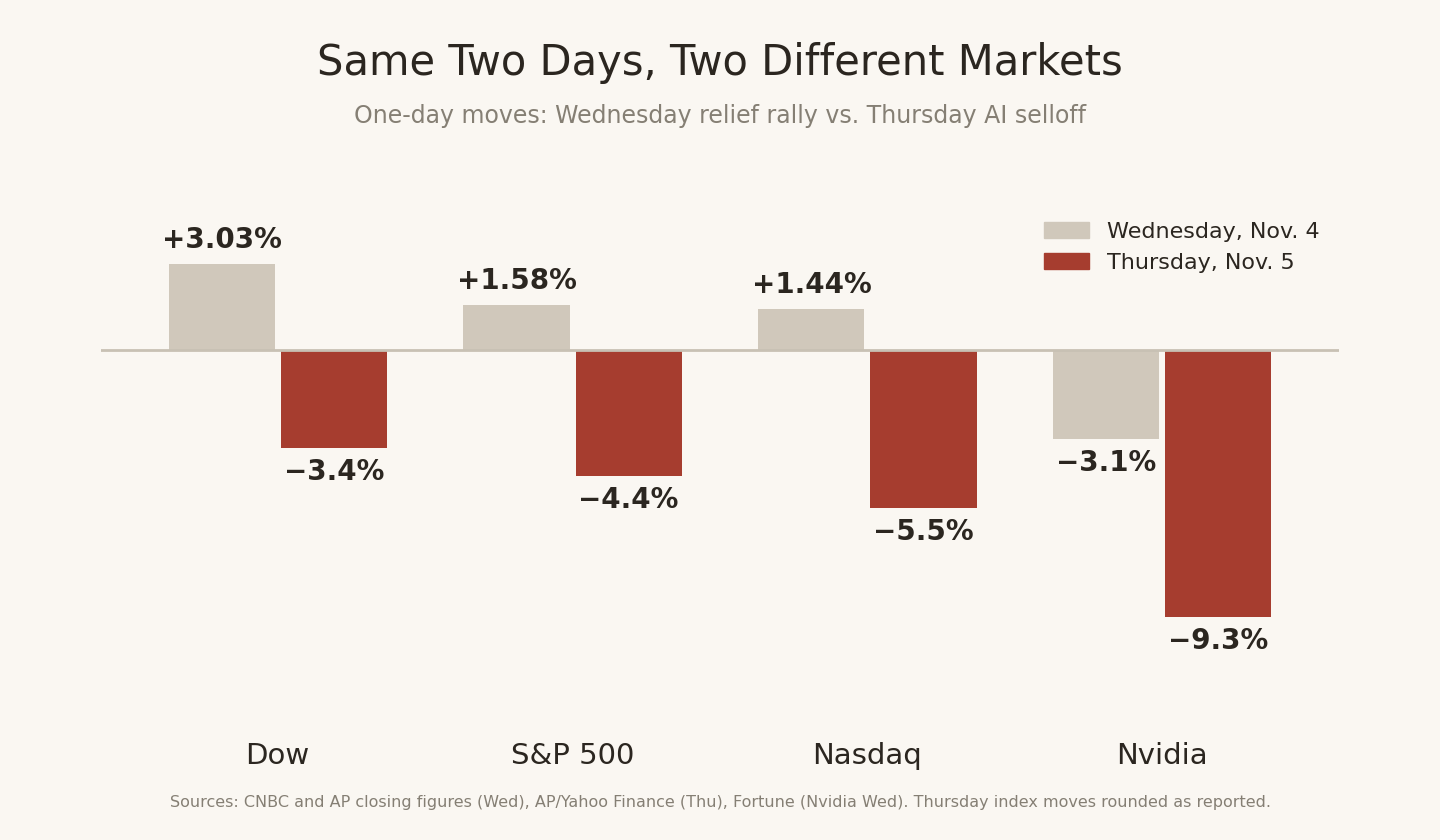
The Short Version
- It looks less like one drop that arrived a day late and more like two different markets on two different days.
- Wednesday: a broad relief rally in the big indexes, while chip and AI-infrastructure stocks were already falling underneath.
- Wednesday night: Qualcomm and Arm reported results that investors read as weak. NBC News called those reports the trigger for Thursday’s sell-off.
- Thursday: the AI trade broke, and the indexes followed.
- Who sold when? No public coverage I found says. Retail, hedge-fund, retiree and age-group positioning for these two days is simply not in what I could read.
- All of the “why” below is reported, not proven.
Wednesday: One Market on the Surface, Another Underneath
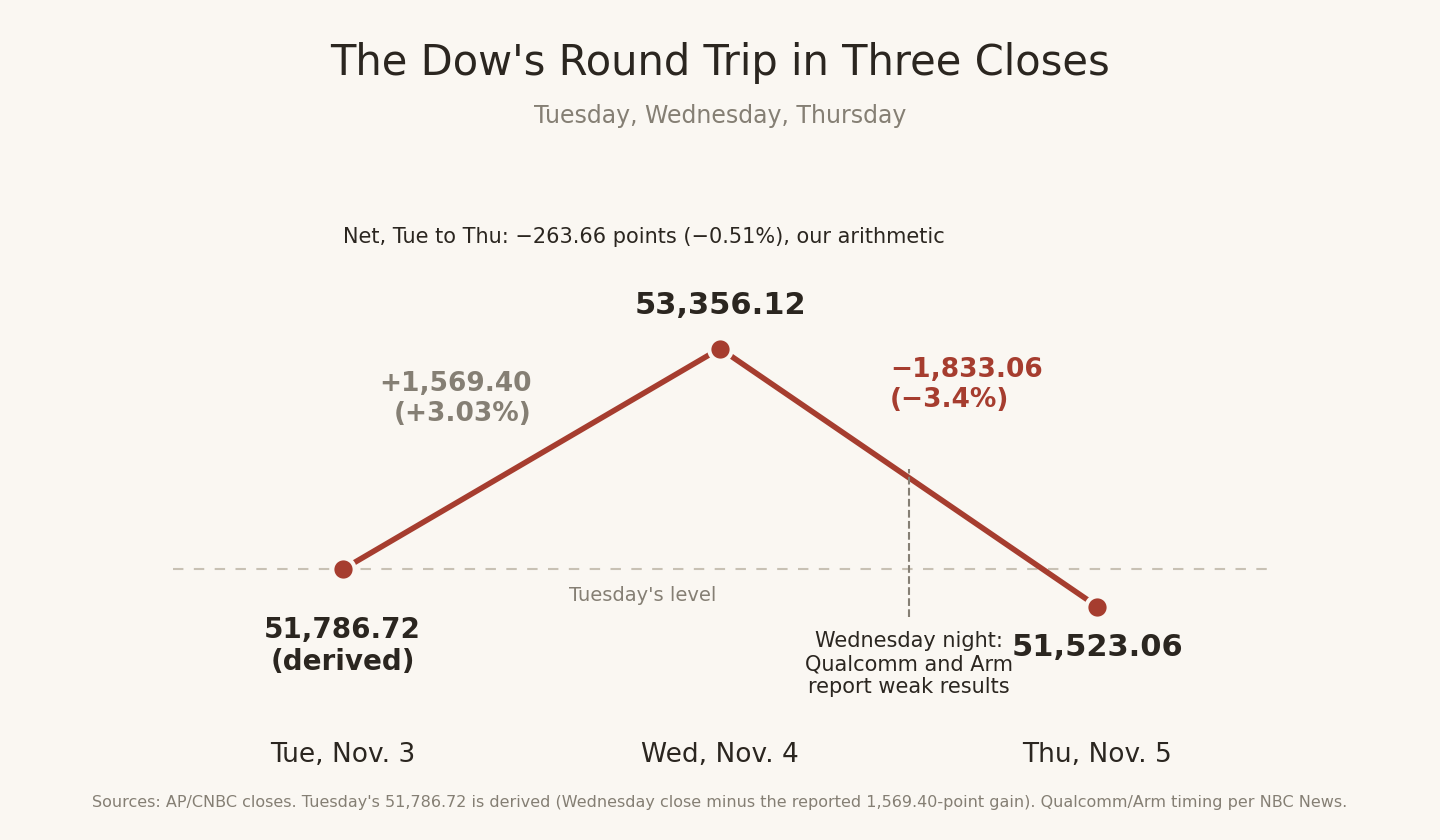
- The Dow rose 1,569.40 points (+3.03%) to 53,356.12. The S&P 500 rose 1.58% to 7,688.62. The Nasdaq rose 1.44% to 25,736.51.
- Yet CNN reported that underneath, shares of chipmakers and companies tied to the AI data-center buildout were falling.
- Fortune: Vistra fell 14% and Vertiv 13% on Wednesday on fears of data-center moratoriums, while Nvidia slipped about 3%. Fortune’s line: the midterm risk to AI “was showing up on Wednesday, but only in parts of the market, before it showed up in full Thursday.”
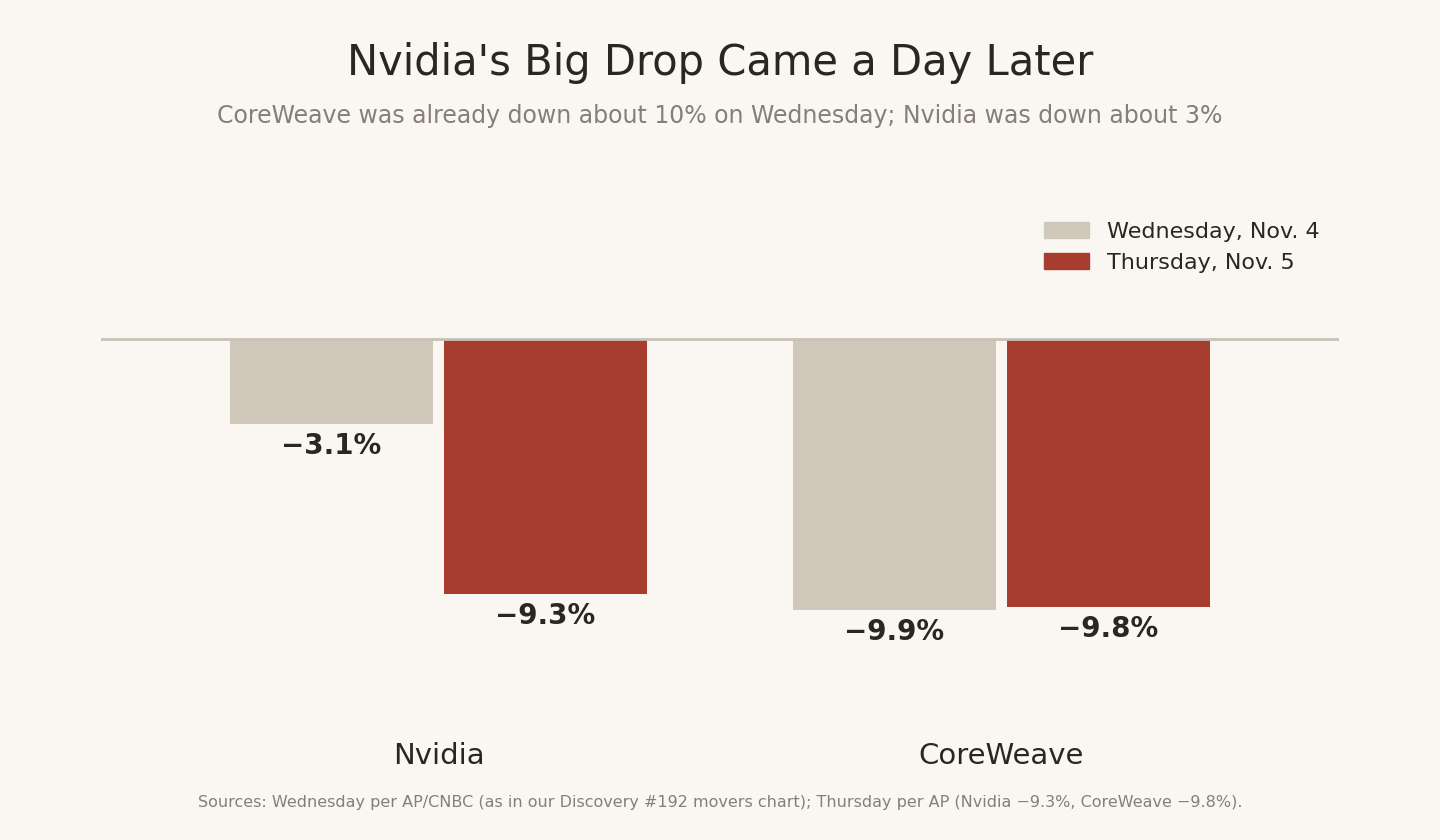
- CoreWeave fell about 9.9% and Nvidia about 3.1% on Wednesday, per the movers chart in #192.
- What worried people: Yahoo Finance reported that in local ballot measures across 10 states, voters sided against data centers, approving bans, moratoriums and new restrictions. Fortune counted 41 such measures, most of which passed. Texas’s governor-elect has pledged a temporary data-center moratorium.
- What soothed people: a clear, accepted result, which removed a layer of political uncertainty. Oil also fell sharply on Wednesday.
Source: CNN. Source: Fortune. Source: Yahoo Finance. Index levels: AP and CNBC, as used in #192.
Wednesday Night: the Report Cards Landed After the Bell
- NBC News reported the Thursday sell-off was triggered by two lackluster earnings reports from chipmakers, Qualcomm and Arm Holdings, released after the close on Wednesday.
- CNN said Qualcomm missed estimates and blamed higher memory-chip costs, echoing Intel’s guidance the week before.
- Qualcomm fell about 9% to 11% on Thursday depending on the outlet (AP, NBC and CNN say about 9% or more; Fortune says 11.2%). Arm fell about 11% to 13%.
- So at least part of the “delay” has a plain explanation: some of the news hadn’t happened yet when Wednesday’s market closed.
Source: NBC News. Source: CNN. Source: Fortune.
Thursday: the AI Trade Broke
- Dow: −1,833.06 (−3.4%) to 51,523.06. S&P 500: −334.89 (−4.4%) to 7,353.73, its worst day since April 2025. Nasdaq: −1,421.52 (−5.5%) to 24,315.00, 11.9% below last month’s record and in correction territory.
- AMD −17.3%, Nvidia −9.3% (CBS and NBC say 9.2%), CoreWeave −9.8%, GE Vernova −7.5%. CNBC reported double-digit drops for Micron and Applied Materials; the big cloud spenders fell roughly 2% to 4%.
- NBC and CNN: the Philadelphia semiconductor index fell 12.3%, its worst day since March 2020.
- Reported drivers: worries that a Democratic Congress could slow or pause data-center construction, expensive borrowing for the AI buildout, AI-bubble talk, and Qualcomm’s weak forecast.
- Oil bounced: Brent rose 3.9% to $98.29 after Wednesday’s roughly 9% drop.
- Bonds: the 10-year yield fell to 4.84% from 4.90% on Wednesday (AP; other reports said 4.88%), 4.95% on election night and above 5.30% last month.
- Fortune said the Dow was heading for its worst second trading day after a midterm in data going back to 1896. That is Fortune’s comparison, and I haven’t checked it independently.
Source: AP via NBC Philadelphia. Source: CBS News. Source: CNBC. Source: NBC News. Source: CNN. Source: Fortune.
How Much Value Disappeared? Depends Who You Ask
- NBC News: the Nasdaq 100 fell 6.3%, erasing $2.3 trillion.
- CNN: about $2.5 trillion.
- Fortune: roughly $3 trillion.
- Benzinga’s headline figure was about $2.2 trillion. I couldn’t open that page (see below), so I can’t vouch for it.
- The range, about $2.2 trillion to $3 trillion, likely reflects what each outlet counted (which index, which moment in the day). I didn’t try to reconcile them.
Did Big, Old, Young or Retiree Money Act Differently?
Plainly: I don’t know, and neither does anything I read. The coverage of these two days has no data on retail, hedge-fund, retiree or old-versus-young positioning. No one has published who sold on Wednesday versus Thursday, and I won’t pretend otherwise.
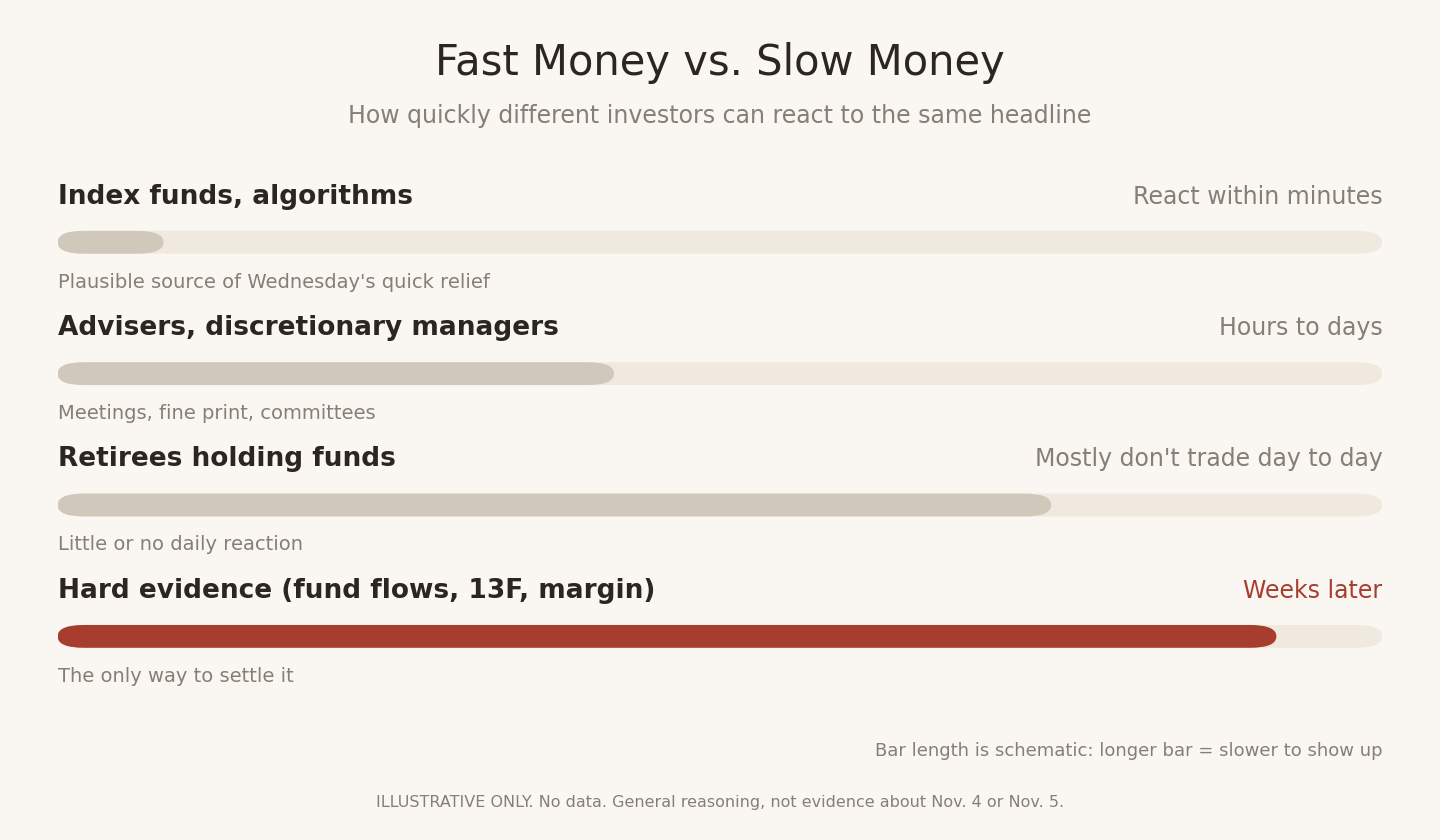
General reasoning, not evidence about these days:
- Index funds and trading algorithms react to headlines within minutes. That fits a fast, broad Wednesday relief move.
- Discretionary managers, advisers and investment committees reading fine print (a moratorium here, a guidance cut there) can take longer. A “slow-money” delay is plausible, but unmeasured.
- Most retirees hold funds and rarely trade day to day, so they probably weren’t the ones hitting sell on either day. Also a guess.
- Hard evidence arrives weeks later: ETF and mutual-fund flow data, 13F filings and margin-debt reports.
As for the theory that old men simply took a day to call their brokers: I can’t rule it out. Somewhere a man in a recliner may well have said “I’ll call first thing tomorrow.” But I can’t assert it either, because broker phone calls don’t show up in any dataset I could open.
What would settle it:
- Daily fund-flow data for both days, split by investor type.
- Brokerage and retail trading-volume reports for November 4 and 5.
- Later regulatory filings (13F) and margin-debt numbers showing who actually reduced exposure.
One expert view, for balance: Truist’s Keith Lerner, quoted by CNN, saw the week’s volatile moves as more of a knee-jerk reaction than a real indication of how tech will fare under a Democratic Congress. That is one adviser’s read, not proof.
Back to My Prediction
- In Story #180 I said a Democratic Congress meant a selloff, driven by tax fears. In #192 I graded that call partial credit at best.
- This reporting doesn’t change the grade: the drop that arrived was about AI, borrowing costs and a weak chip forecast, not taxes.
- Related reading on the AI-bubble worry: Story #163 on circular deals and the dot-com pattern.
- No victory lap. Two days of data isn’t a trend.
What I Got Wrong, and What I Still Don’t Know
What I got wrong:
- I framed this as a one-day delay. The reporting points to two different markets and a Wednesday-night catalyst.
- I expected taxes to be the story. They weren’t in the coverage I read.
What I still don’t know:
- Who sold on which day. No data in the coverage.
- How much of Thursday was the election and how much was Qualcomm and Arm. Outlets weight them differently.
- Whether Wednesday’s rally was a trap or Thursday was an overreaction. Truist’s Lerner leans toward overreaction; that is an opinion.
Sources I Opened, and One I Couldn’t
- Opened and checked for the figures above: Fortune, CBS News, Yahoo Finance, NBC News, AP via NBC Philadelphia, CNBC, and CNN. The CNBC page loaded only partially, so CNBC-specific figures are secondhand via AP and our earlier posts.
- Could not open: Benzinga (it blocked the request), so its $2.2 trillion figure is unverified.