
I was today days old when I found out how fast a scorecard can flip. I wrote the first draft of this post on Wednesday night, and it was a short, humbled one: I had predicted the midterms would sink the market, and instead the Dow had its best post-midterm day since 1982. That draft assumed Wednesday’s rally was the whole story. Then Thursday happened, and I threw it out. Here is the full three-day scorecard instead.
What I Said Then
On October 31 I published Story #180, where I put my own “a correction is coming” hunch on trial. One of its four planks was that Democrats retaking Congress would spook investors about higher taxes and the market would sell off. That was the plank I was most confident about. My prediction, in one line: a selloff because Democrats retook Congress, driven by tax fears.
To be fair to my past self, the data in #180 had already warned me. The S&P 500 has risen in every one of the 19 years following a midterm election since 1950, and in the window from five trading days before the vote to two days after, it has gained in 22 of 23 midterms going back to 1934, with 1994 the lone exception. I had the right numbers in front of me and still expected a pullback. Source: my earlier post.
The Three Days at a Glance
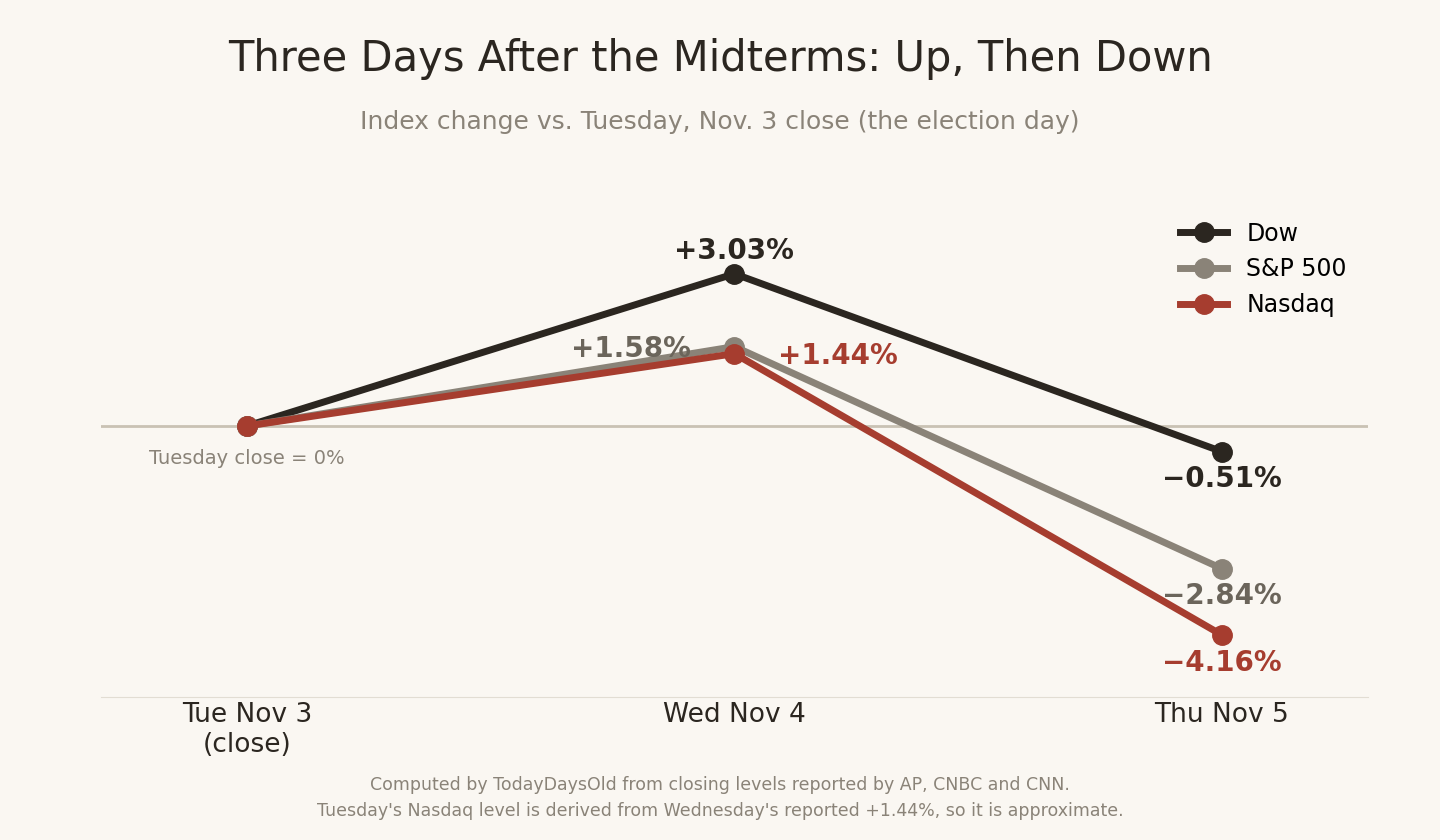
- Tuesday, Nov. 3 (election day): the baseline. Computed from the reported Wednesday changes, the Dow closed at 51,786.72, the S&P 500 at 7,568.92, and the Nasdaq at about 25,371.
- Wednesday, Nov. 4: Democrats win Congress, and the Dow jumps 3.03%, its best post-midterm day since 1982. My call looks dead wrong.
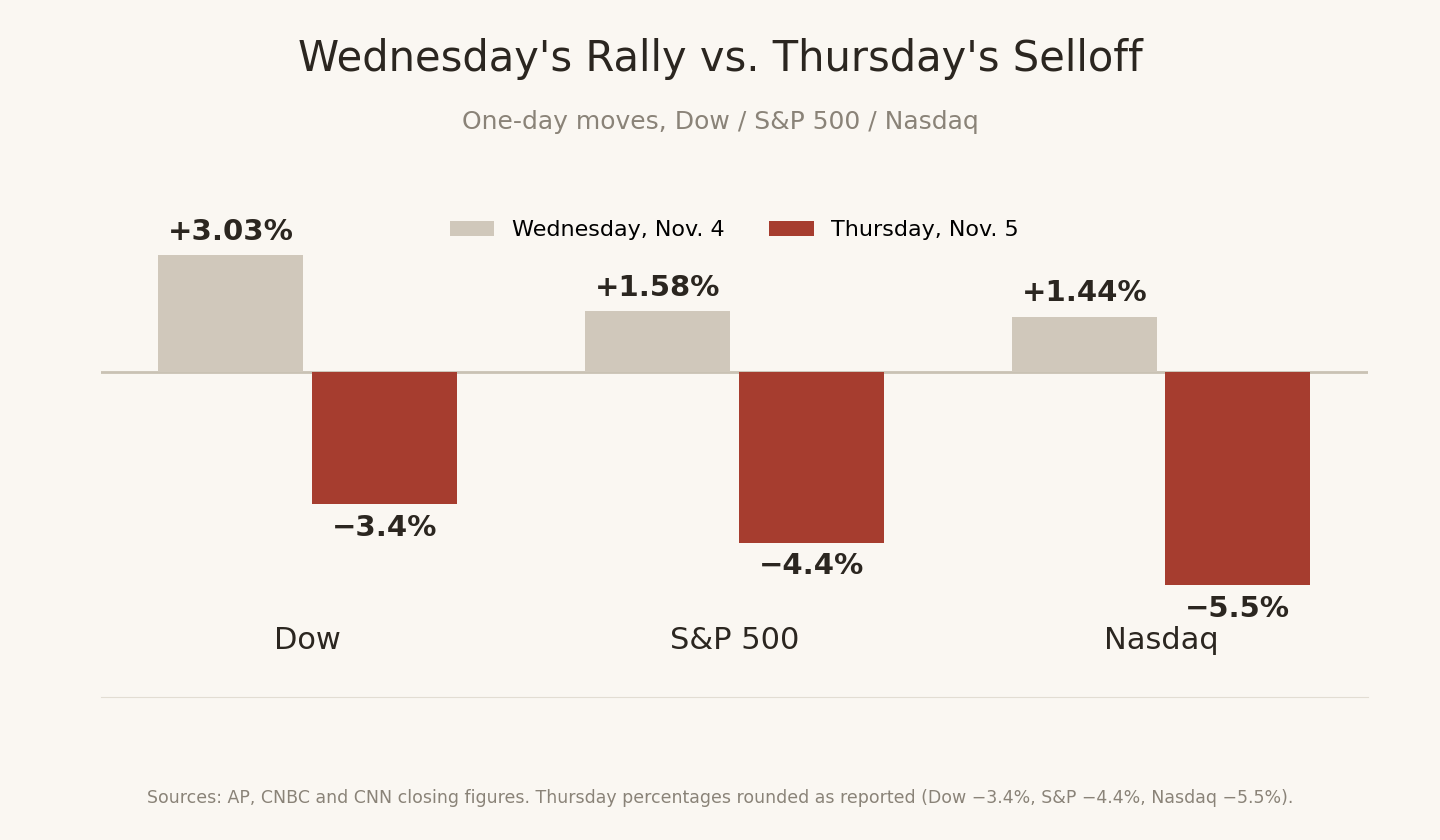
- Thursday, Nov. 5: the worst day for the S&P 500 and Nasdaq since April 2025. The Dow drops 3.4%, the S&P 500 4.4% and the Nasdaq 5.5%.
- Net, Tuesday close to Thursday close (computed by us): Dow −0.51% (about 264 points), S&P 500 −2.84% (about 215 points), Nasdaq about −4.2% (about 1,056 points; approximate because the Tuesday Nasdaq level is derived).
Source: CNBC (Wednesday). Source: AP via NBC Philadelphia (Thursday). Net figures are our own arithmetic from those closes.
Wednesday: the Rally That Broke My Call
Democrats won majorities in the House and Senate on Tuesday, and President Trump said he would accept the results. Wednesday, November 4:
- The Dow Jones Industrial Average rose 1,569.40 points, or 3.03%, to 53,356.12 — its best day since April 9, 2025, and its first close above 53,000 since September 8.
- The S&P 500 rose 1.58% (119.70 points) to 7,688.62, its best day in three months.
- The Nasdaq rose 1.44% to 25,736.51.
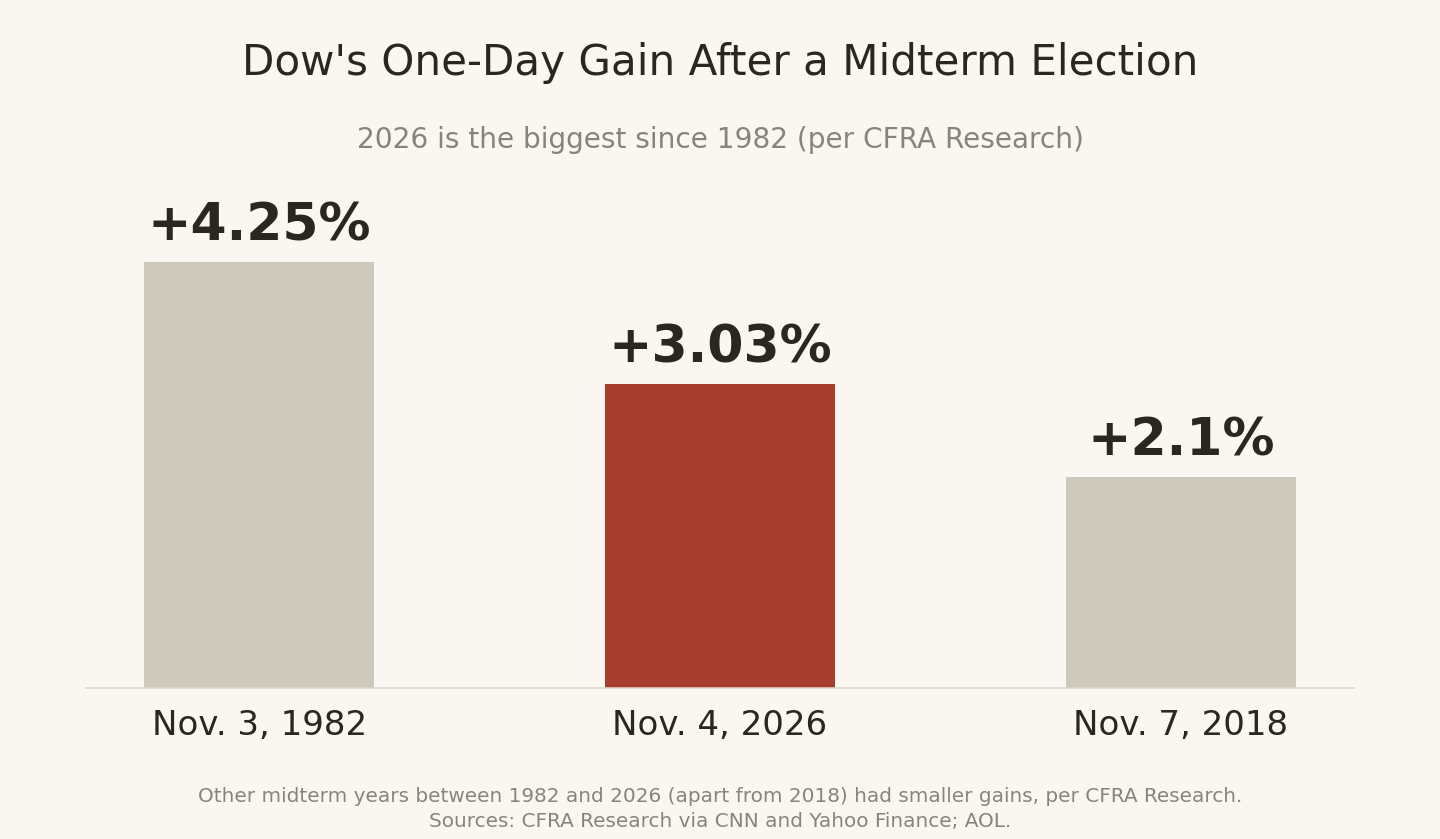
- CFRA Research called it the Dow’s biggest single-day move after a midterm election since 1982. The S&P 500’s 1.58% ranks second since 1982 (only 2018 was larger) and the Nasdaq’s 1.44% was its biggest post-midterm day since 2018.
- The footnote on “44 years”: the 1982 day was bigger. On November 3, 1982 the Dow rose 4.25%; on November 7, 2018, 2.1%. Wednesday’s 3.03% sits between them.
Source: CNBC. Source: AP. Source: Yahoo Finance. Source: CNN. Source: AOL.
Reasons reported for Wednesday (reported, not proven):
- The election result was clear and accepted, which removed a layer of political uncertainty.
- Oil fell sharply on hopes of de-escalation in the Iran war: WTI dropped more than 8% to $88.12, and Brent fell 8.7% to $94.62, its lowest settle since August 31.
- The VIX, Wall Street’s fear gauge, fell 4.22 points to 16.61, a drop of about 20%.
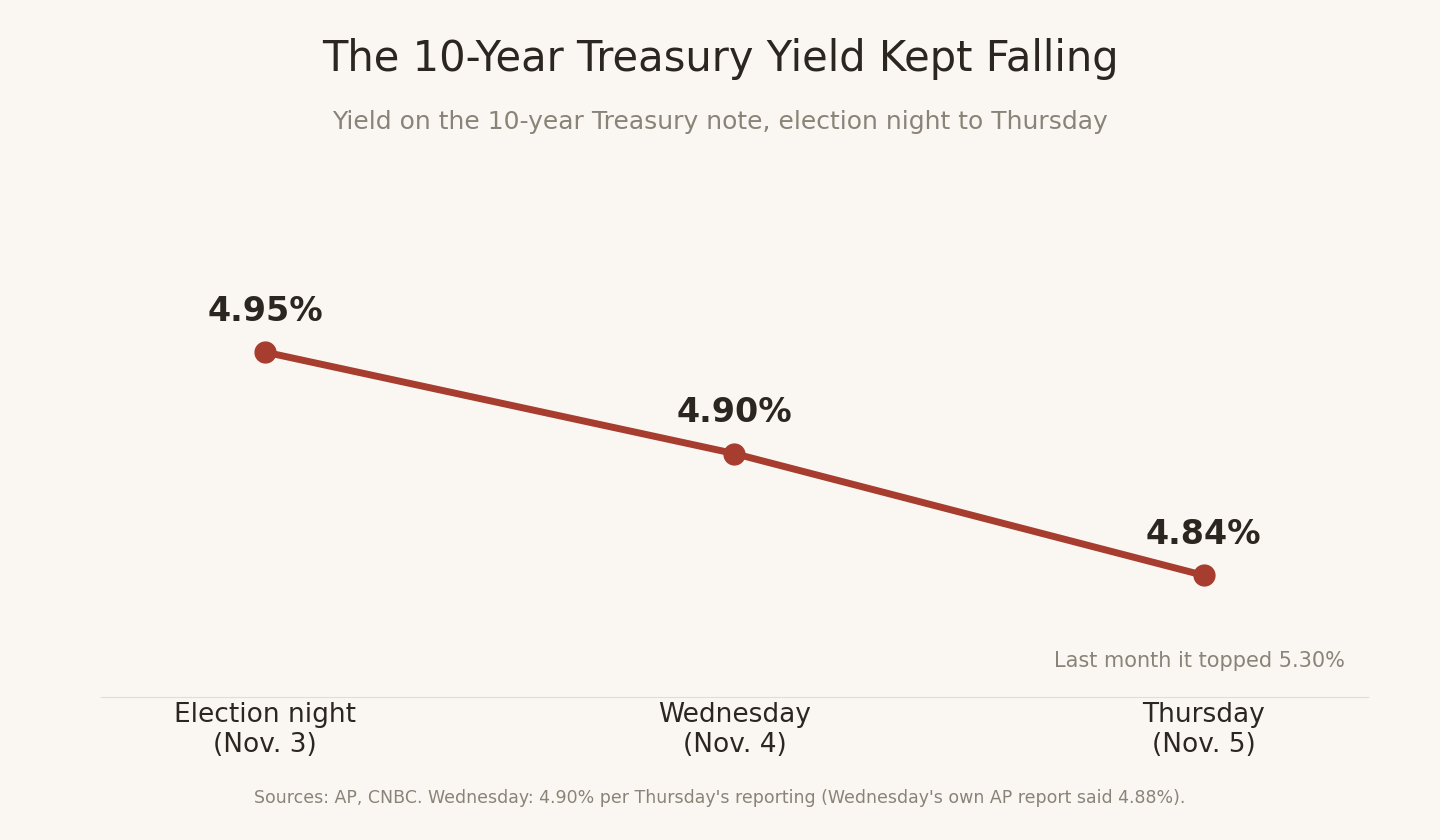
- The 10-year Treasury yield fell to 4.88% from 4.95% (Thursday’s reporting cites 4.90% for Wednesday).
- Hopes that Democrats might reverse some federal healthcare and food-assistance cuts lifted healthcare and retail stocks.
Source: CNBC. Source: AP. Source: AOL.
Wednesday’s movers:
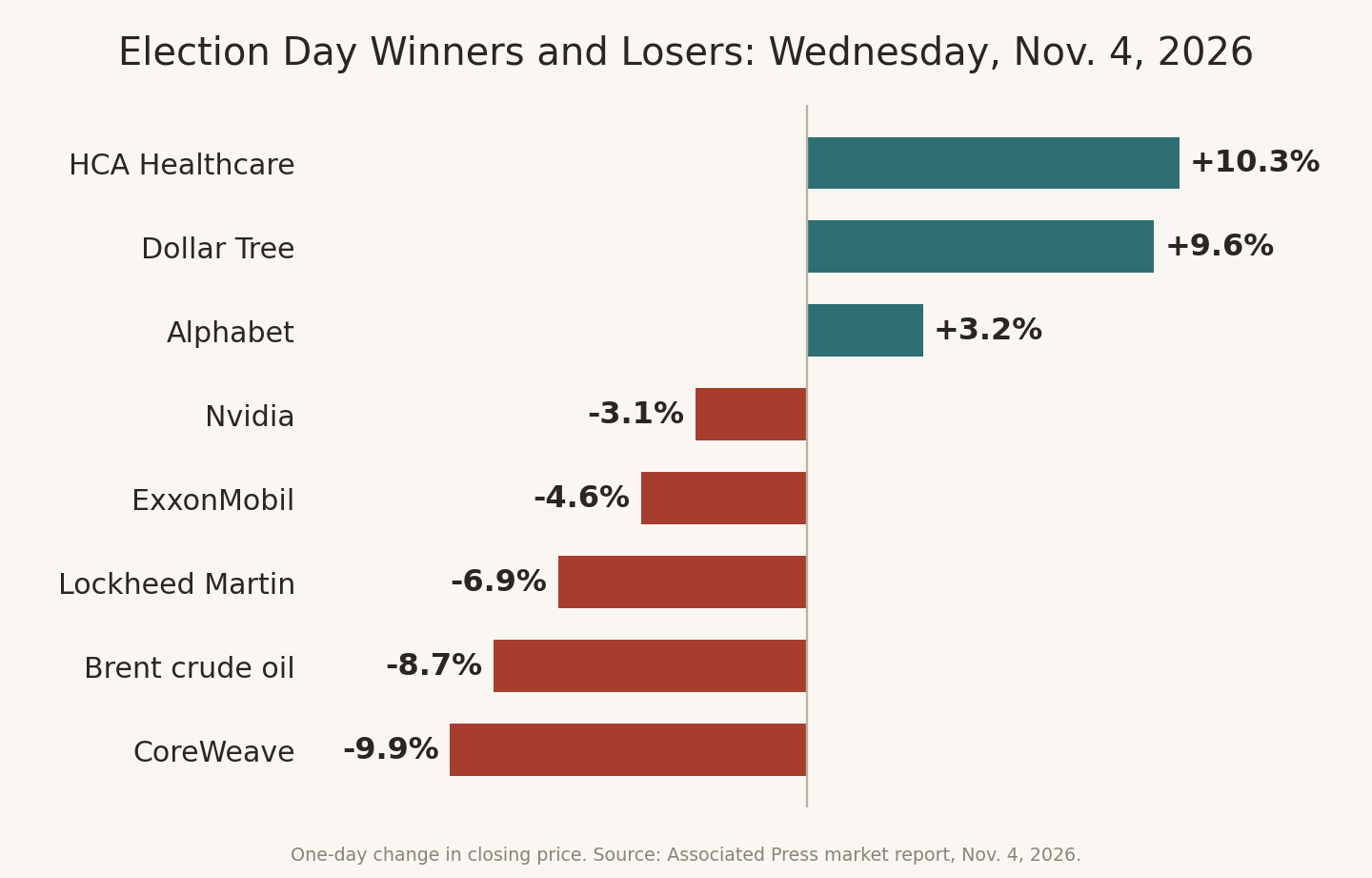
- Winners: HCA Healthcare +10.3%, Dollar Tree +9.6%, Apple +6% to an all-time high of $354.33, Amazon +7%, Microsoft +6%, Alphabet +3.2%.
- Losers: CoreWeave −9.9%, Nvidia −3.1%, ExxonMobil −4.6%, Lockheed Martin −6.9%, Caterpillar −5.23%, Trump Media & Technology Group −24.5%.
- The AI-infrastructure names (Nvidia, CoreWeave) were already weak on Wednesday, on worries that a Democratic Congress could restrict data centers and that Texas’s governor-elect has pledged a data center moratorium. In hindsight, a preview.
Source: AP. Source: CNBC. Source: AOL.
Thursday: the Selloff Nobody Ordered
The next day the market gave back everything and then some. Thursday, November 5:
- The S&P 500 fell 4.4% (334.89 points) to 7,353.73, its worst day since April 2025.
- The Dow fell 1,833.06 points, or 3.4%, to 51,523.06.
- The Nasdaq fell 5.5% (1,421.52 points) to 24,315.00, also its worst day since April 2025, leaving it 11.9% below its all-time high from last month. That is correction territory.
Source: AP via NBC Philadelphia. Source: CNN.
Who got hit on Thursday:
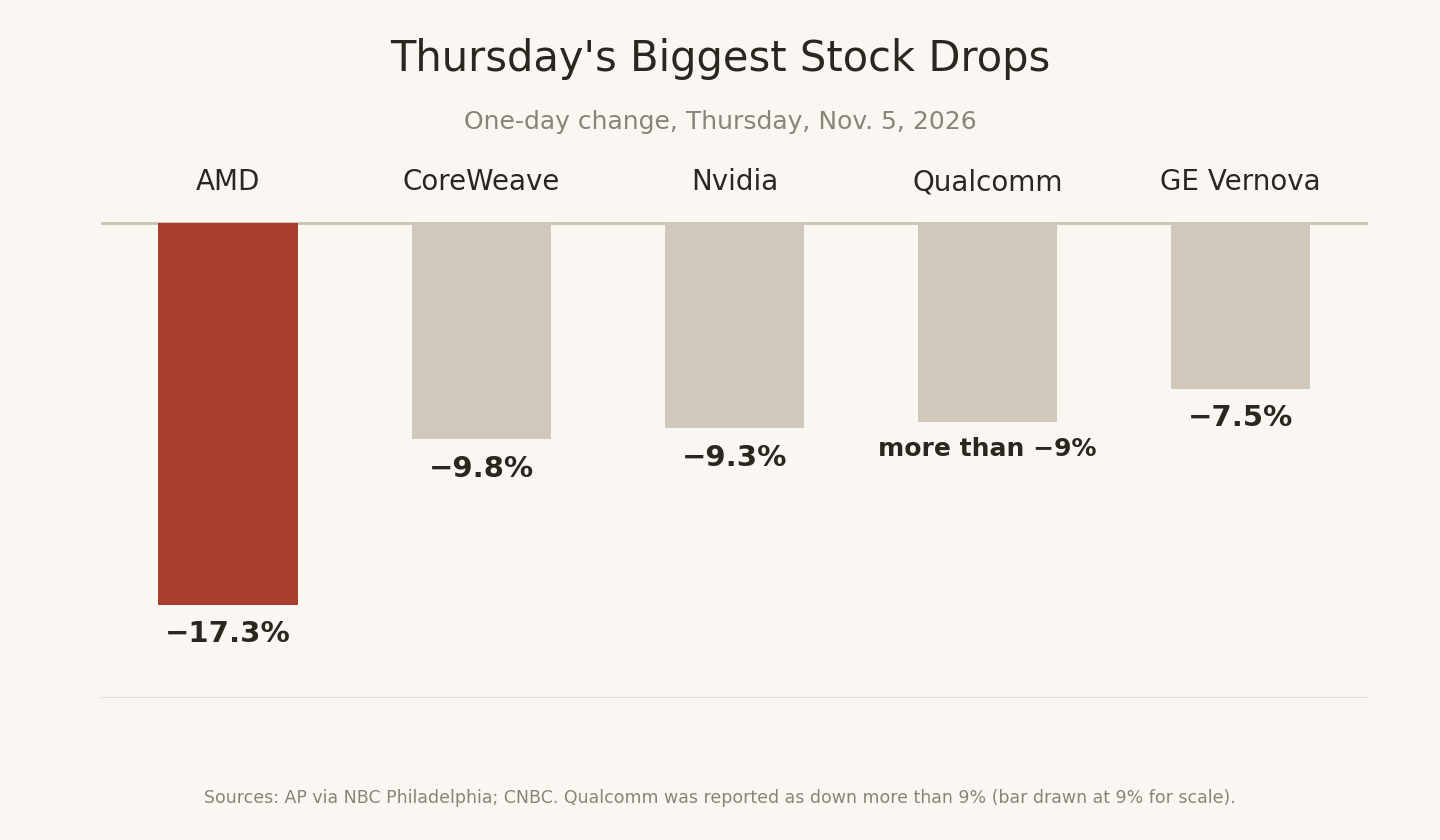
- AMD −17.3%.
- CoreWeave −9.8%.
- Nvidia −9.3%, which leaves it down 2.6% for the year and wiped out roughly $450 billion of market value, per CNBC.
- Qualcomm down more than 9% after a weak quarterly forecast.
- GE Vernova −7.5%.
- CNBC also reported double-digit drops for Micron and Applied Materials, and drops of more than 9% for Tesla and SpaceX.
- The big cloud spenders fell less: Alphabet, Amazon, Meta and Microsoft were each down roughly 2% to 4%.
Source: AP via NBC Philadelphia. Source: CNBC.
Reasons reported for Thursday (reported, not proven):
- Midterm results raised worries about possible regulation or pauses on AI data-center construction.
- Expensive borrowing could slow the AI buildout.
- Renewed talk that AI stocks are in a bubble.
- Qualcomm’s weak outlook, which dragged chip stocks lower.
- Oil rebounded: Brent rose 3.9% to $98.29, recovering part of Wednesday’s roughly 9% drop.
- One relief valve: the 10-year Treasury yield slipped to 4.84% from 4.90% on Wednesday and 4.95% on election night. Last month it topped 5.30%.
Source: AP via NBC Philadelphia. Source: CNBC. Source: Spectrum News.
Note what is and isn’t in that list: the election is cited, but as a source of AI-regulation worries, and I did not find any of these reports blaming tax fears. One more detail, our own arithmetic: the Dow’s Thursday close is about 5.2% below its August 5 record close of 54,349.12.
Grading My Own Prediction
Prediction: a selloff because Democrats retook Congress, driven by tax fears.
What I got right (partly):
- A real selloff did arrive, two days after Democrats took Congress, and the election results are cited in the reporting on it.
- It hit the part of the market I worried about in #180’s AI-capex plank hardest: Nvidia, AMD, CoreWeave and other chip names, with the Nasdaq now in correction territory.
- Wednesday’s weakness in Nvidia and CoreWeave was a hint I should have weighted more.
What I got wrong:
- The mechanism. My plank was taxes. The reported drivers were AI regulation, expensive borrowing and bubble talk, plus one chipmaker’s bad forecast. Right outcome-ish, wrong reason, and I don’t get full credit for that.
- Wednesday, flat out: the best post-midterm day for the Dow since 1982 is the opposite of what I predicted.
- The Dow, the index most people mean by “the market,” ended the three days only about 0.5% below its election-night close.
- The Nasdaq being 11.9% below its October high is not the same as my prediction working, because by our arithmetic the Nasdaq was already roughly 8% below that high on election day.
The honest grade is partial credit at best, and no victory lap. Two days of data is not a trend, and the strategists who said “earnings trump elections” and that markets “like gridlock” had the more useful take. The pattern in the history, that stocks usually rise after midterms, is still standing. Source: AP.
I ended #180 with this: “If I’m wrong, I’d rather be wrong on the record than right in my head.” Well, here it is, on the record, both days. The October inflation number lands November 10. I’ll check back then, with my gut on a shorter leash.