I was today days old when I learned that 31,000+ ham radio operators across North America set up portable stations every fourth weekend of June, run on batteries and generators, and try to make as many contacts as possible in 24 hours — it’s a coordinated continent-wide field exercise, and you can drive to one near you and watch.
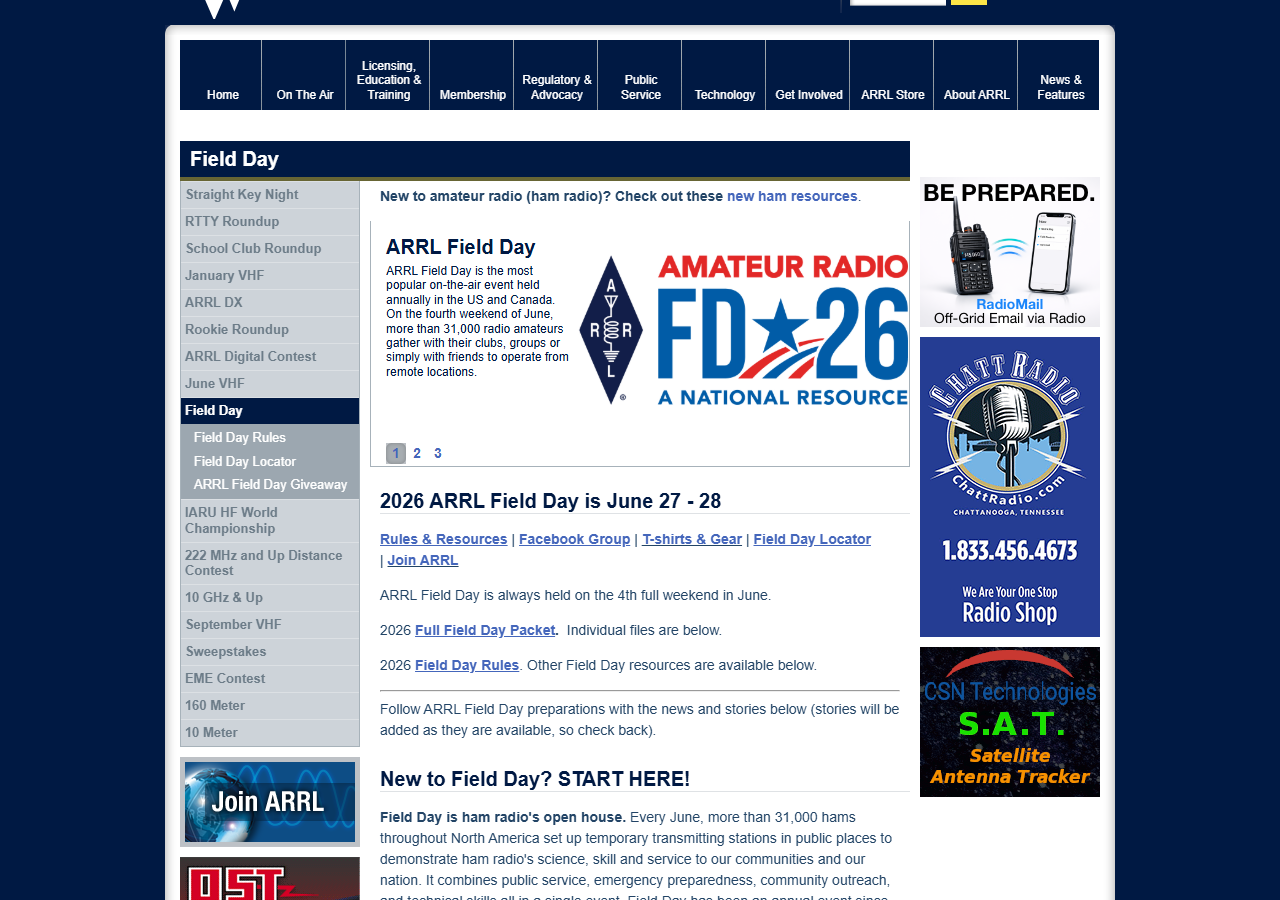
This weekend is 2026 ARRL Field Day: June 27–28. It happens every year on the fourth full weekend of June, and it is the largest amateur radio operating event in North America. More than 31,000 licensed amateur radio operators, organized into roughly 3,000 groups and clubs, spend those 24 hours setting up temporary stations — in parks, on mountaintops, in parking lots, in fields, on rooftops — and making as many radio contacts as possible with other Field Day stations across the continent.
What exactly are they doing? Field Day is designed to simulate emergency operating conditions. The rules require that stations run on battery, solar, or generator power — no permanent power connections. Antennas must be temporary. No fixed station infrastructure. The goal is to demonstrate that you can set up a functional communications station anywhere, from nothing, with equipment you brought with you, and make it work. Operators score points by completing contacts on as many different frequency bands and modes — voice, Morse code, digital — as possible. A contact on 40 meters voice counts. A contact on 15 meters CW counts separately. Contacts via satellite count extra. The 24-hour clock starts at 1800 UTC Saturday and runs through 1759 UTC Sunday. Most groups run multiple stations simultaneously, with operators rotating in shifts around the clock.
How to find one near you. The ARRL publishes a free Field Day Station Locator at arrl.org/field-day-locator. Enter your zip code and it returns a list of Field Day sites in your area, with club name, address, and contact information. Most of them are in public places — community parks, fairgrounds, school athletic fields, church grounds. The vast majority are open to anyone who wants to walk in. You do not need to be a licensed operator or a club member. You can just show up.
This is the at-air companion to WebSDR and KiwiSDR (#073) — where that post is the stay-home-and-listen side of amateur HF radio, Field Day is the get-in-your-car-and-watch side. Both are free. Both require nothing from you. WebSDR gives you the spectrum from your couch; Field Day shows you the people behind the spectrum. The same HF bands, the same propagation, the same community — just different vantage points.
The community behind it. Almost every Field Day site is run by a local amateur radio club. The ARRL — the American Radio Relay League, founded 1914 by Hiram Percy Maxim, the national association for amateur radio in the United States — organizes the event nationally, sets the rules, and tallies the scores. But the actual operations are purely local. Your county has a club. That club has members. Those members pick a site, file a notification with the ARRL, haul out antennas and radios and generators on Friday afternoon, and spend the weekend doing something they love in public so that other people can see it. If you show up at a Field Day site and ask someone to explain what they’re doing, they will explain it. At length. Enthusiastically.
Why it matters outside the hobby. The thing that makes Field Day genuinely notable — not just “neat hobby event” but actually significant — is what it’s practicing for. When a hurricane takes out power and cell towers, when a wildfire cuts a community off, when a search-and-rescue operation needs coordination across terrain where nothing digital works, the people who show up with working communications are often licensed amateur radio operators running exactly the kind of portable battery-powered HF setup that Field Day trains for. ARRL emergency communications teams have been activated for hurricane relief, flood response, and wildfire support. Field Day is the annual drill that keeps the muscle memory sharp — across the whole community, at the same time, continent-wide. There is no other hobby event quite like it in scope or purpose.
One more angle for this weekend: DashView Live (#063) — the live sports and events second-screen dashboard we covered in June — is putting up a Field Day dashboard on YouTube and Rumble starting hopefully tonight. If you can’t get out to a site, you can follow the contest from your couch.
Find a site near you at arrl.org/field-day-locator. Drive over. Bring kids. Ask questions. The people there will be thrilled to explain what they’re doing.