I was today days old when I learned you can tune real radio receivers around the world from your browser — shortwave broadcasts on a radio in the Netherlands, HF amateur traffic on a radio in Iowa, weather fax on a radio in the Pacific, all live, all free, no login.
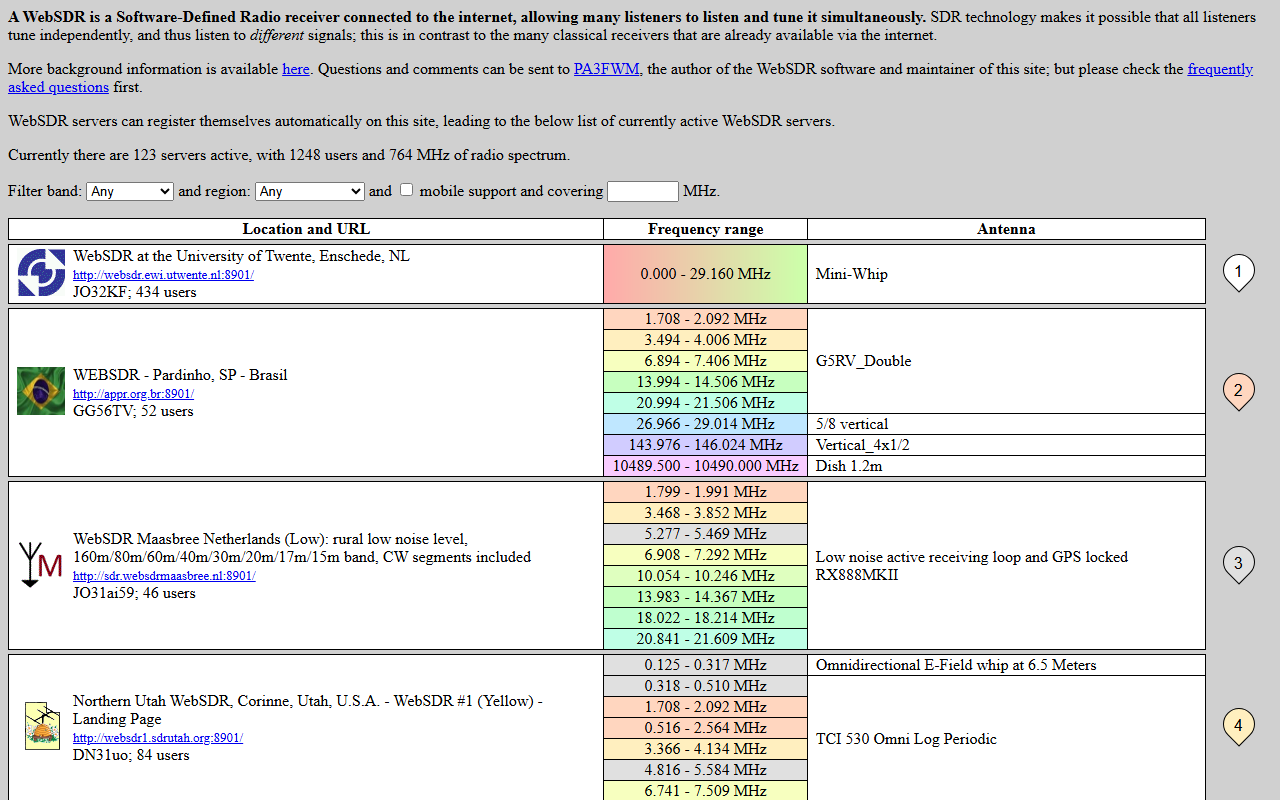
Start at websdr.org. That page lists every WebSDR receiver that’s currently online — 123 of them as of this writing. Click the first entry: the University of Twente WebSDR in Enschede, the Netherlands. The control panel that loads is the actual interface for their radio. The frequency dial is real. The waterfall display — that scrolling cascade of colors showing signal activity across the spectrum — is updating live from their antenna on campus. Move the dial to something active. You hear whatever their antenna is picking up at that frequency, right now.
This is completely different from Radio Garden (#017). Radio Garden streams curated broadcast stations — somebody chose to be in that directory. WebSDR is the raw spectrum. No curation. Nobody chose to be on the band. Tune to 14.074 MHz in USB mode on the Twente receiver and you hear FT8 — a digital mode where hundreds of amateur radio operators exchange automated contacts. Tune to 14.225 MHz and you might catch voice traffic on the 20-meter ham band. Find 15 MHz and WWV, the US time standard in Fort Collins, Colorado, comes in as a tick every second and a voice announcement every minute — crossing the Atlantic via shortwave. Shortwave broadcasters are still active in 2026 across the 6, 9, and 11 MHz international broadcasting bands. The dial does not know what it will find.
KiwiSDR extends the network in hardware. John Seamons designed the KiwiSDR — a standalone receiver board built around a Xilinx FPGA and a BeagleBone single-board computer, covering 10 kHz to 30 MHz, with four independent simultaneous listeners and a built-in web server. Plug it in, connect an antenna, and it registers itself on the public directory. Hundreds of these are deployed worldwide by volunteer hosts, mostly licensed amateur radio operators. The public list is at kiwisdr.com/public/ — pick a receiver by location, click its link, and you are tuning that antenna. A receiver in New Zealand hears Pacific HF propagation paths differently than one in Iowa. Geography matters in shortwave, and this network lets you sample it.
The click path on either site is the same: find a receiver with open slots, click in, pick a frequency in the waterfall where there’s visible signal energy, click play. No account. No install. That’s it.
The honest angle here is the same one that runs through Flightradar24 (#021) and WiGLE (#033): all of this is volunteer infrastructure. The KiwiSDR hosts are hams who have antennas up anyway and decided to share. There is no business model, no corporate entity, no venture funding. The WebSDR software was written by Pieter-Tjerk de Boer at the University of Twente and made freely available. The whole network is a public-spirit thing, same as amateur radio has always been.
One thing to check before citing: sdr.hu is gone. It was a popular aggregator of public SDR receivers for years, but it shut down — the site now displays a farewell message from the developer. If you’ve seen it mentioned anywhere, it’s no longer the place to go. websdr.org and kiwisdr.com/public/ are the current live directories.
The spectrum is always on. Go to websdr.org, open the Twente receiver, and tune around. Whatever you land on is live.