I was today days old when I realized I’d written dozens of posts about casino floors — Reno’s best rooms, every property on the Vegas Strip, the walk from The LINQ — without ever once explaining how to actually play any of the games sitting on them. That changes today. This is the first post in a new series on how to actually play the table games this site has already toured the venues for, and it starts with one of the fastest, simplest ones on the floor: Three Card Poker.
A game built on purpose to be fast:
Three Card Poker isn’t an old game that evolved into its current casino form — it was designed, on purpose, by a single person. British poker player Derek Webb created the casino version in 1994 specifically to play at the speed of other table games like blackjack, while still keeping real poker hand rankings instead of a simplified house system. He patented it in 1997. Wikipedia traces the whole history, and the design clearly worked: today Three Card Poker is the third most-played poker-style table game in Las Vegas, behind only Pai Gow Poker and Ultimate Texas Hold’em, running across 110+ active tables at roughly 58 Las Vegas casinos.
Two separate bets, judged two completely different ways:
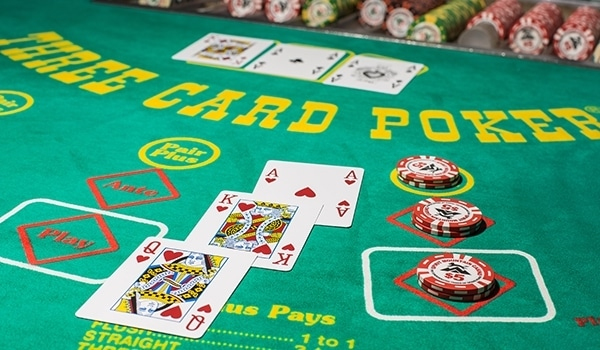
Here’s the part that trips up first-timers: Three Card Poker isn’t one bet, it’s two, and they don’t interact. The first is Ante & Play. You place an Ante bet before any cards come out, then the dealer deals you three cards, face down. You look at your hand and make one decision: either match your Ante with an equal Play bet to stay in, or fold and lose the Ante. Once everyone’s decided, the dealer turns over their own three cards. For the dealer’s hand to count at all, it has to “qualify” — Queen-high or better. If the dealer doesn’t qualify, your Play bet automatically wins 1:1 and your Ante simply pushes, win or lose on your actual hand. If the dealer does qualify, then it’s a straight comparison: beat the dealer and both your Ante and Play pay 1:1; lose to the dealer and you lose both bets. The second bet, Pair Plus, is entirely separate and optional — you can place it instead of, or alongside, the Ante. It never touches the dealer’s hand at all. Your three cards are judged only against a fixed payout table: on the common version, a Straight Flush pays 40:1, Three of a Kind pays 30:1, a Straight pays 6:1, a Flush pays 3:1, and a single Pair pays 1:1. Both bet structures, dealer-qualifying rule included, are laid out in detail by Wizard of Odds.

The one strategy rule that actually matters:
Three Card Poker has a reputation for being a game of luck with no real strategy, and for Pair Plus that’s basically true. But the Ante & Play decision — play or fold — is not a coin flip. Wizard of Odds ran the full game-theory-optimal math and it collapses down to a single, memorizable threshold: make the Play bet with any hand of Queen-6-4 or better — meaning your highest card is a Queen or better, and if your highest card actually is a Queen, your second-highest card needs to be a 6 or better and your third needs to be a 4 or better — and fold everything worse than that. That’s the entire strategy. No suited bonuses to track, no dealer up-card to read, no deviations for different table rules. Following that one rule consistently brings the Ante/Play house edge down to 3.37%, which is where the real, repeatable edge in this game actually lives. One catch worth spelling out: the Queen-6-4 threshold only governs plain high-card hands, where your three cards don’t form a pair, straight, or flush. Hand ranking comes first — any pair, straight, flush, three of a kind, or straight flush beats every no-pair hand, full stop, no matter how low it ranks. A hand like Jack-4-4 is just a pair of 4s, but a pair of 4s still beats Queen-6-4 high, so it’s always a play, never a fold.
Pair Plus, honestly: bigger swings, worse odds:
It’s worth being straight about Pair Plus rather than just listing its payouts. On that same common paytable, Wizard of Odds puts its house edge at 7.28% — roughly double the 3.37% you get from playing Ante/Play correctly. That doesn’t mean don’t play it. It means Pair Plus is a bet people make for the swing, not the math: a shot at a 40:1 Straight Flush payout that Ante/Play simply doesn’t offer, at a real, known cost in expected value. Knowing that going in is the whole point — it’s your call to make, not a trap to avoid.
That’s the whole game, and it’s genuinely that simple at the table: ante up, look at three cards, play or fold against one threshold, decide separately whether Pair Plus is worth the swing. This site has spent a lot of posts standing in front of casino floors describing what’s on them. This is the first of a planned run actually explaining how to sit down and play.