
I was today days old when I decided to stop nodding along every time someone said “tokens.” The prompt was a tagline I couldn’t shake: “Every token has to earn its keep.” So here is the deep dive: what a token is, what it costs, why the numbers got so big, and why some companies started counting them like points on a scoreboard.
Ken’s Questions, Answered Up Front
- Does anyone who uses AI really know what a token means? Mostly no, and that is fair. You never see tokens when you chat. They show up on the bill, in usage limits and in “context window” specs.
- More is bad, less is good? Only half true. For the same job, fewer tokens means a smaller bill. But more tokens can also mean more work done, and a cheap token used wastefully is still waste.
- Token maxxing, a measure of how hard someone is working? It is a real workplace trend, and it is a textbook case of a measure turning into the target. Counting tokens measures spend, not results (details below).
The Short Answer
- A token is a chunk of text the model reads and writes. Tokenizers (commonly using a method called byte-pair encoding, BPE) cut text into pieces: common words are often one token, rare words split into several.
- OpenAI’s rule of thumb: 1 token is about 4 characters, or about ¾ of a word, so 100 tokens is about 75 words. These are estimates.
- You are billed and limited in tokens. Input (what you send), output (what the model writes) and reasoning tokens are counted, and output usually costs more.
Source: OpenAI Help Center. Unverified detail: I could only see this page through a search snippet because the fetch was blocked.
How Tokenizing Actually Splits Text (Computed, Not Guessed)
I ran real text through OpenAI’s open-source tiktoken package, using its o200k_base and cl100k_base encodings. These are OpenAI tokenizers. Claude and Gemini use their own, so their counts for the same text will differ.
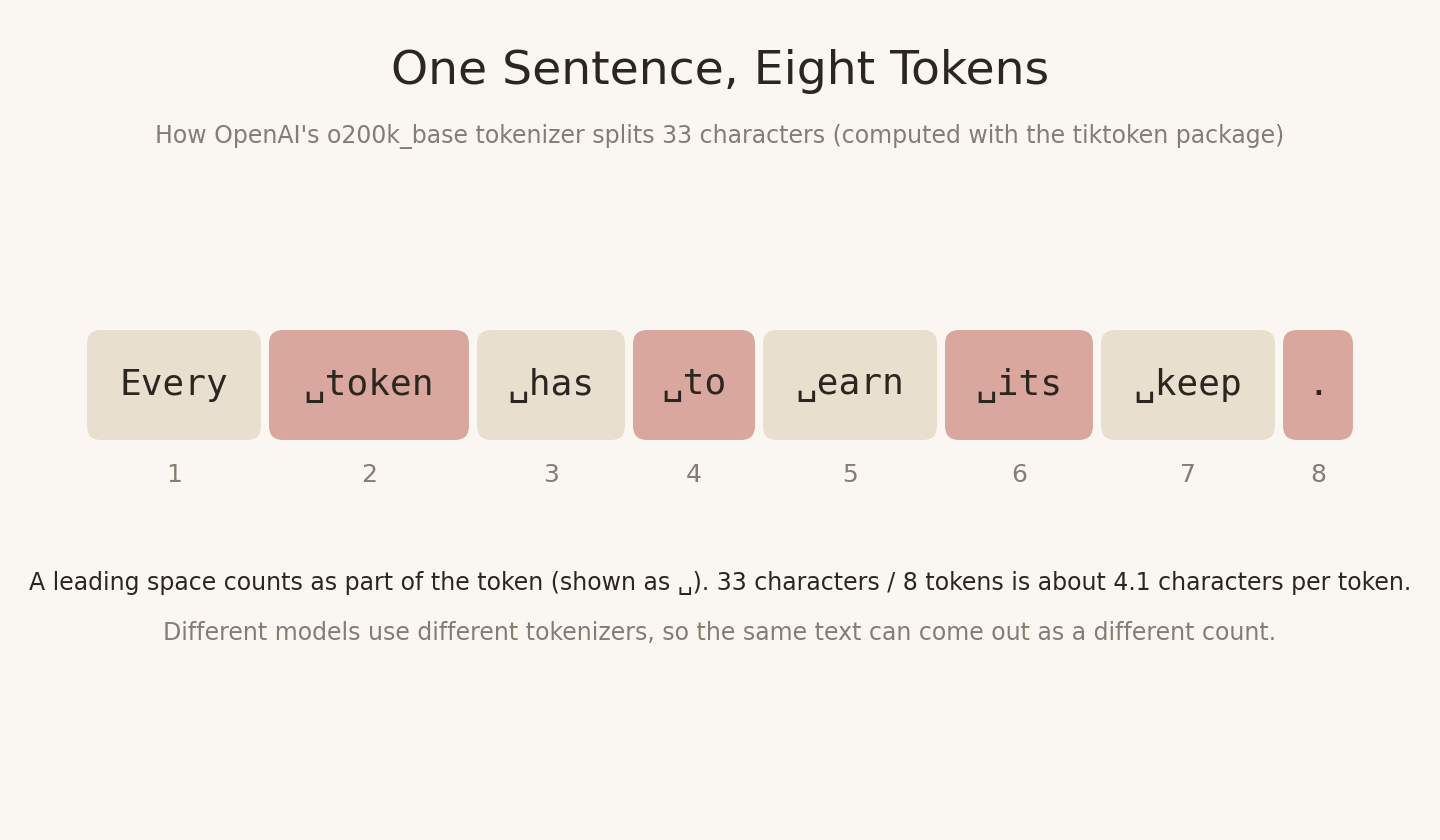
- “Every token has to earn its keep.” 33 characters, 8 tokens (the picture above). About 4.1 characters per token, close to the rule of thumb.
- “unbelievably” splits into 3 pieces, and the two tokenizers disagree:
un | bel | ievablyino200k_base,un | belie | vablyincl100k_base. Same word, different cuts. - Italian: “Ogni token deve guadagnarsi il suo posto.” (my own rough translation of the tagline, 41 characters) came out as 12 tokens versus 8 for the English. That is one sentence on one tokenizer, not a general rate.
- Code:
def add(a, b): return a + bon two lines, 31 characters, came out as 11 tokens, about 2.8 characters per token, so denser than prose. - Emoji: a simple smiley is 1 token, but a family emoji (one visible symbol built from five characters) is 8 tokens, as many as the whole tagline.
Want to try your own text? Search for an online tokenizer (OpenAI has one), or run tiktoken yourself. These counts are from one run on 2026-11-06 and cover a handful of samples.
Why Other Languages Cost More
Tokenizers are trained mostly on English-heavy text, so English gets the efficient cuts. Other scripts often get chopped into smaller pieces. Figures reported in research papers, taken from search-result snippets rather than the papers themselves, so treat them as approximate and secondary:
- Italian: about 1.6x the tokens of English. Bulgarian: about 2.6x.
- Armenian: about 9x. Burmese: over 10x.
- Romance languages land close to English.
- Sources: arXiv 2509.05486 and arXiv 2305.15425.
- Claim I could not source: that code and emoji generally cost more. My own samples above went both ways (code was denser than prose, one emoji was cheap, a family emoji was costly), so I would not generalize.
The practical effect is a surcharge on being a non-English speaker: the same idea can cost several times more tokens, and therefore money or usage allowance.
What a Token Costs
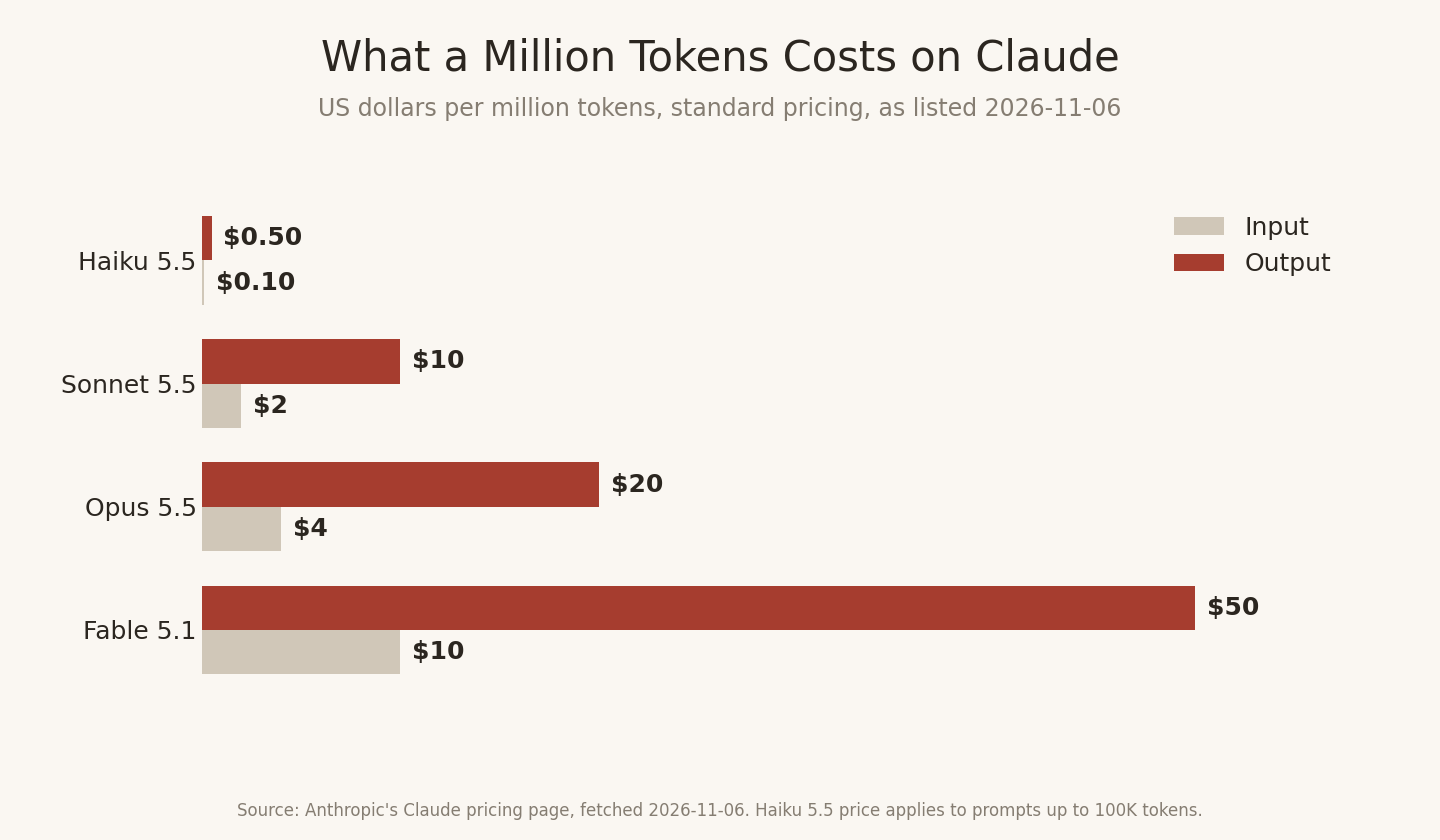
- Claude, per million tokens (input / output), from Anthropic’s pricing page fetched 2026-11-06: Fable 5.1 $10 / $50, Opus 5.5 $4 / $20, Sonnet 5.5 $2 / $10, Haiku 5.5 $0.10 / $0.50 (prompts up to 100K tokens).
- Cache hits cost about a tenth of the base input price, and batch processing is half price.
- Claude 4.6 and later models, except Haiku 5.5, include the full 1-million-token context window at standard pricing. I did not find Haiku 5.5’s own window.
- A worked example, our own arithmetic from the rule of thumb: a 1,000-word reply is about 1,333 tokens. At Sonnet 5.5’s $10 per million output tokens, that is roughly 1.3 cents. On Fable 5.1 at $50 it is roughly 6.7 cents.
- A catch on “price per token”: Anthropic’s docs say Claude 4.7 and later models use a newer tokenizer, and the same input text produces approximately 30 percent more tokens. All else equal, the same text costs more tokens than it did on older models, so a token price alone does not tell you the price of your text. (Token counts are also estimates.)
- Other companies, from aggregator sites rather than their own pricing pages (which I could not open), so unverified: GPT-5 at $1.25 / $10 and GPT-5.5 at $5 / $30 per million; Gemini 3 Pro at $2 / $12, rising to $4 / $18 above 200K tokens. Aggregators conflict on some models (one lists Gemini 3.1 Pro at $2.50 / $15), so check the vendor’s page before relying on any of these.
Source: Anthropic pricing. Source: Anthropic token counting. Aggregators: Morph (OpenAI), AnotherWrapper (Gemini).
The Paradox: Cheaper Tokens, Vastly More Tokens
- a16z’s “LLMflation” analysis (Nov 2024): the cost of a given level of AI performance falls about 10x per year, or 1,000x in three years.
- Epoch AI (Mar 2025) reportedly put it at 9x to 900x per year depending on the task, median 50x. Unverified: this is from a search summary, and I did not open the Epoch page.
- Yet usage went up faster than prices fell. That is the Jevons paradox: cheaper electricity means more appliances.
Source: a16z, LLMflation.
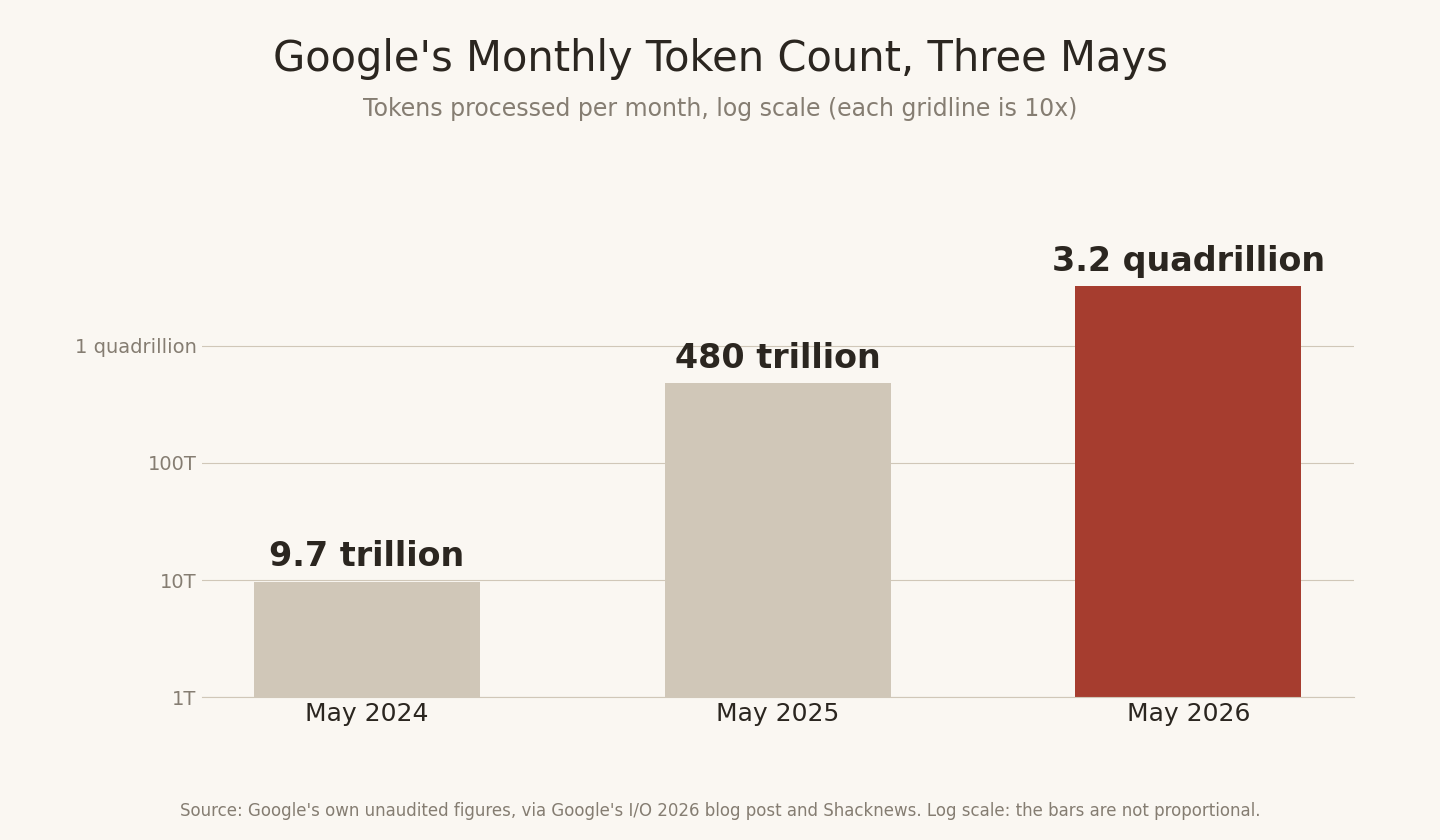
- Google, tokens per month: 9.7 trillion (May 2024), 480 trillion (May 2025), 3.2 quadrillion (May 2026), up about 7x year over year. These are Google’s own unaudited figures. Our arithmetic: that is roughly 330 times May 2024 in two years.
- Google said its APIs processed about 19 billion tokens a minute at I/O. FourWeekMBA reports nearly 32 billion a minute in the Q3 earnings release (28 Oct 2026). The second figure is secondary.
- Why so many? Reasoning models and agents emit far more tokens per task, so cost per task falls much more slowly than cost per token. That is a qualitative claim in what I found; I have no number for it.
Source: Google (I/O 2026). Source: Shacknews. Secondary: FourWeekMBA.
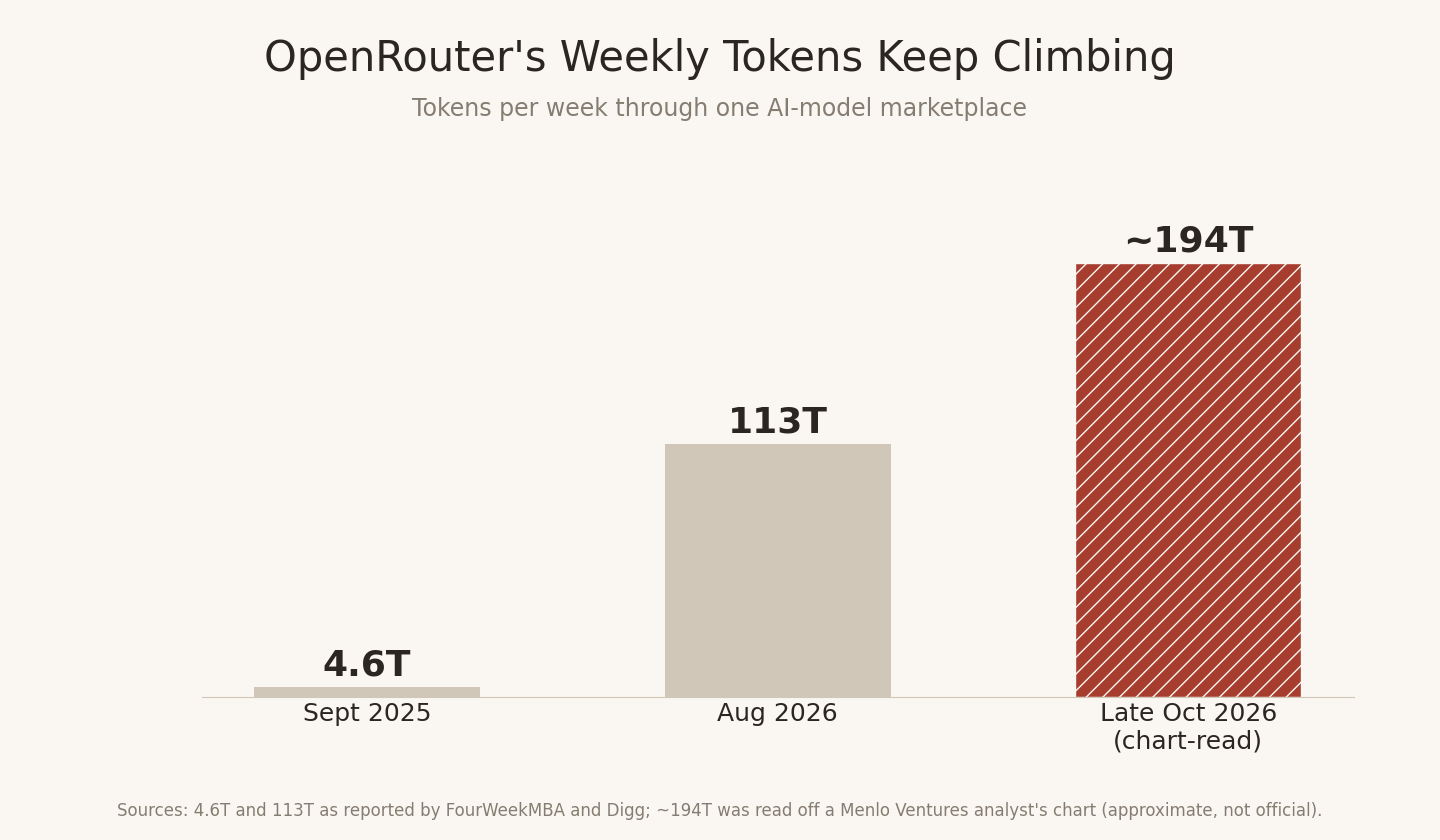
- OpenRouter, tokens per week (one marketplace that routes requests to many models): 4.6 trillion (Sept 2025), 113 trillion (Aug 2026), about 194 trillion (week ending 26 Oct 2026), roughly a 10 quadrillion annual run rate.
- Label: the 194 trillion figure was read from a Menlo Ventures analyst’s chart, so it is approximate and not official. The 113 trillion figure is also secondhand. OpenRouter is one marketplace, not all AI use.
- I found no sourced Microsoft token volume.
Sources: Digg and FourWeekMBA.
“Token Maxxing”: When the Count Becomes the Score
- Wikipedia defines token maxxing as a workplace metric where token consumption is treated as productivity. The “-maxx” suffix comes from internet slang.
- Developer Sigrid Jin said he used 50 billion tokens in a year (Axios, 13 May 2026, as cited on Wikipedia).
- The gaming tactics Wikipedia lists: running several agents at once, longer prompts, and over-automation. It also notes bloated code and burnout.
- Meta’s “Claudeonomics” leaderboard: it ranked 85,000+ employees, with 60 trillion tokens in 30 days and a top user averaging 281 billion. It was shut down within days. The reason is disputed between sources. Meta later told about 6,000 employees it would impose central controls, citing billions in AI costs.
- Microsoft reportedly renamed its token leaderboard a “usage dashboard.” Reported secondhand; I did not confirm it directly.
Sources: Wikipedia, The Decoder, People Matters. More: IBM, Forbes, Pragmatic Engineer.
Why it goes wrong:
- Goodhart’s law: when a measure becomes a target, it stops being a good measure. Wikipedia’s article links Goodhart’s law under See also but does not name it in the body, so that framing is mine.
- Token maxxing is like paying a driver by miles driven. Mileage rewards driving in circles.
- An employee who finishes the same job in fewer tokens looks less “productive” on a token leaderboard, which is backwards.
The Opposite Idea: Value Per Token
- Barry Lowenthal, MediaPost, “Why The Token Is Becoming The New CPM” (27 Apr 2026): Performance per Token = outcomes divided by (media cost + compute cost). Unverified detail: the article is paywalled, so I only saw excerpts.
- That is the “earn its keep” idea in formula form: don’t ask how many tokens you used, ask what you got for them.
Source: MediaPost (paywalled).
Why Companies Suddenly Care: Token Economics
- Gartner (Aug 2026): inference (running models) is about 55% of AI-optimized IaaS spending in 2026 (about $23.3 billion versus $19 billion for training), rising to 59% in 2027. Training built the models; tokens are the ongoing bill.
- Jensen Huang’s “token factory”: value is tokens per watt times the gigawatts available. Secondary coverage of GTC 2026.
- Nvidia’s claim: up to 50x more throughput per megawatt and 35x lower token cost than Hopper on GB300. This is a vendor claim for one model and workload, not an independent measurement.
- Why watts show up in a post about text: every token takes electricity and chips to produce. See our posts on voters pushing back on data centers (#196) and data-center water use (#201), and what a flat-rate Claude plan costs the provider (#162).
Sources: Gartner, Mobile World Live, Wccftech. Related: Story #163 on circular AI deals.
Five Analogies That Help
- Kilowatt-hour: a token is to AI what the kWh is to electricity. A meter measures it and you pay by usage.
- Reading versus writing: input tokens are what the model reads, output tokens are what it writes, and writing costs more.
- A desk: the context window is the desk. Everything the model is working on has to fit on it.
- Paying a driver by miles: token maxxing, as above.
- Longer words, bigger surcharge: a non-English word can cost more, like a surcharge on longer words.
What I Still Don’t Know
- Whether Meta’s leaderboard was shut down over backlash or over data concerns. Sources disagree.
- OpenAI’s and Google’s own current prices. I used aggregator sites, which conflict on some models.
- The exact language multipliers. They come from search snippets, not the papers.
- Whether code and emoji cost more in general. No sourced figure; my small samples were mixed.
- Microsoft’s token volume. No sourced number.
- The OpenRouter 113 trillion and 194 trillion figures (secondhand chart readings).
Sources I Opened, and Ones I Couldn’t
- Opened and checked: Anthropic’s pricing and token-counting pages, and Wikipedia’s token-maxxing article. Counts in the tokenizing section are my own
tiktokenruns. - Not opened (blocked, 403): OpenAI’s tokenizer and pricing pages. Their figures here are from search snippets or aggregators.
- Everything else above came from search results and is marked where it matters.