I was today days old when I found a sound map of the world where every location has both a field recording AND an artist remix of it — 8,000+ sounds across 140+ countries, free, no login. Spin the globe, click a pin, listen.
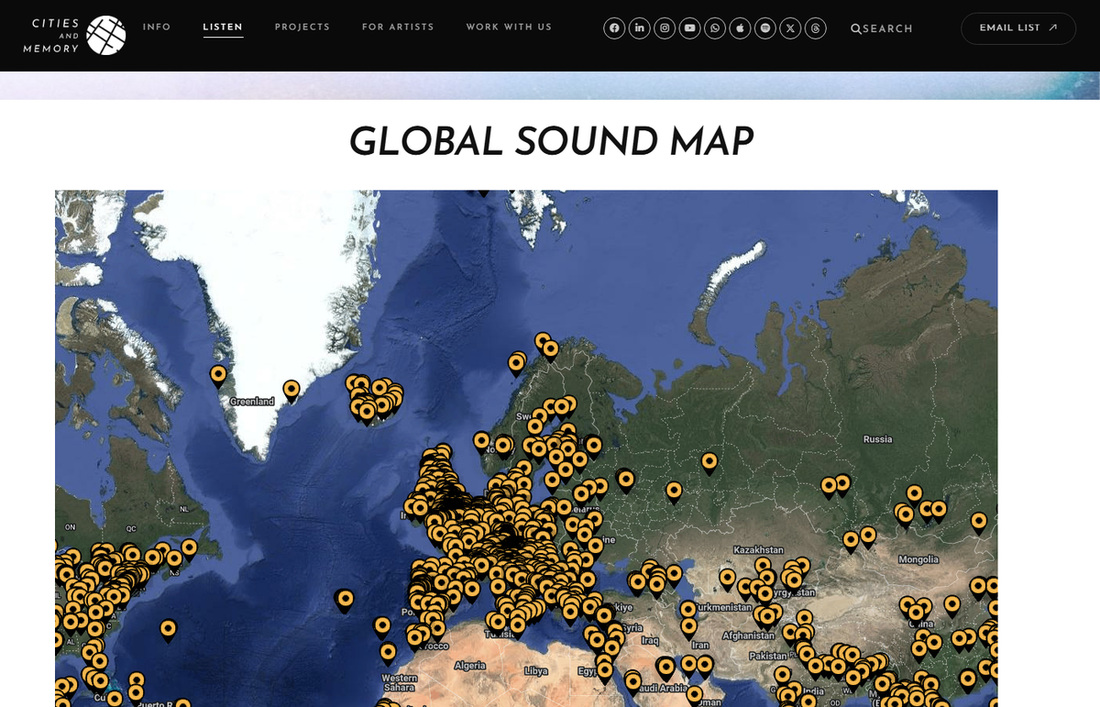
Go to citiesandmemory.com/sound-map/. The page loads a globe. Orange pins everywhere — clustered over Europe, scattered across the Americas, reaching into Southeast Asia and sub-Saharan Africa. Click any pin. You get two audio players side by side. The left one is the field recording: exactly what a microphone captured at that place and time. The right one is the reimagined composition: what a sound artist did with that raw material, turning it into something new.
That dual-recording structure is the whole idea, and it’s a genuinely unusual one. Most sound archives stop at documentation. Cities and Memory treats the raw field recording as source material, then invites artists to compose something in response. The result is two layers you can flip between — the world as it is, and the world as artists hear it.
The scale is real. The project has amassed more than 8,000 sounds from 140+ countries and territories, contributed by more than 2,500 sound artists. It was founded in 2015 by Stuart Fowkes in Oxford, UK — started as a personal project, grew into one of the largest field-recording archives on the internet. The Académie Charles Cros, France’s premier phonographic awards body, has given it both a Grand Prix and a Coup de Coeur. It’s been covered by The Guardian, BBC World Service, Bloomberg, and The Atlantic.
The thematic collections make it stranger and more interesting. Beyond the open world map, Cities and Memory runs structured projects every few months, each with a specific subject and an open call to contributing artists. What’s currently listed on the site: #StayHomeSounds captured how the sound of cities changed during the COVID-19 pandemic — empty squares, birdsong where there was traffic, the particular silence of lockdown. Protest & Politics collected recordings from demonstrations and political events across the last decade. Polar Sounds partnered with the Helmholtz Institute for Functional Marine Biodiversity to record Ross seals, crabeater seals, minke whales, and narwhals using underwater microphones, then handed those recordings to 150 artists. Obsolete Sounds preserved sounds that no longer exist in their original context — the click of a rotary phone, the squeal of a dial-up modem, the specific sound of a cassette rewinding. Each project is on the map as a filterable layer.
One click path. Pin near Kyoto, Japan: the field recording is temple bells at a Buddhist shrine, struck at intervals with that particular echo that concrete and stone make. The artist remix takes those bell tones, layers them into a drone, slows the decay, adds what sounds like field recordings of rain from somewhere else entirely. The documentation version and the composition version are recognizably from the same source material, but they are completely different listening experiences. That gap — between document and interpretation — is what the whole project is exploring.
This is the third post in what’s accidentally become a “spin a globe, hear the world” trilogy here. Radio Garden (#017) lets you click anywhere on a globe and hear live local broadcast radio from that city — curated stations, somebody chose to put them in the directory. WebSDR (#073) gives you access to real radio receivers so you can tune the raw spectrum, not curated stations. Cities and Memory is a third thing entirely: not live, not broadcast, not radio at all. Recorded. Curated by location and theme. The archive version of a globe you can listen to.
The honest framing is the same one that runs through Flightradar24 (#021) and WiGLE (#033): this is volunteer infrastructure. The field recordings come from contributors worldwide — anyone can submit. The reimagined compositions come from an open artist community. Stuart Fowkes has been building this since 2015 on cultural-heritage grants and community submissions, not venture capital. The project page notes the Spring Project and Autumn Project open calls, twice a year, where artists get access to the full database of field recordings to work with.
It’s free, no login, open in any browser. citiesandmemory.com/sound-map/. Find a pin somewhere you’ve been. Then find a pin somewhere you haven’t.